 All Deities
 Gift & Worship
 Best seller
 About Us
 Contact Us
 Blogs
Agni Dev Weapon: The Agneyastra and the Spear
The elders tell us that when a family begins anything new, a wedding, a home, a child's first rice, the first thing they do is light a flame. Before the idol is placed and before the bell is rung, there is fire. And fire has a name: Agni.
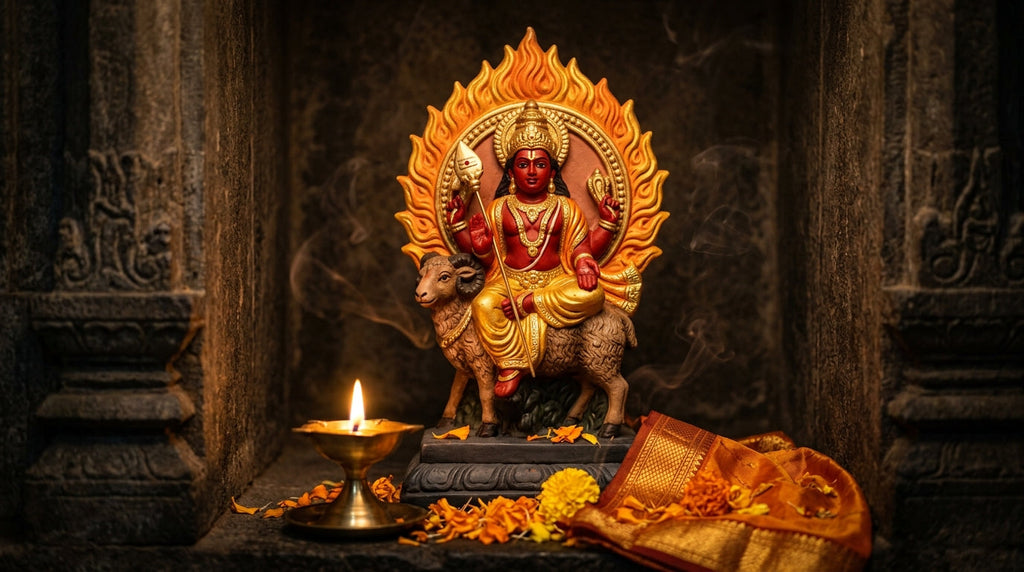
Agni Dev's named weapon is the Agneyastra, a fire arrow or missile that is called up by mantra. In most idols and temple images, though, he holds a spear (shakti) and rides a ram. Both answers are right, because they come from different parts of the tradition.
At Dev Tattva, where we make handcrafted murtis for home mandirs and car dashboards, families often ask what a god's symbols mean before they bring an image home. So let us sit together and go through it slowly, katha first and meaning after.
What Is Agni Dev's Weapon? Three Meanings of One Word
When someone asks about Agni's weapon, they may be asking three different questions. Pandit-ji always separates them, because the confusion starts when they are mixed.
The first is the weapon in his icon. Descriptions of Agni's image commonly give him a spear or lance, called a shakti, along with a ram as his vahana (vehicle). Some images show a flame, a ladle or a water pot in his hands instead, and the number of arms differs from text to text and from region to region. So there is no single fixed picture.
The second is the Agneyastra, the fire-astra of the epics. An astra is not an ordinary arrow. It is a divine missile, awakened by a mantra and by the discipline of the one who holds it. The Agneyastra is named after Agni, and warriors such as Rama and Arjuna are remembered as masters of such weapons.
The third is the weapons Agni gave to others. In the Mahabharata he is the giver of the great bow Gandiva to Arjuna and of a discus to Krishna. Here Agni is not fighting. He is the one who hands the weapon over, and that is perhaps the most interesting part of his story.

One small note for modern readers. India's well-known Agni missile is named after this god, and that is why the plain word "Agni" brings up defence pages on a search. Our subject today is the deity and his katha, not the machine.
The Katha of the Khandava Forest
Listen to how the story goes. It is told in the Mahabharata, in the days when the Pandavas were building their city of Indraprastha.
Agni came before Krishna and Arjuna as a hungry guest. He wished to eat the great Khandava forest and be satisfied. But every time the flames rose, Indra, king of the devas, sent down rain and put them out. The hunger of the fire god stayed unfulfilled.
So Agni asked the two friends for help: someone had to hold the rain back. Arjuna was willing, but a warrior needs weapons equal to the task. Then Agni gave him gifts. According to the tradition, there was the bow Gandiva, a quiver that would never run empty, and a chariot with a monkey banner. To Krishna he gave a discus. The Puranic accounts add that these treasures had first come to Agni from Varuna, the god of the waters.

Imagine the scene: the forest standing green and silent, smoke beginning to curl up from its edge, birds rising in a great cloud. When Agni blazed and Indra sent his storm clouds, Arjuna filled the sky with arrows, so that no drop of rain could reach the fire. Krishna stood beside him with the discus. The forest burned, and the story does not hide how hard that was.
Notice what the tale is telling us. The god of fire, who could burn anything, could not finish his task alone. He needed a bow, a charioteer and a friend, and he gave away the weapons he had so that the work could be done.
When the Gandiva Went Back to the Sea
The katha has an ending that few people remember. After the great war was over, Agni appeared before Arjuna near the shore. The bow had served its purpose, he said, and it belonged to Varuna, the lord of the waters. Arjuna should return it.
Arjuna, who had carried that bow through victory and grief, let it go into the sea. Some tellings describe Agni in a different form here, and the details vary from one retelling to another. But the heart of it is the same: a weapon is lent for a time, and then it must go back to where it came from.
Elders often read this as a lesson on power. Strength is a trust, not a possession. Even a bow as famous as the Gandiva had an owner older than the hero who used it.

Rama and the Fire Arrow of the Sage
Now to the Agneyastra itself. In the Bala Kanda of the Valmiki Ramayana, young Rama goes into the forest with the sage Vishwamitra and his brother Lakshmana. After Rama has fought the demoness Tataka, the sage is pleased and gives him divine weapons, along with the mantras to call them and to call them back.
Popular tellings count fire-linked astras among these gifts. Where exactly the Agneyastra is used, and by whom, is told differently in different places, so we will not pin it to one episode. The safe thing to say is this: the Agneyastra is a mantra-powered fire weapon that great archers of the epics are said to have mastered.
Mastery was the point. The astra did not belong to just anyone. It was given by a guru to a student who had shown self-control, and it came with the knowledge of when to call it back. Families who keep a Ram Lalla murti from Dev Tattva in the car or home may find it moving to remember that the same Rama received such weapons from a sage, not from his own pride.
Why the Weapon of Fire Is Also a Purifier
Fire in our tradition does two things at once. It burns, and it cleans. A flame can destroy a forest, and a flame can also carry the offering of the havan up to the devas. The weapon of Agni carries both meanings.
This is why the old texts do not let Agni stand alone. The fire-astra has a partner that answers it, the Varunastra, the water weapon of Varuna. It is said that the one can cool the other. Fire is held in balance by water, just as in the Khandava story Indra's rain stood against Agni's hunger. One element on its own becomes dangerous; two in balance keep the world going.
The spear in his hand is read in the same spirit. A spear is straight and sharp, and it points in one direction. Devotees see in it the focused flame, the kind of attention that burns away doubt and distraction. We should be careful not to turn this into a promise of results. It is a way of seeing, handed down in the tradition, and families hold it differently in different regions.

Then there is the word svaha. In Puranic tradition Svaha is called the consort of Agni, and the cry of svaha is what we say as each offering is placed in the fire. Even the sound that ends an offering belongs to Agni's household.
The Rigveda itself begins with him. Its very first hymn opens with the words:
अग्निमीळे पुरोहितं यज्ञस्य देवमृत्विजम्।
Agnim ile purohitam yajnasya devam ritvijam.
I praise Agni, the priest placed at the front, the divine minister of the sacrifice. (Rigveda 1.1.1)
That is a quiet kind of power. The oldest hymn does not call him a warrior first. It calls him a priest.
How to Read an Agni Dev Idol
If you see an image of Agni in a temple or a book, here is how the elders read it, remembering that traditions vary.
- Red or golden body. The colour of flame and of the rising sun.
- The ram. His vahana, said to carry him. Traditions explain the ram in different ways, and some speak of a goat, so treat any single reason as one family's reading.
- The spear (shakti). The commonly described weapon of the icon, a sign of focus and of fire's sharpness.
- Flames and many tongues. Some texts speak of seven tongues of fire, each one tasting the offering.
- Southeast. Agni is traditionally the guardian of this direction, which is why it is called Agneya. The kitchen fire and the lamp are often placed there in old homes.
A woodcarver or murti maker works from these descriptions, and so the image you meet in one place may not match the one you meet in another. That is not an error. It is the tradition breathing, as it always has. The same spirit of careful, respectful making is what we try to bring to every murti of Ganesha, Shiva, Hanuman and Ram at Dev Tattva.
Honouring Agni Dev at Home Today
You do not need a special idol to honour Agni. Every day he is already present in your home, in the diya you light at dusk, the camphor of the aarti and the small fire of the havan.

A few simple and respectful practices are common among devotees:
- Light the diya with care, and let it burn in a safe place, away from curtains and children's reach.
- Before an aarti or havan, say a short prayer or the opening line of the Rigveda hymn above, if it is familiar to your family.
- At a wedding, remember that the saptapadi, the seven steps, is taken around the sacred fire, so Agni is the witness of the vows.
- At Holi and Diwali, remember that the fires and lamps carry a meaning and not only a celebration. Dates for these festivals change every year, so check a trusted panchang.
If you are setting up a small temple for your home, many families keep the lamp towards the southeast corner of the room, following the old direction of Agni. Where space does not allow it, a clean and steady lamp in front of the deity is what matters. Practices vary by family and region, so follow your own elders.
For the murtis themselves, Dev Tattva offers handcrafted images of other beloved deities, such as the Shiv collection with his trishul. Those who like to begin a journey with a small prayer often look at the car dashboard collection on devtattva.com. The fire in your diya and the idol at its side work together in worship.


Frequently Asked Questions
What is Agni Dev's weapon?
His named weapon is the Agneyastra, a fire arrow invoked by mantra. In idols he is commonly shown holding a spear, called a shakti. Some images show a flame or ladle instead, as traditions differ.
What is the Agneyastra and who can use it?
It is a divine fire missile of the epics, called up with a mantra and taken back by the same mantra. Great archers such as Rama and Arjuna are remembered as having mastered such weapons, but only after discipline and a guru's gift.
Which astra answers the Agneyastra?
The tradition names the Varunastra, the water weapon of Varuna, as the one that counters it. Fire and water are held in balance, which is a theme through many of the stories.
What is Agni Dev's vahana?
His vahana is the ram, according to common descriptions of his icon. Some regional traditions speak of a goat, and the reasons given for the choice differ from place to place.
Agni has been the first witness of our prayers for as long as we have prayed. May the flame in your home stay steady, and may the stories we told today stay with your family. When you are ready to bring a murti home, visit Dev Tattva and choose the one your heart recognises.

About the author
Pandit Om Prakash Saxena
Pandit Om Prakash Saxena is 94 years old and still active. For the last 72 years he has been involved in pooja, paath and all forms of karmakand, and he is associated with Shanti Kunj, Haridwar.
-
Posted in
agneyastra, agni dev, fire god, hindu mythology, hindu symbols