 All Deities
 Gift & Worship
 Best seller
 About Us
 Contact Us
 Blogs
Powerful Krishna Mantra: Meaning and How to Chant
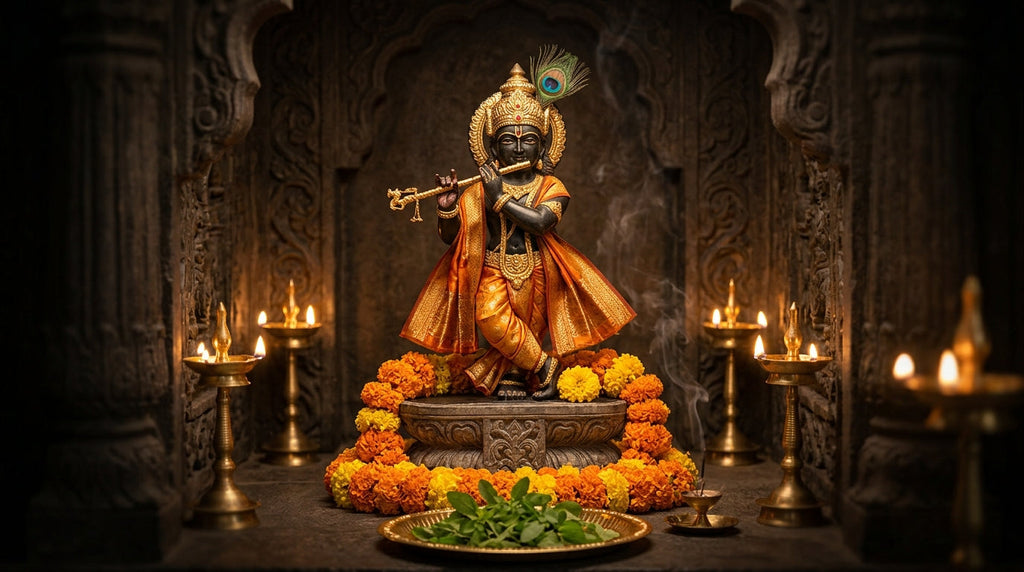
It is said that before the first light touches the Yamuna, a small lamp is already burning in many a home, and someone is softly repeating the name of Krishna. No book is open. Only a name, said again and again, until the house itself seems to listen.
So which is the most powerful Krishna mantra? Tradition names no single winner. The ones most often chanted are Om Namo Bhagavate Vasudevaya, Om Krishnaya Namah, Shri Krishna Sharanam Mama and the Hare Krishna maha-mantra, and the elders say a mantra grows strong through sincere, steady remembrance, not through what we hope to gain from it.
Let us sit together and hear where these mantras come from, what they mean, and how a family can chant them with ease. At Dev Tattva, where handcrafted murtis are made for home mandirs, we believe a name and a form belong together, and so we begin, as all good teaching begins, with the story.
The Night Krishna Was Born: Why the Name Vasudeva Matters
Listen to how the story goes. In the city of Mathura, the cruel king Kansa had locked his sister Devaki and her husband Vasudeva in a prison cell, because a prophecy had warned him that her eighth child would bring about his end. One by one, the earlier children had been taken from them, and the Bhagavata Purana tells the sorrow of that cell with great tenderness.
Then came the eighth night. Rain fell over Mathura and the sky was thick with cloud. The air inside the cell was damp and heavy, and the parents could hear the guards pacing outside. At midnight the child was born, and the cell filled with a light the parents had never known. According to tradition, Vasudeva and Devaki first beheld the newborn in his divine form, before he became a small baby in their arms.
The chains on Vasudeva's wrists fell open. The guards slept where they stood, and the heavy prison doors swung wide. He lifted the infant into a basket and walked out into the storm, towards the river Yamuna and the village of Gokul on its far bank.
The river was swollen and loud. Yet as Vasudeva stepped in, the waters made way for him, and in popular tellings the great serpent Shesha spread his hoods over the basket to keep off the rain. In Gokul he laid the child beside Yashoda, took up her newborn daughter, and returned to the cell as quietly as he had left it.

Why do we begin with this night? Because of a name. Krishna is called Vasudeva, the son of Vasudeva, and in some Vaishnava explanations the word also points to the One in whom all beings dwell. When a devotee chants Om Namo Bhagavate Vasudevaya, the elders say, that whole night is folded into the words: a prison, a prayer, and a light no chain could hold.
Kurukshetra: The Mantra of Surrender
There is a second scene, and it is quite different. On the field of Kurukshetra, the Mahabharata tells us, Arjuna let his bow slip and told Krishna, his charioteer, that he could not fight. Conches had sounded and two great armies stood ready, yet the finest archer of his age was trembling and could not lift his hands.
What followed is the Bhagavad Gita. Near its end, Krishna gives Arjuna the line that many devotees hold as the heart of it all:
सर्वधर्मान्परित्यज्य मामेकं शरणं व्रज
Sarva-dharmān parityajya mām ekaṁ śaraṇaṁ vraja
Setting aside all other supports, come to Me alone for refuge. (Bhagavad Gita 18.66)
Krishna then tells him, mā śucaḥ, do not grieve. From this idea comes the short, beloved mantra Shri Krishna Sharanam Mama, 'Shri Krishna is my refuge.' It asks for nothing. It only hands the heart over.
Put the two scenes side by side and a quiet lesson appears. In Mathura a father carries the Lord across a river in the dark, trusting a promise he cannot see. In Kurukshetra a warrior is asked to trust in the same way. Both times, the way forward opens only after the trust is given.

Powerful Krishna Mantras and What Each One Means
Not every mantra flows from the same stream. Some rest on scripture, some on one sampradaya, and some are in common use without a single source we can name with certainty. Let us sort them honestly, so that you know what you are holding when you chant.
1. Om Namo Bhagavate Vasudevaya
ॐ नमो भगवते वासुदेवाय
Om Namo Bhagavate Vasudevaya: I bow to Bhagavan Vasudeva, the Lord. This twelve-syllable mantra is revered across Vaishnava traditions, and it is the one most often named when people ask for a Krishna mantra with deep roots.
2. Om Krishnaya Namah
ॐ कृष्णाय नमः
Om Krishnaya Namah: I bow to Krishna. It is the gentlest mantra of all, and the easiest for children and beginners, because the meaning sits right on the surface.
3. Shri Krishna Sharanam Mama
श्री कृष्णः शरणं मम
Shri Krishnah Sharanam Mama: Shri Krishna is my refuge. As we heard, it grows out of the surrender taught in the Gita. Many people turn to it on a day when the heart feels heavy.
4. The Hare Krishna Maha-Mantra
हरे कृष्ण हरे कृष्ण कृष्ण कृष्ण हरे हरे ।
हरे राम हरे राम राम राम हरे हरे ॥
Hare Krishna Hare Krishna, Krishna Krishna Hare Hare, Hare Rama Hare Rama, Rama Rama Hare Hare. Maha means great. The Gaudiya tradition and ISKCON place this above all other mantras, and it is a call, a calling out to the Lord by name. Other traditions honour it warmly but may keep a different mantra first.
5. The Krishna Gayatri
ॐ देवकीनन्दनाय विद्महे वासुदेवाय धीमहि । तन्नः कृष्णः प्रचोदयात् ॥
Om Devakinandanaya Vidmahe Vasudevaya Dhimahi, Tanno Krishnah Prachodayat. We come to know Devaki's son, we meditate on Vasudeva; may Krishna inspire our understanding. Its exact wording and source differ between lineages, so follow your family's version.
6. The Offering Verse
पत्रं पुष्पं फलं तोयं यो मे भक्त्या प्रयच्छति ।
तदहं भक्त्युपहृतमश्नामि प्रयतात्मनः ॥
Patram pushpam phalam toyam yo me bhaktya prayacchati, tad aham bhakty-upahritam ashnami prayatatmanah. Whoever offers Me with love a leaf, a flower, a fruit or water, I accept that loving offering. (Bhagavad Gita 9.26) Devotees often say it while placing a flower before the murti.
7. The Bala Mukunda Verse
करारविन्देन पदारविन्दं मुखारविन्दे विनिवेशयन्तम् ।
वटस्य पत्रस्य पुटे शयानं बालं मुकुन्दं मनसा स्मरामि ॥
Kararavindena padaravindam mukharavinde vinivesayantam, vatasya patrasya pute sayanam balam mukundam manasa smarami. With a lotus hand he lifts a lotus foot to his lotus mouth, and I remember the child Mukunda resting on a banyan leaf. It comes from the Bala Mukunda Ashtakam, and lovers of Bal Gopal cherish it.
A Word on Kleem
You may meet a form like Om Kleem Krishnaya Namah. Kleem is called a beej, or seed sound. I cannot point you to a clear scriptural source for this form, so chant it only if your family or guru already does. It is never needed, and the simpler mantras above are complete in themselves.

Saying a Krishna Mantra Correctly
Many people hold back from chanting because they fear a wrong sound. Relax. The Lord listens to the heart first. Still, a little care makes the chanting smoother and more pleasing to say.
Break the long words into small parts. Vasudevaya is vaa-su-day-vaa-ya, with every vowel given its full length. Bhagavate is bha-ga-va-te. Sharanam is sha-ra-nam, and the final m is a soft hum at the close. In Krishna, the first sound is like 'kri' and the next is a soft 'shna'. In Hare, the last letter sounds like the 'e' in 'say', so it is ha-ray, two beats.
Go slowly at first, even slower than feels natural. Speed comes by itself after a few weeks, and a family can learn together by saying each mantra aloud once, and then repeating it softly.
What Does 'Powerful' Really Mean in a Krishna Mantra?
Two kinds of answers are given. The Gaudiya teachers say the maha-mantra is supreme, since it is the Name itself. Other teachers say a mantra's strength lies in the sincerity of the remembrance, never in the reward. Many websites promise success, protection and wealth. We make no such promises here, and the tradition does not ask us to.
Notice what Krishna himself says in the offering verse. He does not weigh the size of the gift; he accepts what is offered with love. A mantra said with a wandering mind and a clenched heart is a lesser thing than the same mantra said quietly, with attention, even for two minutes.
Many devotees simply say a mantra gives them a quiet place to return to when the day turns difficult. That is a gentle claim, and an honest one. So when you ask which mantra is most powerful, ask also which one you will actually say tomorrow morning, and the morning after.

How to Chant a Powerful Krishna Mantra: A Simple Routine
- Wash your hands and face, and sit on a clean mat before a small lamp and an image or murti of Krishna.
- Choose one mantra, preferably the one your family or guru already uses, and stay with it for some time.
- Take a mala of 108 beads, often made of tulsi. Turn one bead per chant with the right hand, and when you reach the larger head bead, turn the mala around instead of crossing it.
- Speak slowly. Let the lips move softly and keep the mind on Krishna's face.
- If time is short, chant eleven times or a single round. Regularity matters more than the count.
- Close with a moment of silence and a bow.
Early morning is loved for chanting, and so is the festival of Janmashtami, whose date changes every year. But any quiet hour is a good hour, even a few minutes before the evening lamp.
People also ask about initiation. In common practice, Om Krishnaya Namah and the maha-mantra are chanted by anyone, in any language. If you belong to a particular sampradaya, or have a guru, follow that guidance for the rest.

The Murti, the Mantra and the Home Shrine
Krishna is seen in many forms, and each gives the mind a place to rest. Bal Gopal, the child with the butter pot, brings out tenderness. Krishna with the flute draws the heart inward, Radha and Krishna together speak of love, and Parthasarathi, the charioteer of Arjuna, reminds us of clear thinking and surrender. Choose the form your heart already loves, and let the mantra be said to that face.
Keep the murti on a clean, raised spot, never on the floor, facing the direction your family tradition prefers. A fresh flower, a few tulsi leaves and a small lamp are plenty. The same care applies to a small idol for the car dashboard, where a short mantra can be whispered before a journey. Murtis for the temple corner and the office desk are made for the same reason: to keep a loved name before the eyes.
Dev Tattva makes handcrafted murtis for home mandirs, and families often keep more than one devotion together on a single shelf. A Ram Lalla idol and a Hanuman idol with Ram in his heart are two such companions, and the Dev Tattva home page shows the full range, so you can choose slowly and with a calm mind.

Frequently Asked Questions
What is the most powerful Krishna mantra?
There is no single answer. Om Namo Bhagavate Vasudevaya, Om Krishnaya Namah and the Hare Krishna maha-mantra are the most widely chanted. Gaudiya tradition holds the maha-mantra supreme, while other teachers say the best mantra is the one you chant with real devotion.
How many times should I chant a Krishna mantra daily?
Many devotees chant 108 times on a mala, which is one round. If that is too much, eleven or twenty-one times with full attention is a lovely beginning. Daily steadiness counts for more than a large number.
Can I chant Krishna mantras without initiation or Sanskrit knowledge?
Simple mantras like Om Krishnaya Namah and the maha-mantra are commonly chanted by everyone. Learn the syllables slowly and understand the meaning. If you follow a lineage that gives mantras by initiation, ask your guru.
Which Krishna mantra should a beginner or child start with?
Om Krishnaya Namah is the usual first choice because it is short and clear. Shri Krishna Sharanam Mama is another gentle one, and children love to sing the Hare Krishna maha-mantra.
A Blessing Before You Go
May the name of Krishna stay light on your tongue and warm in your heart, whether you chant for one minute or one hour. If you are choosing a murti to sit beside your mantra, or a gift for a loved one's new home, explore the gifting collection at Dev Tattva. Hare Krishna.

About the author
Pandit Om Prakash Saxena
Pandit Om Prakash Saxena is 94 years old and still active. For the last 72 years he has been involved in pooja, paath and all forms of karmakand, and he is associated with Shanti Kunj, Haridwar.
-
Posted in
home mandir, janmashtami, krishna mantra, mantra meaning, powerful mantra