 All Deities
 Gift & Worship
 Best seller
 About Us
 Contact Us
 Blogs
Son of Hanuman Ji: The Katha of Makardhwaj
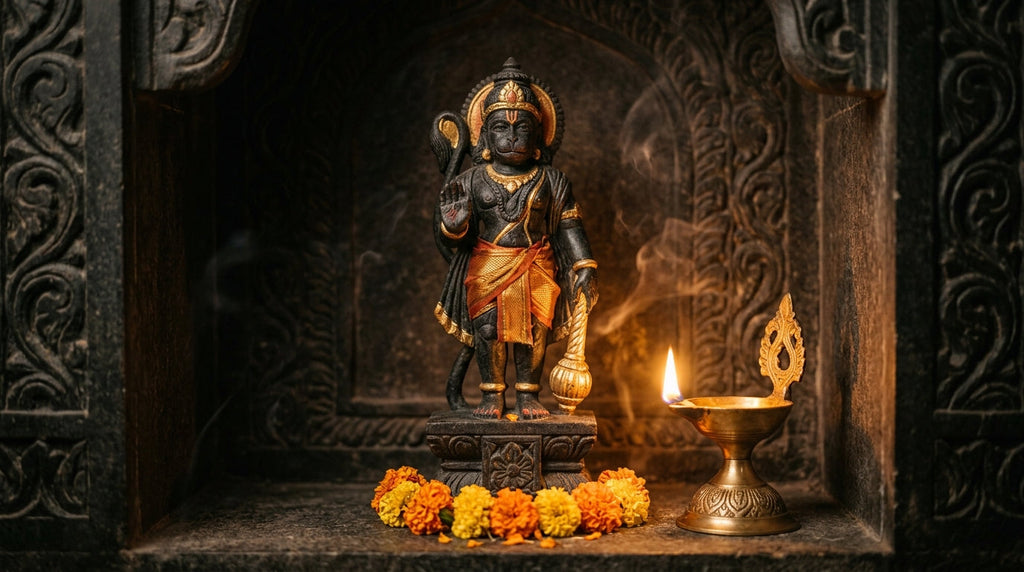
Come, sit close. The lamp is lit, the incense has gone soft in the evening air, and today we will speak of a part of Hanuman's story that many have heard in whispers and few have heard in full.
According to folk and regional tellings of the Ramayana, the son of Hanuman ji is Makardhwaj (also written Makaradhwaja). He is said to have been born from a single drop of Hanuman's sweat, not through marriage, so Hanuman remains a brahmachari, a lifelong celibate. This tale is not found in Valmiki's Ramayana. It belongs to later, much-loved traditions.
It is a question many devotees ask, and at Dev Tattva we love answering it the old way, through the katha. Let us hear the story first, and then talk about what it means.
The Son of Hanuman Ji Is Born: A Drop of Sweat by the Sea
It is said that Hanuman, son of Anjana and the Wind God Vayu, was the greatest servant of Shri Ram. Strong enough to lift mountains, humble enough to call himself a messenger. In the tellings of Makardhwaj, one day he went down to the sea to bathe.
Picture the shore. The wind smells of salt, the waves roll in slow and heavy, and the mighty vanara steps into the water to cool his body. Nobody else is near. There is only the sea, the sky and the sound of the tide.
While he bathes, a drop of sweat slips from him and falls toward the water. At that very moment a makara, a great sea creature often pictured as part crocodile, opens her mouth. The drop falls inside, and she swallows it.
The tellings differ on what this creature was. Some say a crocodile, some a huge fish, some simply a being of the deep. They agree on the wonder of it: the strength of Hanuman, carried in that single drop, began to grow into a child.
The elders remind us that this is a miracle story, not a household story. Hanuman did not marry, and the katha never says he did. The child comes into the world the way a seed is carried by a river, quietly and by a power beyond the ordinary.

What happened to the makara and her unborn son? Here the tellings branch again. In some, the people of Ahiravana, the ruler of Patala, caught the great fish and found a living child inside it. They brought him to their king, and the boy grew up in the underworld, strong as a young lion, knowing nothing of his father.
He was named Makardhwaj, which is often explained as 'the one with the makara banner', pointing to his sea-born beginning. Ahiravana, so the story goes, set him as the guardian of the gate to his kingdom.
The Gates of Patala: Ahiravana Takes Ram and Lakshman
Now the katha moves to the great war with Ravana. Patala, as the elders describe it, is the world below the earth, a land of jewelled caverns and hidden palaces. In these tellings Ahiravana, a son of Ravana, ruled there.
Ahiravana kidnapped Shri Ram and Lakshman and carried them away into Patala. The tellings describe how the vanara army woke to find their princes gone, and how heavy grief fell on every heart.
Who would go after them? Who could walk into the underworld itself? Everyone looked toward Hanuman, and Hanuman did not wait to be asked. He set out at once, with only one thought in his heart: my Prabhu is in danger.
Down he went, through the dark tunnels and the silent halls, until he reached the great gate of Ahiravana's city. And there, standing firm in the way, was a warrior he had never seen before.
Father Meets Son: The Duel at the Gate
The guard was strong. His shoulders were broad, his eyes steady, and he stood before the greatest devotee of Ram as if he had been born for this very moment. In a sense, he had. This was Makardhwaj, set there by his master to challenge any who came.
Hanuman looked at him and was surprised. Who was this? How did a guardian of the underworld carry such strength, and a presence that felt strangely familiar?
In the telling that most people know, Hanuman stilled his mind and meditated, and through that inner sight he saw the story of the boy's birth. He understood that the young man before him was the child of his own sweat, the son he had never known.
Yet the gate remained a gate. Makardhwaj was bound by his duty to Ahiravana, who had given him his post. Hanuman was bound by his duty to Shri Ram, whose life was in danger just beyond that threshold. Each stood for his own master.

So the two fought. The elders tell it as a duel between equals in strength, a father and a son, each doing what loyalty demanded. In the end Hanuman prevailed and bound the young guardian. He did not strike him down in anger, and the katha takes care to say so.
Then Hanuman went forward into the city, and in the end he killed Ahiravana. Beyond this point the tellings differ in their details, and I will not add to them what the tradition does not clearly say.
Is the Son of Hanuman Ji in Valmiki's Ramayana?
Let us be honest and clear here, because this is where many pages blur the lines. Valmiki's Ramayana, the great original, does not contain the story of Makardhwaj. Hanuman appears there as a celibate, wise and humble servant of Ram, and no son is mentioned.
The Makardhwaj katha comes from regional and folk Ramayana traditions, which grew across centuries as storytellers in different lands retold the epic in their own languages. I cannot honestly name a single Purana or chapter as its source, and I will not pretend to. What I can tell you is that the story is deeply loved, and that it has been sung, painted and carved in many places.
Is a story less sacred because it is not in the oldest text? The elders would say no. Our tradition has always been a river with many streams, and each stream carries its own sweetness. We only ask that the stream be named for what it is.
How Devotees Understand Hanuman's Brahmacharya
The natural question follows. If Hanuman had a son, was he truly a brahmachari? Listen to how devotees answer.
The katha itself answers it. Makardhwaj was not born of a husband and wife. He was born of a drop of sweat, in a moment when Hanuman was bathing in the sea, without any married life behind it. The birth happens to Hanuman, not through any plan of his.
So the tradition holds both truths together. Hanuman's vow remains whole, and the story marvels at how the strength of a perfect brahmachari could be so great that even a drop of his sweat carried life.
Some families hold other views and tell other stories about Hanuman, and traditions vary by region. Here, as elsewhere, we do not insist on one answer for everyone. We simply tell what the widely known katha says, and leave each family to hold it in its own way.

Hanuman Ji and His Son: What the Katha Teaches
Why would the tradition give Hanuman such a strange and beautiful son? The elders see several lessons in it.
Duty can stand on both sides of a gate. Makardhwaj was not painted as a wicked man. He was loyal to the one he served, just as Hanuman was loyal to Ram. The fight at Patala is a picture of two faithful hearts meeting in a hard place.
Devotion comes first. Even after Hanuman saw that Makardhwaj was his son, he did not turn from his path to Ram. Nothing, not even the sight of his own child, drew him away from seva, selfless service. That is the heart of Hanuman's story everywhere.
Strength is meant to be held gently. A being who could lift mountains chose to bind his son rather than harm him. Power guided by dharma has restraint in it.
Greatness leaves a trace. A single drop of sweat carried life. The idea, simply put, is that the energy of a true devotee does not vanish. It echoes outward and touches even the depths of the sea.
When you say ॐ हनुमते नमः (Om Hanumate Namaha, 'I bow to Hanuman'), you are bowing to this whole picture of him: strong, humble, loyal and restrained.
Other Tellings: Macchanu and the Ramayana of Southeast Asia
The story did not stay in one land. As the Ramayana travelled across the sea to Southeast Asia, it took on new colours, and there too a son of Hanuman appears. In some of these tellings he is called Macchanu, and his mother is named Suvannamachha.
Notice how the shape of the tale echoes the Indian version. The sea, a being of the water, a miraculous child. The details differ, and I will not pretend to know every version, but the thread is the same: Hanuman's strength, and a child of the waters.
This is how living stories behave. A grandmother in one village tells it one way, a storyteller in another land tells it another way, and both are sincere. The elders never saw this as confusion. They saw it as a sign of how far Hanuman's name had travelled.
Where the Story Lives Today: Temples of Hanuman and Makardhwaj
The katha is not only told. It is also remembered in stone. Temples that honour Hanuman together with his son are spoken of in Gujarat, with shrines at places such as Bet Dwarka, and others in Rajasthan, such as Beawar. In these shrines, devotees recall the meeting of father and son at Patala's gate.
There is also a clan tradition. The Jethwa clan of Porbandar in Gujarat, by their own tradition, trace their descent to Makardhwaj. This is their family belief, and we mention it respectfully as exactly that.
If you ever visit such a shrine, go slowly. Look at how the figures are placed, and remember that every temple has its own local telling. Ask the priest, listen, and carry home what you hear.

Not everyone can travel to such places. That is one reason families keep a small shrine at home, and why the humble murti has such a long place in our tradition. It brings the temple's quiet into the house.
Honouring Hanuman Ji at Home Today
You do not need a grand ceremony to honour Hanuman. The elders always said that sincerity matters more than size. A small corner, a clean cloth, a diya and a few minutes of quiet are enough.
Many families keep a Hanuman murti in the home mandir and light a lamp before it each morning or evening. Tuesdays and Saturdays are the days many devotees keep for Hanuman, though customs differ by family and region. Offer a few red or orange flowers, speak his name, and say जय श्री राम (Jai Shri Ram, 'victory to Lord Ram'), because Hanuman's heart always turns toward Ram.
At Dev Tattva, we make handcrafted murtis with exactly this kind of everyday devotion in mind. The Hanuman idol with Ram in his heart shows Hanuman with his Lord within his heart. It carries the very message of the Patala story: his whole being belongs to Ram.

Others prefer a seated form for a study table or an office desk, and for them the Hanuman sitting idol with a round tail is a calm companion. You can browse the whole Hanuman collection to see which figure speaks to your family.
Many travellers also like to keep a small murti on the dashboard as a reminder to travel with care and humility. The car dashboard collection at Dev Tattva is meant for this purpose. Whatever you choose, place the murti on a clean, steady surface, and treat it with the same respect you would give a guest in your home.
A murti also makes a thoughtful gift for a housewarming or a birthday. On devtattva.com you will find figures of Hanuman, and of Shri Ram too, since the two are never far apart in the heart of a devotee.

To be plain about it, a murti is not a charm and makes no promises. It is a support for your attention. When your eyes fall on it, your mind remembers the stories, and your heart remembers the values the stories hold.
You may also tell the Makardhwaj katha aloud to your children. Use your own words, stay with the beats the tradition agrees on, and let them ask questions. A story told beside a lamp is remembered long after the small details are forgotten.

Frequently Asked Questions
Who is the son of Hanuman ji?
According to folk and regional tellings of the Ramayana, the son of Hanuman ji is Makardhwaj, also spelt Makaradhwaj. In the usual version he was born from a drop of Hanuman's sweat that fell into the mouth of a makara, a sea creature, after Hanuman bathed in the sea.
Did Hanuman have a son even though he was a brahmachari?
In the tradition that tells of Makardhwaj, the birth is miraculous and not the result of marriage. Hanuman stays a lifelong celibate, and the story wonders at the power of his discipline. Some families follow other accounts, and traditions differ by region.
Did Hanuman fight his own son?
Yes, in the Patala tellings. Makardhwaj guarded the gate for Ahiravana, while Hanuman came to rescue Ram and Lakshman. Each was bound to his own duty, and Hanuman prevailed and bound his son, then went on to end Ahiravana. Details vary between tellings.
Is Makardhwaj mentioned in Valmiki's Ramayana?
No. Valmiki's Ramayana does not contain the story of Makardhwaj. The tale belongs to later regional and folk traditions, and there are Southeast Asian versions in which the son has a different name, Macchanu, with a different mother.
May the story of Hanuman and his son remind your family that strength can be gentle, and that duty and devotion can walk together. If you wish to bring a Hanuman murti into your home mandir, your study or your travels, Dev Tattva's Hanuman collection is there for you, made with care and with the blessings of the old stories. Jai Shri Ram, Jai Hanuman.

About the author
Pandit Om Prakash Saxena
Pandit Om Prakash Saxena is 94 years old and still active. For the last 72 years he has been involved in pooja, paath and all forms of karmakand, and he is associated with Shanti Kunj, Haridwar.
-
Posted in
Hanuman, Hanuman katha, Hindu mythology, Makardhwaj, Patala, Ramayana