 All Deities
 Gift & Worship
 Best seller
 About Us
 Contact Us
 Blogs
Lord Vishnu Weapons Name: Chakra, Shankh, Gada & More
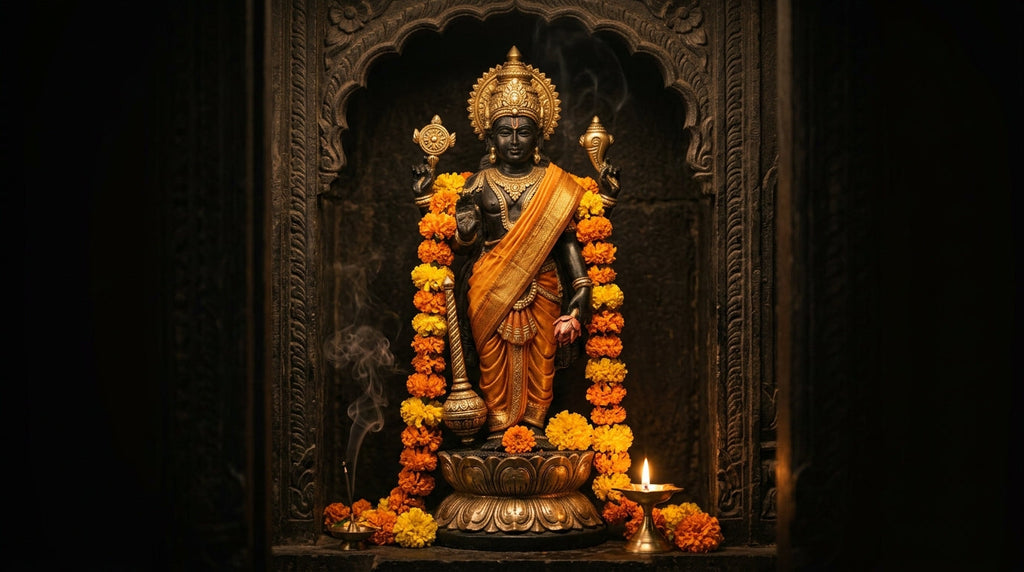
It is said that when Lord Vishnu rests on the coiled serpent Shesha upon the ocean of milk, nothing in his four hands is there by chance. Each object has a name, a story and a meaning, and the elders knew them all by heart.
So here is the direct answer. The weapons and emblems of Vishnu are the discus Sudarshana Chakra, the conch Panchajanya, the mace Kaumodaki and the lotus Padma. Tradition also names his bow Sharnga and his sword Nandaka.
Come, sit with me, and let me tell it the way the elders tell it. First the stories, then the meaning, and then how to read these symbols on a murti in your own home. This katha is for every family that has looked at an idol and wondered what each hand holds, and Dev Tattva is glad to share it.
The Katha of Sudarshana Chakra: A Gift in a Time of War
Listen to how the story goes. There came a time, the tradition says, when the asuras grew strong and the devas were losing the fight. The gods were tired and anxious, their banners torn, and they turned to Lord Vishnu for help.
According to the Linga Purana, the chakra, the shining wheel we call सुदर्शन चक्र (Sudarshana Chakra), was given to Vishnu by Mahadev Shiva. The name means the wheel of auspicious vision. With it, the tradition says, the asuras were overcome and the gods were restored to their place.
Notice something lovely here. The Preserver receives his best-known weapon from the Destroyer. The two great gods do not stand apart, and each honours the other. That is why many families keep Vishnu and Shiva together in one prayer corner, and why Dev Tattva's handcrafted murtis of Lord Shiva sit so naturally beside the Vaishnava stories.

Not every telling agrees. In some traditions Vishwakarma, the divine craftsman, forged the chakra from the radiance of the sun. The sources for this version are less clear, so I tell it only as one of the old ways the story is carried.
The Rigveda also speaks of the wheel as a sign of time, which turns and never stops. Remember that when you see the discus spinning on the Lord's finger. It is not only a weapon. It is time itself, obedient to the one who preserves the world.
Panchajanya, the Conch That Speaks Before the Battle
The conch is called Panchajanya. In popular tellings, Krishna won it from a sea-dwelling demon named Panchajana, when he went to bring back the son of his teacher Sandipani. The details differ from place to place, but the conch always comes out of the story as the Lord's own.
Its most famous moment comes on the field of Kurukshetra. The Bhagavad Gita (1.15) names the conches of the heroes as the war begins:
पाञ्चजन्यं हृषीकेशो देवदत्तं धनञ्जयः
Pāñcajanyaṁ hṛṣīkeśo devadattaṁ dhanañjayaḥ
Hrishikesha (Krishna) blew the Panchajanya, and Dhananjaya (Arjuna) blew the Devadatta.
Imagine that sound rolling over the dry plain, over horses and chariots and waiting men. A conch does not wound anyone. It announces, it calls, it gathers. This is why the shankh is blown at the start of a puja in so many homes, to tell the house that something sacred is about to begin.
Kaumodaki, Sharnga and Nandaka: The Other Weapons
The mace is Kaumodaki, called gada in everyday speech. It is the weapon of plain, steady strength. In images it is usually held with its head resting on the ground or raised upright, and a careful eye can read the mood of the Lord from it.
The bow is Sharnga, sometimes spelled Sharanga. The sword is Nandaka, and the Vishnu Sahasranama honours the Lord with the name Nandakī, the one who bears this sword. These two are mentioned less often than the chakra and the conch, and many pages pass over them. Yet they complete the set.
The prayer of the five weapons, the Panchayudha Stotram, recalls the chakra, conch, mace, sword and bow together. Who composed it and when is not known with certainty, but families have recited it for generations.
Where does the lotus fit? Here the elders speak carefully. The lotus is not an ayudha, a weapon, in the strict sense. It is an emblem, a sacred attribute. Some writers count it among the weapons and others keep it apart, and both views live in the tradition.

When the Weapons Become Living Beings
Here is something many readers do not know. In old Indian art and poetry, Vishnu's weapons are sometimes shown as persons, called ayudhapurusha. They stand beside the Lord like loyal attendants.
At the Gupta-period temple of Deogarh and at Mahabalipuram, sculptors carved Nandaka as a young man leading the weapons in the fight against the demons Madhu and Kaitabha. The poet Kalidasa, in the Raghuvamsa, mentions the weapons as small, dwarf-like figures. The Mahabharata, in the chakra-mushala episode, has Krishna's weapons appear in human form.
I find this beautiful. To the old craftsmen and poets, these were not cold metal. They were devoted servants, and they stood in service of the Lord with their whole being.

Lord Vishnu Weapons Name and Meaning, Hand by Hand
Now let us read an idol the way a pandit would. In the common four-armed form, the upper right hand holds the chakra. The conch is usually in the upper left. The mace and the lotus are in the two lower hands, and here the traditions differ, since some images place the mace in the lower right and others in the lower left.
The elders also say that different arrangements of the same four objects give the different named forms of Vishnu, such as Keshava, Narayana and Madhava, counted as twenty-four in many traditions. So if your image differs from the one in your neighbour's mandir, neither is wrong. They are simply two ways of seeing the same Lord.
Here is what each object is commonly understood to mean:
- Sudarshana Chakra: the wheel of time, and the mind turned toward dharma. It cuts through ignorance and falsehood.
- Panchajanya (conch): the sacred sound, linked in devotion to the primal Om. It calls us to wake up.
- Kaumodaki (mace): strength used to protect and to uphold order, not to bully.
- Padma (lotus): purity and creation. It grows in muddy water and rises clean above it.
When you look at a handcrafted murti of any deity, whether it comes from Dev Tattva or from a temple craftsman near your home, take a quiet moment. Name what each hand holds, one by one. The image then becomes a story you can read aloud to your children.
Why Four, Five, Eight or Sixteen?
People ask why Vishnu has four arms in one picture and many more in another. The tradition gives a gentle answer. Four arms are the usual form of the Lord as protector of the world. Four is also a number of completeness, for the four directions, the four Vedas and the four goals of human life.
Some images, called Ashtabhuja, show eight arms. A Shodasayudha form, spoken of in some traditions, shows sixteen weapons. The five-weapon prayer counts five, and there are forms, such as Narasimha, that are described very differently from the usual four-armed image.
So the number is not a rule. It is a way of showing how much the Lord can do for his devotees, and the tradition allows many ways to draw that picture. The artist and the family choose the form that speaks to them.

Weapons Carried Into the Avatars
When Vishnu comes to earth, his power travels with him in new forms. As Krishna, he carries the chakra, and the Mahabharata tells how he used it against Shishupala. In the Bhagavata Purana, the elephant Gajendra, caught by a crocodile, cries out to the Lord, and the chakra comes to his rescue.
As Rama, the weapon is the bow Kodanda. It is the bow of a king who keeps his word even when it costs him dearly. Families who love the Ramayana often keep a murti of the young Lord, such as the Ram Lalla face idol from Dev Tattva.
Parashurama, another avatar, is known for his axe. Each avatar carries a different tool, but all are tools of dharma, held for the protection of the good and never for pride.

How Devotees Honour Vishnu and His Weapons Today
Devotion to Vishnu needs very little. A clean corner, a lamp, a few flowers and a calm mind are enough. Many families begin with ॐ नमो नारायणाय (Om Namo Narayanaya, I bow to Narayana) or ॐ नमो भगवते वासुदेवाय (Om Namo Bhagavate Vasudevaya, I bow to the Lord Vasudeva).
You can also remember the five weapons in a simple way. Say their names slowly: chakra, shankh, gada, khadga (sword) and dhanush (bow). The Panchayudha Stotram is a prayer built on this very remembrance. Recite it only if you know it well, or simply name the five weapons with love and let that be your offering.
A home mandir does not need to be large. A small shelf, a diya and fresh flowers are enough, and Dev Tattva's temple collection is one place to look for handcrafted murtis for a prayer corner. Some travellers like a small murti on the dashboard for the road, and the car dashboard collection shows what Dev Tattva offers for that purpose.
Festivals such as Janmashtami and Vaikuntha Ekadashi turn our hearts toward Vishnu and Krishna. Their dates change every year, so please check a trusted panchang. Customs differ by region and family, so follow what your own elders do.


Frequently Asked Questions
What are the weapons of Lord Vishnu?
The weapons named in tradition are the Sudarshana Chakra (discus), Panchajanya (conch), Kaumodaki (mace), Sharnga (bow) and Nandaka (sword). The lotus, Padma, is held in one hand as a sacred emblem, though some writers count it among the weapons.
What is the name of Vishnu's chakra and who gave it?
It is called Sudarshana Chakra. According to the Linga Purana, Lord Shiva gave it to Vishnu when the gods were being defeated by the asuras. Some other traditions say Vishwakarma made it from the sun's radiance.
Which weapon is in which hand of Vishnu?
The usual rule puts the chakra in the upper right hand and the conch in the upper left. The mace and lotus are in the lower hands, but images differ on which side holds which. Different arrangements give the different named forms of Vishnu.
What are Vishnu's conch and mace called?
The conch is Panchajanya and the mace is Kaumodaki. The Bhagavad Gita (1.15) names Panchajanya as the conch that Krishna blew at Kurukshetra.
May the Lord's discus turn your mind toward dharma, may his conch wake you gently, and may your home be full of peace. When you are ready to set up a corner for prayer, you are welcome to look through Dev Tattva. Jai Shri Hari.

About the author
Pandit Om Prakash Saxena
Pandit Om Prakash Saxena is 94 years old and still active. For the last 72 years he has been involved in pooja, paath and all forms of karmakand, and he is associated with Shanti Kunj, Haridwar.
-
Posted in
Hindu symbols, Lord Vishnu, Panchajanya, Sudarshana Chakra, Vaishnavism, Vishnu weapons