 All Deities
 Gift & Worship
 Best seller
 About Us
 Contact Us
 Blogs
Who Is the God of Weapons in Hinduism?
It is said that when the gods first faced a danger too large for any one of them, each brought forward what he held most dear: a trident, a discus, a thunderbolt, a spear. But who shaped those weapons, and who rules over them? Many families ask this question, and the answer is a little different from what people expect.
Here is the direct answer. Hinduism has no single official god of weapons, and the phrase itself is a modern label, not a title found in scripture. The name given most often is Vishvakarma, the divine craftsman who forged the weapons of the gods. Kartikeya is honoured as the war god and commander of the divine army, and Goddess Durga is the one whom all the gods armed.
So let us sit together and hear each katha in turn, as the elders tell them. At Dev Tattva, where we love handcrafted murtis and the stories behind them, we believe the story makes the answer stay in the heart long after the question is forgotten.
The Katha of Vishvakarma, Maker of the Gods' Weapons
The elders begin with the oldest voice, the Rig Veda. There, in the hymns to Vishvakarma (Book 10, hymns 81 and 82 are the ones usually named), he is the all-maker, the one with eyes, faces, arms and feet on every side, who shaped heaven and earth. At that time Vishvakarma was less a person than a title, an epithet meaning "maker of all."
Before him, the craftsman of the gods in the Vedic hymns was Tvashtri, remembered as a skilled shaper of divine things. Over the centuries the two ideas grew close. By the time of the epics and Puranas, Vishvakarma is the architect of the gods, builder of their chariots, palaces and cities, and maker of their weapons. In popular tellings even Indra's thunderbolt, the vajra, is credited to this divine craftsman.
Now listen to how one famous story goes. Surya, the Sun god, was married to Sanjna, the daughter of Vishvakarma. But Surya's blaze was so fierce that Sanjna could not bear to stand near it, and she sought her father's house.
Vishvakarma understood his daughter's trouble. In popular tellings he asked Surya to let him gentle that overwhelming glare, and he set the Sun upon his great lathe and trimmed away a portion of the radiance. The brilliance that fell away was not wasted. It was shaped into divine weapons for the gods.
Some tellings name the discus of Vishnu and the trident of Shiva among them. Other tellings give a different origin for the Sudarshan Chakra, even a story in which Shiva himself gifts it to Vishnu. Do not be troubled by this. The tradition is a large river with many streams, and each stream carries the same truth: the gods' weapons were not ordinary iron, they were made with divine skill.
The Sun's heat softened, the household found peace, and the gods were armed. That is why craftsmen, builders and workers have always looked to Vishvakarma as their patron. His mantra is simple: ॐ विश्वकर्मणे नमः (Om Vishvakarmane Namah), meaning "I bow to Vishvakarma, the maker."

Kartikeya and the Spear Against Tarakasura
The second name is the one people mean when they say "war god." He is Kartikeya, also called Skanda, Murugan, Subramanya and Kumara, depending on the region and the heart that is calling. The Skanda Purana is dedicated to him, and his name appears in Sanskrit literature from very early times.
The elders tell us that a demon named Tarakasura had grown mighty through severe tapas, and he oppressed the gods and the three worlds. In the popular telling, he had received a boon that only a son of Shiva could bring about his end. But Shiva sat in deep meditation, withdrawn from the world, and the gods were in despair.
Picture those gods gathered at the foot of a silent mountain, praying that the great yogi would turn his mind toward Goddess Parvati. In time the union came, and from it was born the radiant child who would lead the divine army. The gods made him their commander, the Devasenapati.
Kartikeya rode out against Tarakasura, and the battle was long and terrible. In the end the demon fell before the young commander's spear, the Vel. In many South Indian tellings the Vel is a gift from Goddess Parvati herself, and devotees cry out in joy, "Vetrivel, Veeravel!"
Traditions differ on one point. In much of North India, Kartikeya is spoken of as the elder son of Shiva and Parvati, with Ganesha the younger. In the south, Murugan is a great deity in his own right, loved as the lord of the hills, and some tellings place him as the younger brother. Neither family is wrong. They are simply loving the same Lord in their own way.


When the Gods Armed Goddess Durga
The third katha is told in the days of Navratri. A demon called Mahishasura, who took the form of a buffalo, had become so powerful that the gods could not defeat him. He drove them from heaven, and they came together, frightened and weary, to plead for a remedy.
According to tradition, the anger of the gods rose together and became a blaze of light, and from that light the Goddess appeared. Each god then placed in her hands a weapon of his own. In popular tellings Shiva gave his trident, Vishnu his discus, Indra his thunderbolt, and Varuna his conch, while the Himalaya offered the lion as her mount.
Armed by all the gods, Durga went out to face Mahishasura. The tellings say the fight went on for nine days, which is why the nine nights of Navratri are remembered, and it ended on the tenth, Vijayadashami. The elders say the lesson is quiet but strong: when many good powers join together, no darkness can stand before them.
If a child asks you, "Which goddess is the goddess of weapons?" you may gently say that Durga is the goddess who is armed by every deity, so many families think of her first.

Which One Do You Mean? Maker, Commander or Armed Goddess
The question "who is the god of weapons" holds three different roles, and it helps to separate them.
- The maker: Vishvakarma, the divine craftsman who forged the gods' arms, and the patron of tools and workmen.
- The commander: Kartikeya, who wields the Vel and leads the army of the gods. He is the closest to a "war god."
- The armed goddess: Durga, who received a weapon from every god and is honoured with weapons and tools during Navratri.
So if you are asking who makes weapons, say Vishvakarma. If you are asking who leads in battle, say Kartikeya. If you are asking who holds the gods' weapons together in one form, say Durga. Each answer is true in its own katha.
What Weapons Mean in Hindu Thought: Why Do the Gods Carry Them?
A child will sometimes ask, "Why do gods who preach peace carry weapons?" It is a fair question, and the tradition answers it plainly. The weapons are not for cruelty. They protect dharma, the right order of things, and they cut down adharma when it grows too strong.
The Bhagavad Gita holds this idea in a well-known verse: यदा यदा हि धर्मस्य ग्लानिर्भवति भारत। अभ्युत्थानमधर्मस्य तदात्मानं सृजाम्यहम्॥ (Yada yada hi dharmasya glanir bhavati Bharata, abhyutthanam adharmasya tadatmanam srijamyaham). It means, "Whenever dharma declines and adharma rises, O Arjuna, then I send forth myself." (Bhagavad Gita 4.7)
Each weapon also carries a meaning, though readings vary from family to family and from sampradaya to sampradaya. Many read Shiva's trishul, with its three prongs, as standing for the three gunas, or for creation, preservation and dissolution. The Sudarshan Chakra of Vishnu is often understood as time and the turning wheel of dharma, and Hanuman's gada as strength used in humble service. Murugan's Vel is read by many devotees as sharp knowledge that pierces ignorance.
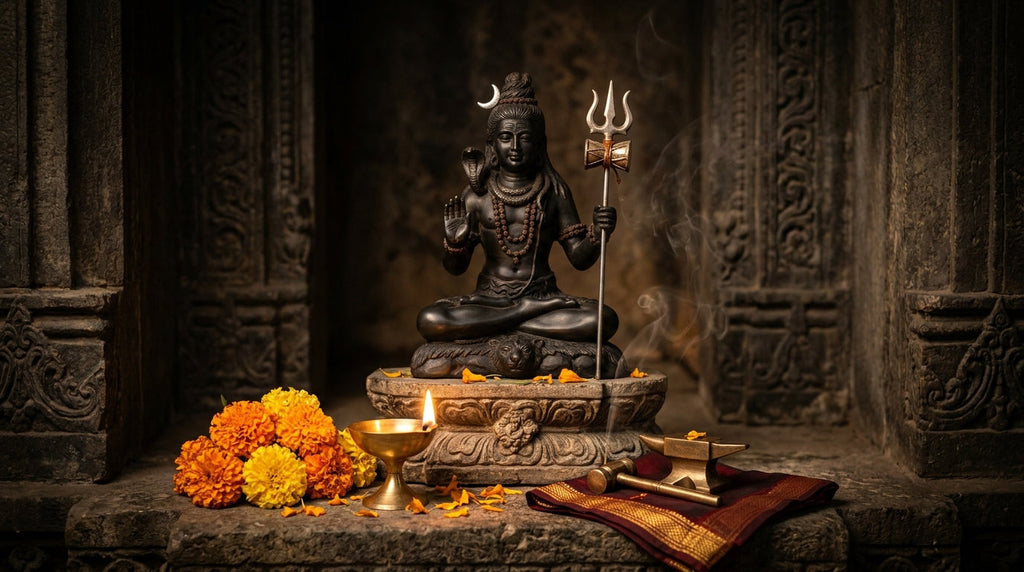
And here the elders turn the story inward. The real battlefield is within us: ego, anger, fear and ignorance. When we hold a murti of a deity with a weapon, we are reminded to take up the weapon of discernment against our own weaknesses. A Shiv hand with trishul idol from Dev Tattva, for instance, can be a small, steady reminder of that thought.

How Devotees Honour the God of Weapons Today
The simplest and most beautiful way to honour this tradition is through Ayudha Puja, the worship of weapons and tools. It is observed during Navratri, most widely on the ninth day in many parts of South and West India. Families clean their tools, books, instruments and vehicles, mark them with turmeric and kumkum, offer flowers, light a lamp and give thanks. The date changes every year with the lunar calendar, so ask your family pandit or check a trusted panchang.
Many workshops and factories also hold Vishwakarma Puja, where machines and tools are cleaned and worshipped before the day's work is set aside. The time of observance varies by region. The spirit is the same everywhere: gratitude to the One who gave us skill, and respect for the instruments that give us our livelihood.

At home, you do not need a grand arrangement. Keep a clean, quiet corner, light a diya, offer a flower and a little sweet, and say a mantra such as ॐ नमः शिवाय (Om Namah Shivaya), "I bow to Shiva." Families who like to keep a weapon-bearing deity close often choose from the Shiv murtis at Dev Tattva, where the trishul is shown with care and devotion.
Those who revere Hanuman, remembered in tradition with his mace, may prefer a murti from the Hanuman collection. For a workplace or study corner, a small idol from the office desk collection sits well beside tools and books, and the car dashboard collection offers murtis made for travelling. All of them are handcrafted at Dev Tattva with a simple intention: to help a family keep a little reverence close at hand.

Whichever form you choose, treat the murti with respect. Keep it clean, place it at a modest height, and never set it near anything unclean. Tradition matters, but so does the sincerity of the offering.
Frequently Asked Questions
Is Vishwakarma the god of weapons?
Vishvakarma is the one most often named, because the epics and Puranas describe him as the craftsman who made the weapons, chariots and cities of the gods. But "god of weapons" is a modern label, not an ancient title. It is more accurate to call him the divine architect and maker, and the patron of tools and craftsmen.
Who is the Hindu god of war?
Kartikeya, also known as Skanda or Murugan, is honoured as the war god and the commander of the gods' army. He is remembered for slaying the demon Tarakasura with his spear, the Vel. Traditions differ on whether he is the elder or younger brother of Ganesha, so you will hear both in different regions.
Which goddess is the goddess of weapons?
Goddess Durga is the one most closely linked with weapons, because in the tradition each god placed a weapon in her hands before she faced Mahishasura. She is worshipped with her many arms and her many weapons during Navratri. Again, this is a devotional reading rather than a formal title in a scripture.
What is Ayudha Puja and which deity is worshipped?
Ayudha Puja is the worship of tools, instruments, books, vehicles and weapons, usually during Navratri. In many homes the Goddess, Durga or Saraswati, is invoked, and in workshops Vishvakarma is also remembered. The date shifts every year with the lunar calendar, so it is best to confirm it with your family's pandit or a trusted calendar.
May the maker guide your hands, may the commander keep your courage, and may the Mother guard your home. If you wish to bring a murti into your sacred space, you are welcome to browse the handcrafted idols at Dev Tattva, and may every one of them be a quiet reminder of dharma in your daily life. Jai Shri Vishvakarma, Jai Maa Durga.

About the author
Pandit Om Prakash Saxena
Pandit Om Prakash Saxena is 94 years old and still active. For the last 72 years he has been involved in pooja, paath and all forms of karmakand, and he is associated with Shanti Kunj, Haridwar.
-
Posted in
Ayudha Puja, Durga, god of weapons, Hindu mythology, Kartikeya, Vishvakarma