 All Deities
 Gift & Worship
 Best seller
 About Us
 Contact Us
 Blogs
Yada Yada Hi Dharmasya: Meaning of Gita 4.7
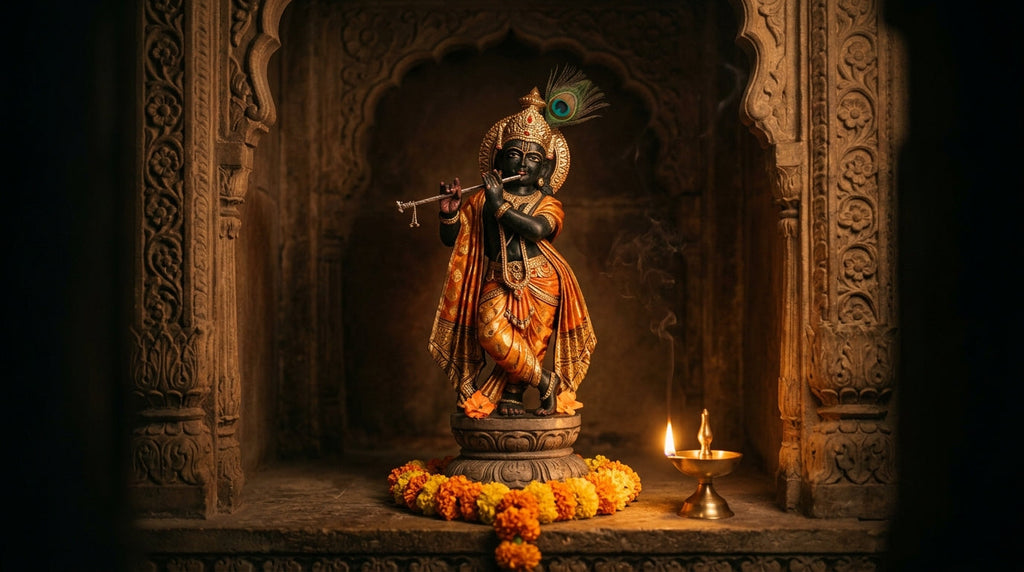
Picture the field of Kurukshetra just before the great war. Two armies stand ready, conches are sounding, and one warrior has sunk down in his chariot, his bow slipping from his hands. It is here that Krishna speaks the lines the world knows as “yada yada hi dharmasya”.
The direct answer is this. In Bhagavad Gita 4.7, Krishna tells Arjuna that whenever dharma, the moral order that holds life together, declines and adharma rises, he manifests himself. Verse 4.8 gives the purpose: to protect the good, to remove those who do wrong, and to establish dharma again, age after age.
Many of us have heard this verse in films, speeches and family WhatsApp messages without ever hearing the scene around it. Come, sit with me, and let us hear it the way the elders tell it. At Dev Tattva, where we make handcrafted murtis for the home mandir, we believe a verse is understood best when its story is understood first.
The Katha: A Warrior Who Laid Down His Bow
The Mahabharata tells us that two branches of one family, the Pandavas and the Kauravas, were about to fight for the kingdom. Arjuna, the finest archer of his age, asked Krishna to drive his chariot between the two armies so that he might see who stood against him. Krishna was not a king in that chariot that day. He had taken the humble seat of the charioteer, holding the reins.
Arjuna looked across the field and saw his grandsire Bhishma, his teacher Drona, his cousins, his friends. Then something broke in him. According to the first chapter of the Gita, his limbs grew weak, his mouth went dry, his bow Gandiva slipped from his hand, and he sat down on the floor of the chariot, unwilling to fight.
What did Krishna say? His first words in the second chapter are not soft. He asks where this weakness has come from at such an hour, tells Arjuna it does not suit a man of his standing, and bids him not to yield to unmanliness but to shake off this small faintness of heart. It was a rebuke, but the rebuke of an elder who loves, spoken to someone who has forgotten who he is.
Arjuna, however, still argues. He speaks of his teachers, of grief, of confusion, and at last he tells Krishna plainly that he will not fight, and falls silent. Only then does Krishna begin the teaching proper, and the Gita unfolds from that silence.

By the fourth chapter, Krishna is speaking of a yoga so ancient that, as he says, he first taught it to Vivasvan, the Sun-god. Arjuna is puzzled, and honestly so. Vivasvan belongs to the dawn of time, and Krishna stands before him as a man of his own age. How could he have taught the Sun? It is the question any of us might ask.
Krishna answers gently. Many births of his have passed, and of yours too, Arjuna, he says; I remember them all, and you do not. Then comes the great statement of verse 4.6: though he is unborn and imperishable, and the lord of all beings, he still comes into manifestation through his own divine power, which tradition calls yogamaya. And in the very next breath, he speaks the verse we are here to understand.
The Verse Itself: Yada Yada Hi Dharmasya
यदा यदा हि धर्मस्य ग्लानिर्भवति भारत ।
अभ्युत्थानमधर्मस्य तदात्मानं सृजाम्यहम् ॥yadā yadā hi dharmasya glānir bhavati bhārata
abhyutthānam adharmasya tadātmānaṃ sṛjāmy aham
In plain English: whenever, O Bharata, dharma declines and adharma rises up, at that time I send myself forth, I manifest.
Let us take the words one by one, the way a teacher would with children. Yada yada means “whenever, at any time”. Dharmasya glanih is the fading or weakening of dharma. Abhyutthanam adharmasya is the rising of adharma. Tada means “then”, atmanam srijami means “I bring myself forth”, and aham is simply “I”.
Now the verse that completes the thought:
परित्राणाय साधूनां विनाशाय च दुष्कृताम् ।
धर्मसंस्थापनार्थाय सम्भवामि युगे युगे ॥paritrāṇāya sādhūnāṃ vināśāya ca duṣkṛtām
dharmasaṃsthāpanārthāya sambhavāmi yuge yuge
It means: to protect the good, to destroy the doers of evil, and to firmly establish dharma, I come into being from age to age. Verse 4.7 gives the occasion, and verse 4.8 gives the purpose. They are really one thought, and it is a pity that the world quotes only the first half.
Why Krishna Calls Arjuna “Bharata”
Did you notice the word Bharata in the verse? Krishna is not using a pet name. Arjuna belongs to the great line of King Bharata, a lineage famous for duty and honour, and the very name of the epic, Mahabharata, comes from it.
When Krishna addresses him this way, he is quietly reminding a trembling warrior of whom he descends from. The speaker is not describing a distant cosmic event. He is speaking to a man whose own dharma stands in front of him, and who has just put his bow down.
That is the part many short explanations skip. The promise of divine manifestation is given to a man in despair, in the middle of a crisis, and it is given so that he can stand up again.
What Dharma Means in Bhagavad Gita 4.7
Translators often render dharma as “righteousness” or “religion”, and each word catches only a part of it. The root of the word means “to hold” or “to sustain”. Dharma is what holds a family, a society and the world together in the right order.
In the Gita, it also has a very personal side: one’s own duty in one’s own place. A soldier, a teacher, a mother, a merchant, a king, each has a dharma that fits their role. Arjuna’s sorrow in the first chapter is really a confusion about this. He cannot tell whether his duty is to fight or to turn away, and Krishna’s whole teaching is meant to clear that fog.
So when Krishna speaks of dharma glani, a fading or weariness of dharma, he means more than temples falling silent. He means the moment when people forget what is owed to each other, when power ignores duty, when the weak are not protected. Adharma is not only a wicked king. It is the slow forgetting that makes a wicked king possible.

Three Ways Teachers Read This Promise
Hindu tradition has never had only one way of reading a verse, and this is a good example. Please remember that what follows are different traditions of understanding, not a contest.
The devotional reading. Vaishnava teachers take the verse quite literally. God, out of compassion, takes birth in the world when it is in need. This is the root of the idea of the avatar, the “descent” of Vishnu. Devotees remember Rama and Krishna in this light, and many tellings speak of ten principal avatars, with Kalki spoken of as the one still to come. The verse itself, however, does not name any avatar or count them.
The philosophical reading. Teachers in the Advaita line tend to look at the verse more subtly. For them, the Supreme is beyond birth and change, and the “manifestation” is a way of speaking about how the formless shows itself in the world of form, or how wisdom awakens in the heart when it is most needed.
The reading of conscience. Many families today also hear the verse as a call within. When we see injustice and feel the pull to act, that pull is itself part of dharma asking to be upheld. This reading does not replace the others, and many people hold more than one at once.
A word about a popular misquote. You may have heard it said, even in films, that Krishna promises to arrive at some moment on a horse, or in some dramatic form, to rescue the good. The verse says nothing of the kind. It gives no date, no method and no costume. It says only that he manifests, and that the purpose is the protection of dharma.

What the Image of Krishna Teaches Us
Look at how Krishna is shown in the Gita’s own setting, and the verse begins to open up. He sits at the front of the chariot, reins in hand, and Arjuna sits behind him. According to the Mahabharata tradition, Krishna had agreed not to take up weapons in the war. His power was guidance, not force.
Then there are the other images we love: the flute, the peacock feather, and the Sudarshana chakra that tradition places in his hand. They show two faces of the same truth. The flute is the sweetness that draws the heart. The chakra is the order that protects the world. Dharma, in Krishna’s own form, holds both.
And the charioteer’s posture tells us how he keeps his promise. He does not fight Arjuna’s battle for him. He steadies the reins, speaks the truth, and lets the warrior rise. Perhaps this is the deepest meaning of sambhavami yuge yuge: God comes, and in coming, awakens the courage that was already in us.

Does This Mean God Is Absent When Dharma Is Strong?
Some readers worry about the opposite side of the verse. If God manifests when dharma declines, is he away when all is well? The tradition does not read it so. In the very same passage, Krishna calls himself unborn, imperishable and lord of all beings, which means his being is not switched on and off with the times.
The verse speaks of manifestation, not of presence. A lamp is in the room even at noon, though we notice its light only in the dark. That is how the elders usually explain it to children.
How Devotees Honour This Verse Today
The simplest way is also the oldest: read the verse slowly, aloud, with its meaning. Many households read a few verses of the Gita each morning near the puja shelf, light a diya, and sit for a minute in silence. You do not need to recite the whole chapter. Two verses, understood, are worth more than twenty hurried ones.
The second way is to carry the verse into your day. Ask yourself quietly, where is my own dharma asking something of me today? It may be to speak honestly at work, to care for a parent, to keep a promise that is inconvenient. This is how a verse about the whole world becomes a verse about one person.
The third way is to keep a sacred image where your eyes fall often. A murti is not decoration, and it is not a magic charm. It is a gentle reminder, a face for your devotion. Devotees who love the charioteer image often place a deity on the dashboard of the car, as a thought for the road and for the journey of the day. The car dashboard collection at Dev Tattva has a range of handcrafted idols made for exactly this purpose.
We should be honest about one thing: the Dev Tattva collections do not at present include a Krishna murti. What a family can find there are other forms that speak to the same theme of dharma upheld. The Ram Lalla face idol honours Rama, whom tradition remembers as an avatar of Vishnu, and the Hanuman idol with Ram in his heart shows devotion and duty held together.

If you are thinking of a gift for a housewarming or a new beginning, remember that a sacred image carries a thought along with it. You may like to browse the gifting collection on devtattva.com, and choose a murti for the person’s own ishta devata, the deity they hold dear. Traditions vary from family to family, and no one form is the only right one.

If you keep a small shelf at home, a quiet way to use it is to place the Gita beside the murti and read verse 4.7 there once a week. Let the children ask what it means, and answer them with the katha, not with a lecture. The story stays in a young mind long after the Sanskrit is forgotten.

Frequently Asked Questions
What is the meaning of “yada yada hi dharmasya”?
It means “whenever dharma declines”. Krishna says that whenever dharma weakens and adharma rises, he manifests himself, and verse 4.8 adds that he does so to protect the good, remove evil and re-establish dharma.
Which chapter and verse of the Gita is this?
It is chapter 4, verse 7. The verse that follows it, 4.8, begins with “paritranaya sadhunam” and completes the thought. Chapter 4 is often called the chapter of knowledge and action, and it is where Krishna speaks of his own manifestation.
Is Krishna talking about Kalki or the ten avatars here?
The verse does not name any avatar. Devotional traditions link it to the idea of the avatars, including Rama, Krishna and, in many tellings, Kalki yet to come. Other teachers read it more inwardly, so it depends on the tradition one follows.
Does this promise apply only to Hindus?
The verse speaks of dharma and of the good, and not of any one community. Teachers explain it in different ways. Many readers, whatever their faith, find in it the simple idea that goodness is not left alone.
May the words of Krishna steady your reins on every road you travel, and may your home have a quiet corner where dharma is remembered. If you wish to bring a handcrafted murti into that corner, you are always welcome at Dev Tattva, and may you go forward with a calm heart. Hari Om.

About the author
Pandit Om Prakash Saxena
Pandit Om Prakash Saxena is 94 years old and still active. For the last 72 years he has been involved in pooja, paath and all forms of karmakand, and he is associated with Shanti Kunj, Haridwar.
-
Posted in
avatar, Bhagavad Gita, dharma, Gita 4.7, Hindu scriptures, Krishna