 All Deities
 Gift & Worship
 Best seller
 About Us
 Contact Us
 Blogs
BlogsWhere Is Lord Krishna's Flute Now? The Katha Answers
It is said that when the cows of Vrindavan walked home at dusk, with golden dust rising behind them, a sound would drift across the Yamuna that nobody could name at first. It was thin and sweet, and it seemed to come from everywhere at once. The cowherds knew it, the gopis knew it, and even the river seemed to slow down for it. That was the flute of Shri Krishna.
So, where is Lord Krishna's flute now? No scripture says. The Bhagavata Purana describes the flute lovingly while Krishna lives in Vrindavan, and then never mentions it again after he leaves for Mathura. Every answer beyond that, a broken flute, a temple treasury, a museum, is later devotional belief or rumour, not text.
Let us first sit with the katha, then sort scripture from folklore, and then see why the flute matters so much to every devotee. At Dev Tattva, where we work with handcrafted murtis, families ask us this question often, especially as Janmashtami draws near. It deserves an honest answer.
The Katha of Lord Krishna's Flute in Vrindavan
Listen to how the story goes. In Vrindavan, Krishna grew up as a cowherd boy. Each morning he took the cattle out to the groves and to the banks of the Yamuna, a peacock feather in his hair and a bamboo flute in his hands. In Braj the flute has many names: murali, venu and vamsi. All of them simply mean the bamboo flute.
Who gave him the flute? Here the tradition is quiet. The Bhagavata Purana shows Krishna playing it but does not name a giver. Different devotional traditions tell different loving stories about it, and they vary from place to place, so we hold them lightly.
The most beautiful description is in the Venu-gita, the song of the flute, found in the tenth canto of the Bhagavata Purana. The gopis sing it among themselves, and they hardly describe the notes. They describe what the notes did. Cows stood with their ears raised and their mouthfuls of grass forgotten. Calves stopped drinking, the milk still on their lips. Birds sat silent on the branches like sages in meditation.

Rivers slowed, as if they wished to carry the sound along with them. Clouds drifted over to shade the boy. The tradition says even the heavenly beings passing overhead in their vimanas stopped to listen. And the gopis wondered aloud what penance the bamboo could have done to rest so close to his lips.
Picture the scene: a cool grove, a low sun, the smell of wet earth and crushed grass, and one boy standing at ease with his flute raised. Notice what the story is telling us. The flute is not a weapon and not a crown. It is the humble instrument of a cowherd, and its whole power is that it calls.
The Day Krishna Left Vrindavan and the Flute Fell Silent
Then comes the day every listener dreads. Akrura, sent by King Kamsa, arrives in Vrindavan with a chariot to take Krishna and Balarama to Mathura. The Bhagavata Purana tells how the gopis gathered along the road, and how the whole village stood still as the wheels rolled away.
In Mathura, Krishna ended the tyranny of Kamsa. In time he made his home at Dwarka and became its king. The same Purana tells how he sent Uddhava to Braj to console the gopis, and how the people of Braj met him again at Kurukshetra during an eclipse. At the very end, in the eleventh canto, a hunter named Jara mistakes Krishna's foot for a deer, and Krishna departs from this world.
Now read these passages and look for the flute. You will not find it. The text that sang so tenderly of the flute in Vrindavan does not follow it to Mathura or to Dwarka. It never says the flute was broken, hidden, buried or given away.
Why the silence? Elders offer a reading that is gentle and rather beautiful. The flute belongs to the cowherd boy of Vrindavan, not to the king of Dwarka. When the boy grew into the king, the flute stayed with the world that loved it. This is a devotional reading and not a verse, but it explains the silence better than any rumour does.
A word about Radha, since so many people ask. The Bhagavata Purana does not name her. She becomes central in later devotional literature, such as Jayadeva's Gita Govinda, the Brahma Vaivarta Purana and the Padma Purana. That is why stories that tie the flute to her belong to a later and more devotional layer of the tradition.

Where Is Lord Krishna's Flute Now? The Answers People Give
Where scripture is silent, the people have answered. Here are the five answers you will hear most often, and how a careful elder would weigh each one.
- Broken when Radha died. In this telling, Krishna, heartbroken, snapped the flute and threw the pieces into the forest or the Yamuna, never to play again. It is a moving story and very widely told. But no text that devotees can reliably cite carries it, and the Bhagavata does not even name Radha. Hold it as folklore of love and loss.
- Kept safe in Goloka. Gaudiya Vaishnava belief holds that Krishna's pastimes in Vrindavan never end but continue in a spiritual realm, and that the flute is with him there. This is a statement of faith about an eternal Vrindavan, not a place on any map.
- Left behind with Radha or the gopis in Braj. Some Braj traditions imagine that he left it as a keepsake for those who loved him. It is a lovely thought, and it remains a thought.
- In the Jagannath Puri treasury or the Padmanabhaswamy temple. Both are named online. We know of no reliable record or temple statement that supports either claim.
- In a museum. This is repeated often, with no evidence offered. A stray claim about a temple in Karnataka also cannot be verified. There is no credible relic claim for the flute.
So how do these answers differ? Puranic silence says: the text does not tell us. Braj tradition says: the flute lives on in the songs and dust of Vrindavan. Gaudiya belief says: the lila is eternal, so the flute is still playing. Three answers, three kinds of truth, and not one of them is a street address.

What Is Wrong With the Popular Answers
Notice the pattern. Each answer is an ending, composed after the fact by people who loved Krishna and could not bear the thought of the flute simply vanishing. The heart wants an ending, so it writes one.
The trouble begins when these endings are repeated as if they were verses. A deathbed scene is pasted with no source. A museum is named with no record. A family sitting down to learn about its faith may walk away believing it has read scripture.
The honest answer is smaller and, to my mind, more beautiful: the text keeps the flute in Vrindavan, and so can we. Is it not enough that the sound is still remembered, thousands of years later, in every village that sings of him?
What the Hollow Bamboo of Krishna's Flute Teaches
Think of what a flute really is. A length of bamboo, hollow inside, with a few holes along its side. By itself it makes no music at all. It is the breath of the player that turns it into a song.
That is why devotees read the flute as the soul that has emptied itself of ego. A heart crowded with "I" and "mine" has no room for the music. A heart that is hollow in the right way lets the divine breath pass through it. Many Vaishnava teachers call this surrender.
The flute also calls. Cattle, gopis, birds, even the river turn toward its sound. In the same way, the tradition says, the Lord calls each soul home, softly and without force. He does not shout. He plays.

And then there is the plain matter of the material. Bamboo grows at the edge of every village. Krishna, Lord of the worlds, picks up what any cowherd would pick up. The tradition delights in this: the divine found in the ordinary.
Why Every Murti of Krishna Holds the Flute
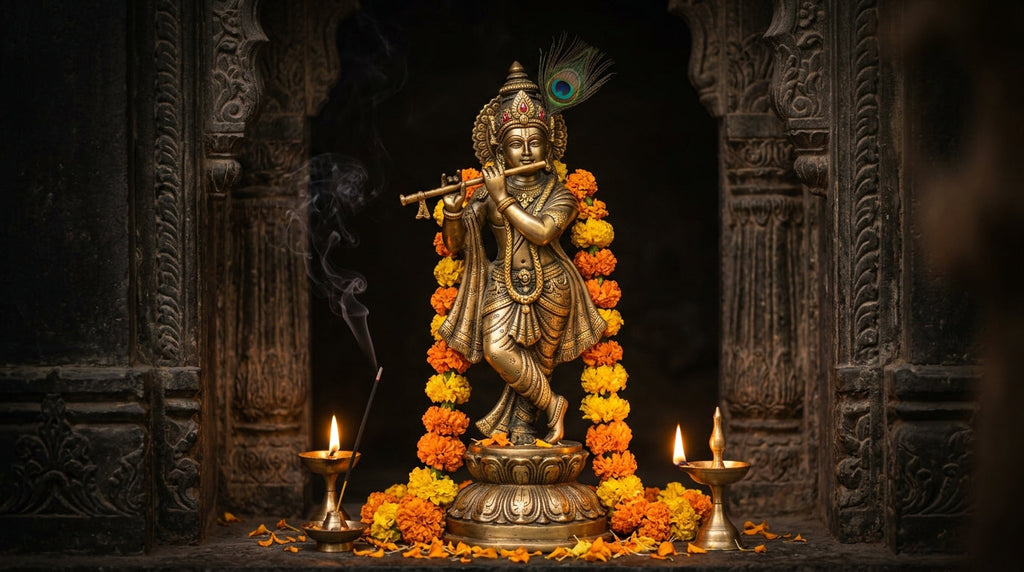
If the original flute cannot be found, the flute is nevertheless never missing. Walk into any mandir or home shrine in India and you will see Krishna with the flute at his lips. The sculptor does not ask where it is. He places it in the hands.
Often the murti stands in tribhanga, the pose of three bends: the head tilted one way, the waist curved the other, and the legs crossed gently at the knee. This soft S-shape is how the craftsman shows music moving through a body. Add the peacock feather and a cow standing beside him, and all of Vrindavan sits in a few inches of metal or resin.
That is the quiet answer to our question. For a devotee, the flute is wherever Krishna is remembered: in a murti, in an aarti, in a bhajan sung at dusk.
Craft matters here. A flute in a murti is slender, and it takes patient hands to shape the fingers around it. At Dev Tattva, the handcrafted murtis available today are of Ganesha, Shiva, Hanuman and Ram, and that same care for small details is what we cherish in any idol. Ram is, like Krishna, an avatar of Vishnu, and the Hanuman idol with Ram in his heart shows devotion in one gesture, much as the flute does for Krishna.

How to Honour the Flute of Krishna at Home
You do not need an elaborate ritual. Traditions vary by region and by family, so take what follows as gentle suggestions.
- Keep a clean, quiet corner for your image or murti of Krishna, and wipe it softly each morning.
- Offer fresh flowers and a tulsi leaf. Many families also offer makhan mishri (butter with sugar crystals), which is dear to the cowherd Krishna in tradition.
- Light a small diya and sit quietly for a minute or two.
- Chant softly: ॐ नमो भगवते वासुदेवाय (Om Namo Bhagavate Vasudevaya), meaning "I bow to the Lord Vasudeva."

On Janmashtami, the birthday of Krishna, families decorate the shrine with flowers, a peacock feather and a small cradle. The date changes every year with the lunar calendar, so check a local panchang. Some homes play soft flute music through the evening, which is a sweet way to remember the Venu-gita.
When you set up a home mandir, you can browse the temple collection at Dev Tattva for murtis that suit a small shrine. Many families also keep a small idol on the dashboard for a calm start to the road, which is why Dev Tattva gathers a car dashboard collection too.
A murti is also a gift that stays in a home for years, at a housewarming, a wedding or a birthday. Dev Tattva's gifting page has ideas for those occasions.

Frequently Asked Questions
Is Krishna's flute in a museum or in Jagannath Puri or Padmanabhaswamy temple?
There is no reliable record that it is. These claims are repeated online without a source, and no temple or museum has made a credible relic claim for Krishna's flute. Treat them as rumour, not tradition.
Did Krishna break his flute when Radha died?
This story is told widely, but it is later devotional folklore. The Bhagavata Purana does not name Radha, and no text that devotees reliably cite describes the flute being broken. Many families love the story, and it is fine to love it as a story.
Who gave Krishna his flute, and what is it called?
The Bhagavata Purana shows Krishna playing it without naming a giver, and later devotional tellings differ, so no single giver is settled. The flute is called murali, venu or vamsi, all words for the bamboo flute.
Why did Krishna never play the flute again?
The text does not say that he stopped, only that it stops speaking of the flute after Vrindavan. Many devotees explain that the flute belongs to the cowherd boy of Braj, not to the king of Dwarka. That is a loving reading, and not a verse.
May the sound of that unseen flute stay in your home, dear reader, whether you hear it in a bhajan, in a quiet evening, or in the thought of a boy under the kadamba tree. If you are building a shrine for your family, you are welcome to visit Dev Tattva, and may every murti you bring home carry your devotion. Jai Shri Krishna.

About the author
Pandit Om Prakash Saxena
Pandit Om Prakash Saxena is 94 years old and still active. For the last 72 years he has been involved in pooja, paath and all forms of karmakand, and he is associated with Shanti Kunj, Haridwar.
-
Posted in
hindu mythology, janmashtami, krishna flute, murali, vrindavan