 All Deities
 Gift & Worship
 Best seller
 About Us
 Contact Us
 Blogs
BlogsWho Is the Father of Sita? The Katha of the Furrow
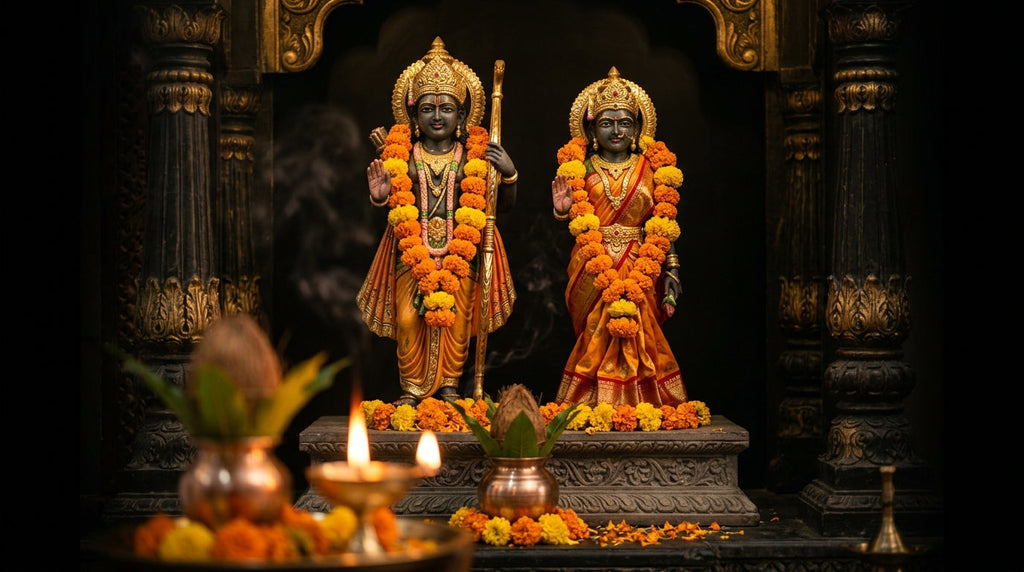
The elders begin this katha in the green fields of Mithila, where a king once walked behind a plough and the earth handed him a daughter.
So, who is the father of Sita? In Valmiki's Ramayana, her father is King Janaka of Mithila, who found her as an infant in a furrow and raised her as his own child. That is why she is called Janaki, the daughter of Janaka, and also Bhumija, the daughter of the earth.
Other tellings give other origins, and we will look at them honestly further on. But first, come and sit with us at Dev Tattva, and hear the story the way it has been told for generations.
The Katha: A Child in the Furrow
Listen to how the story goes. Mithila was a kingdom of learned people, where sages came to debate and the evenings smelled of ghee and burning samidha. Its king, Janaka, was as famous for his wisdom as for his throne. Tradition calls him Videha, and the land too is remembered as Videha.
One day Janaka prepared a yajna, a sacred fire ritual. Before it could begin, the ground set apart for the sacrifice had to be ploughed. According to tradition, the king himself took part in this rite. Imagine the early morning: oxen breathing steam, wet soil turning over in dark waves, priests murmuring near the altar.
Then the blade of the plough stopped. Something lay in the furrow. When the soil was brushed away, there was a baby girl, dusty and quiet, resting in the very earth that had just been opened.
Janaka lifted her in his arms. In Valmiki's Bala Kanda, it is Janaka himself who tells this tale, when the sage Vishvamitra comes to Mithila with young Rama and Lakshmana. He says that the child rose from the furrow, that she was not born of any womb, and that he took her as his daughter. In popular tellings, the king had no child at that time, and the gift felt like a blessing from the sacrifice itself.
The word for a furrow is sita. So the baby was named Sita, the one who came from the line cut by the plough. She was carried home to the palace, where, as tradition has it, Queen Sunayana took her to her heart.

Janaka, the Father Who Raised Her
Finding a child is one thing. Raising her is another, and this is where Janaka truly becomes a father. Sita grew up in the palace of Mithila alongside Urmila, the daughter Janaka and Sunayana had by birth. Their cousins Mandavi and Shrutakirti, daughters of Janaka's younger brother Kushadhvaja, grew up in the same household.
The elders tell a charming episode from Sita's girlhood. Janaka kept in his house a huge, heavy bow that belonged to Lord Shiva. In popular tellings, the young Sita moved it aside with ease while attending to her daily tasks, and Janaka watched in amazement, for no king could even lift it.
From that moment he made a resolve. His daughter would be given in marriage to the one who could string that bow. Kings came from far and wide, and none could manage it. Then Rama, guided by Vishvamitra, lifted it, and the bow broke with a sound that shook the hall.
Picture Janaka at that wedding. He had waited a long time for the right match for the daughter the earth gave him. His joy was great, and so was the quiet ache every father knows when his daughter's palanquin leaves for another home.
Remember also what the name Videha hints at. Many teachers explain it as a king who ruled the world yet was not bound to it, who held his body and crown lightly. The same man could be a ruler, a seeker and a loving father at once.

Is Janaka the Real Father of Sita? Father, Adoptive Father and Mother Earth
Many pages online blur one point, so let us make it clear. In Valmiki's telling, Sita's origin is the earth, and Janaka is the father who found her, accepted her and raised her. Some people call him her adoptive father. Others say a father is the one who gives a child his name, his love and his care, and by that measure he is her father without any doubt.
Sita's names say the same thing. She is Janaki because she is Janaka's daughter. She is Bhumija and Bhumi-putri because the earth, Bhumi Devi, is her source. In many traditions Mother Earth is spoken of as her mother, while the queen who nursed and raised her is named Sunayana.
So the two answers do not fight. The earth gave her, and Janaka raised her. A family, in our tradition, is often made of both kinds of bonds.
Other Tellings: Was Sita the Daughter of Ravana?
Now to the question many people whisper. Yes, there are retellings in which Sita is born to Ravana, or to his queen Mandodari. In these tellings the infant is cast away, buried in the earth or sent far from Lanka, and then found by Janaka in the field.
Where do such stories come from? In many popular tellings there is a link with Vedavati, a woman said to have been troubled by Ravana in an earlier life. The tradition says she vowed to return as the cause of his downfall. Storytellers in different regions have then woven this into a tale of a daughter who comes back to the house of her destroyer.
These versions are later or regional, and they are not what Valmiki tells. Even in them, Janaka remains the father who raises Sita in Mithila. Tradition varies by region and family, and we honour all sincere tellings, but when someone asks for the standard answer, it is Janaka.
Notice one more thing. Even the ancient Vedic hymns speak of the furrow itself as a goddess, Sita, linked with ploughed land and good harvest. The idea of Sita as the earth's own is very old indeed.

Names Born of Her Origin
A great deal of Sita's story sits quietly inside her names. When devotees chant them, they are telling the katha again.
- Sita (सीता): the furrow, the line made by the plough.
- Janaki (जानकी): the daughter of Janaka.
- Vaidehi (वैदेही): the princess of Videha.
- Maithili (मैथिली): the lady of Mithila.
- Bhumija (भूमिजा): the one born of the earth.
- Ayonija (अयोनिजा): the one not born of a womb.
And the joyous cry of every Ram devotee carries her name first: जय सिया राम (Jai Siya Ram), meaning victory to Sita and Rama. Siya is simply a sweet form of Sita.
What the Story Teaches: The Furrow, the Earth and the Father's Love
Why did the tradition choose a furrow? Think about what a plough does. It opens the earth so that life can grow. Sita comes from that opening, and she carries the earth's patience, its fertility and its quiet strength through the whole Ramayana.
The story also honours a way of fatherhood that is not only about blood. Janaka did not ask where the child came from, or whether the gods or the earth had sent her. He saw a child who needed a father, and he became one. That is a lesson many Indian families, and families abroad, understand well.
Then comes the ending. As tradition tells it in the Uttara Kanda, when Sita's last trial comes, she calls upon Mother Earth. The ground opens, and Bhumi Devi receives her daughter back. The furrow where she began becomes the place of her return, and the circle closes.
Many devotees feel that this is not defeat at all, but a daughter going home. It reminds us that the dignity of Sita belongs to something deeper than any kingdom, and that she stood by her truth until the end.
That is why we at Dev Tattva like to tell the story first, and speak of any murti only afterwards. A form in clay or resin means more when the heart already knows the katha behind it.

Honouring Sita and Janaka Today
Her birth is remembered on Sita Navami, which in many traditions falls on the ninth day of the bright half of the month of Vaishakha. Some regions, especially around Mithila, keep their own days for Janaki Jayanti. The dates change every year with the calendar, so check a trusted panchang in your own family tradition.
The observance can be very simple. Many families bathe early, light a diya before Sita and Rama, offer flowers and fruit, and read or listen to the passage of the furrow and the bow. Some keep a light fast, and others do not. Both are accepted, for devotion is not a contest.
A short salutation is enough for a busy morning: ॐ श्री सीतायै नमः (Om Shri Sitayai Namah), which means I bow to Goddess Sita.
Sita is never worshipped apart from Rama in most homes. Siya-Ram are seen as one divine pair. The handcrafted murtis at Dev Tattva follow the same devotion for the Ram side of this family. The Ram Lalla Face idol is one gentle way to keep Lord Ram's calm presence near you, and you can see more in the Ram Lalla collection.

Devotees of Ram also remember Hanuman, who carried Ram's ring to Sita in Ashoka Vatika. The Hanuman idol with Ram in his heart shows exactly that devotion in a form small enough for a study table or a car dashboard. More such murtis wait in the Hanuman collection at Dev Tattva.
Many families visit devtattva.com when they want a handcrafted murti for a home mandir, a housewarming, a wedding gift or a return gift. Whatever the occasion, let the katha travel with the gift, so the one who receives it knows whom they are bowing to.

Frequently Asked Questions
Who is the real father of Sita?
In Valmiki's Ramayana, King Janaka of Mithila is Sita's father. He found her in a furrow and raised her as his daughter, and she is born of the earth. The names Janaki and Bhumija carry both parts of the story.
Was Sita the daughter of Ravana?
Only in some later and regional retellings, which differ from one another. The widely accepted account, from Valmiki, names Janaka as her father and does not make her Ravana's child. Where such tellings exist, they are respected as folk and regional traditions, not as the standard version.
Who is Sita's mother?
Tradition speaks of Mother Earth, Bhumi Devi, as her mother in origin. The queen who raised her in Mithila is named Sunayana in popular tradition. Sita's sister Urmila was the queen's own daughter.
When is Sita Navami?
Sita Navami is observed in many traditions on the ninth day of the bright fortnight of Vaishakha. The English date changes every year, so please consult a panchang. Janaki Jayanti is kept on a different day in some regions.
May the story of the furrow remind your family that love makes a father, and that the earth never forgets her children. If you wish to bring Lord Ram's presence into your own mandir, you are welcome to explore the temple collection at Dev Tattva, and may Siya-Ram bless your home with peace.

About the author
Pandit Om Prakash Saxena
Pandit Om Prakash Saxena is 94 years old and still active. For the last 72 years he has been involved in pooja, paath and all forms of karmakand, and he is associated with Shanti Kunj, Haridwar.
-
Posted in
Hindu mythology, Janaka, Janaki, Ramayana, Sita, Sita Navami