 All Deities
 Gift & Worship
 Best seller
 About Us
 Contact Us
 Blogs
BlogsWhy Do We Celebrate Navratri? The Katha of the Goddess
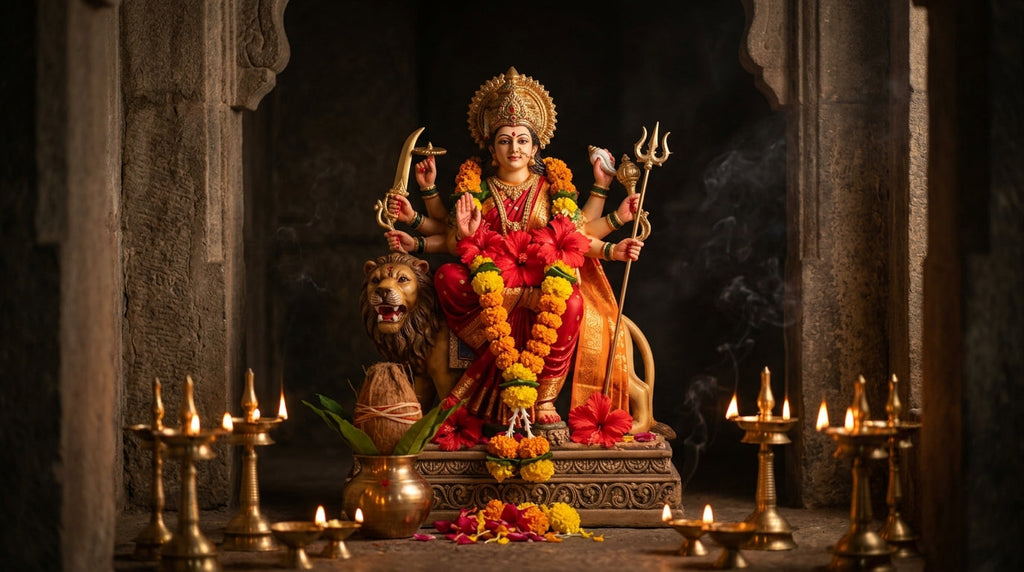
When the air turns soft and the evenings grow cooler, the elders say, a small earthen pot is set down before the Mother in thousands of homes at once. Conch and bell sound together, a lamp is lit, and Navratri begins.
We celebrate Navratri to honour the Divine Mother, Shakti or Durga, and above all her victory over the buffalo demon Mahishasura, the triumph of dharma over adharma. The word means nine nights, and the festival closes with Vijayadashami, the tenth day. In some regions the same days also recall Lord Rama worshipping the goddess before his battle with Ravana.
Here at Dev Tattva, we like to tell the whole katha first and the customs after. So come, sit with me, and listen.
What Does the Word Navratri Mean?
The word has two Sanskrit parts. Nav means nine and ratri means night. Why nights and not days? The elders answer that night is when the noise of the world falls away, and a person can sit beside a lamp and look inward.
These nights belong to Devi, the Goddess, who is called Durga, Ambika, Bhavani, Amba and simply Mata. Every region and family has its own favourite name. Yet all of them mean one Mother, the living power (shakti) behind everything that is made.
The Katha of Mahishasura: Why the Goddess Had to Appear
Listen to how the story goes. It is told in the Devi Mahatmya, the great text in praise of the Goddess, which is part of the Markandeya Purana. Devotees recite it during these nights as the Durga Saptashati.
Long ago there lived an asura named Mahishasura, who could take the form of a buffalo. He performed hard tapasya, and in popular tellings Lord Brahma, pleased with his austerity, granted him a boon: no god and no man would be able to kill him. Mahishasura, certain that nobody could trouble him now, grew proud and hungry for power.

He marched against the heavens and fought the devas. Indra was defeated, and the gods were driven out of Swarga to wander without a home. Sorrowful and tired, they went to Brahma, Shiva and Vishnu and told them everything.
As the three heard the tale, the Devi Mahatmya says, great anger rose in them. A blaze of light poured out from each of the gods, and from the other devas too. The streams joined into one mountain of flame, and out of that fire a woman took shape, shining like a thousand suns.
Every god then gave her something of his own. Shiva gave a trident and Vishnu gave a discus, and the other devas gave their weapons, ornaments and blessings. A lion became her mount. Now she stood armed and fearless, and she laughed so loudly that the worlds trembled.
Mahishasura heard that laugh, and the battle began. It was long and terrible, and popular tellings count it as nine nights of fighting. In the end the Goddess ended his reign, and the devas, with tears of relief, sang her praises.
Now see the meaning inside the story. The boon had shut out gods and men, so the answer to such pride could not come from either. It came as Shakti, born from the combined light of all the gods. That is why the festival is not only about one battle. It is about the power that rises when goodness stands together.

The Katha of Rama and the Goddess Before Ravana
Not every region tells Navratri in the same way. In some tellings, especially in the east and in parts of the north, there is a second story. Before the war with Ravana, Lord Rama is said to have worshipped Durga and sought her blessing. Tellings of the Ramayana differ on this, and families follow the version they have inherited.
In this tradition Rama prayed through the nights, and on the tenth day he defeated Ravana. That is why the tenth day is called Vijayadashami, the day of victory, and also Dussehra. In many northern towns, Ramlila plays are staged during the nine nights, and on the tenth the great effigy of Ravana is burned.
So the two stories do not quarrel. One shows the Goddess herself as the victor, the other shows a devotee winning through her grace. Both end on the tenth day with the same lesson, that truth wins when it is joined to humility and courage. Many homes keep a murti of Rama near the mandir at this time, such as the Ram Lalla face idol, as a gentle reminder of the second katha.
Why Navratri Is Celebrated for Nine Nights
Why nine, and not seven or ten? Tradition gives more than one answer, and I will share the ones the elders repeat most.
The first is the battle itself. Popular tellings speak of nine nights of fighting, with victory coming on the tenth. The second is the worship of the nine forms of Durga, called the Navadurga, one for each night. These are the names devotees most often recite:
- Shailaputri, the daughter of the mountain
- Brahmacharini, she who practises austerity
- Chandraghanta, she who wears the crescent moon like a bell
- Kushmanda, the one whose gentle smile is said to have brought the universe into being
- Skandamata, the mother of Skanda (Kartikeya)
- Katyayani, the warrior form
- Kalaratri, the dark night form who removes fear
- Mahagauri, the radiant and serene one
- Siddhidatri, the giver of perfections
Some families arrange the days a little differently, so please keep to what your own tradition teaches.
A third answer divides the nine nights into three sets of three. In many homes, the first three nights are for Durga, the next three for Lakshmi, and the last three for Saraswati. So the devotee asks first for strength to remove what is wrong within, then for the prosperity of a good and balanced life, and last for knowledge and wisdom.

Why Do We Celebrate Navratri Twice a Year?
Many people are surprised to learn that there are two main Navratris. Chaitra Navratri comes in spring, in the lunar month of Chaitra, and in many traditions it ends with Ram Navami, the birth anniversary of Lord Rama. Sharad Navratri comes in autumn, in the month of Ashwin. It is the grand one, leading to Dussehra and, in Bengal, to Durga Puja.
Both fall at the turning of a season. The elders of old lived close to the land, and they saw these turnings as thresholds, times to slow down, eat simply and sit in prayer. The dates shift every year because the festival follows the lunar calendar, so please check a trusted panchang for the current days.
You may also hear of Gupt Navratri, which comes in the months of Ashadha and Magha. These are observed quietly, mostly by those who follow Devi sadhana, and they are not celebrated publicly like the other two. So when someone says there are four Navratris, they are counting these hidden ones too. For most families, two is the number that matters.
The Inner Meaning: What the Nine Nights Teach Us
Many teachers read the katha on two levels. On the outside, there is a demon and a goddess. On the inside, there are the pride, anger and laziness that live in every heart, and the inner strength that can face them.
Some traditions link the three sets of nights to the three gunas, the qualities of nature. The first nights are for tamas, the heaviness of dullness and fear. The middle nights are for rajas, restless energy and desire. The last nights are for sattva, clarity and peace. By the tenth day, the seeker hopes to stand in light.
There is one more lesson, and I find it the sweetest. The Goddess was not born from one god alone. She rose from the combined light of all of them. When people set aside small quarrels and put their strength together, they become something no pride can stand against.
And why does the festival come to rest on the tenth day? Because prayer is not meant to stay in the temple. After nine nights of turning inward, Vijayadashami asks the devotee to step out and live a little more bravely and kindly.
The Devi Mahatmya holds a verse that devotees love to chant:
या देवी सर्वभूतेषु शक्तिरूपेण संस्थिता।
नमस्तस्यै नमस्तस्यै नमस्तस्यै नमो नमः॥
Ya Devi Sarvabhuteshu Shakti-rupena Samsthita, Namastasyai Namastasyai Namastasyai Namo Namah.
To the Goddess who dwells in all beings in the form of power, salutations to her again and again.

How Navratri Is Celebrated Across India
One festival, many faces. In Gujarat, the evenings ring with garba and dandiya, circles of dancers moving around a lamp or an image of the Mother. In Bengal, Durga Puja fills the streets with beautifully made images, the sound of the dhak drum and the fragrance of flowers, and ends with a tearful farewell as the image is immersed in water.
In the north, Ramlila plays are staged and Dussehra closes with the burning of Ravana. In Karnataka, the festival is celebrated as Dasara with grand processions. In parts of the south, families arrange Golu, a stepped display of dolls and figures, and invite neighbours to see it. Each is a different way of saying the same thing: the Mother is among us.
Across many regions there is also kanya pujan on Ashtami or Navami. Young girls are welcomed as living forms of the Goddess, their feet are washed, and they are given prasad and small gifts. It is a lovely practice, a reminder that the divine feminine is to be respected in every home.

How to Honour Navratri at Home, Simply and Respectfully
You do not need a grand setup. The elders say that a clean space and a sincere heart matter more than any decoration. Here is how many families begin.
- Clean the home and the mandir. Begin on the first day with a bath and fresh clothes, and tidy the place where you will pray.
- Place the kalash. This is the ghatasthapana. A pot of water is topped with mango leaves and a coconut wrapped in red cloth. Many families also sow barley (jau) in an earthen dish and watch the green shoots grow through the nine days.
- Light a diya morning and evening. Some families keep one lamp burning through all nine nights, and others light it at prayer times.
- Offer flowers and a simple bhog. Red hibiscus, marigold and a red chunri are dear to the Mother in many traditions. Fruit, sweets or a home-cooked offering are placed with love.
- Chant or read. Some families recite the Durga Saptashati, while others simply chant a mantra or sing an aarti together.
- Keep the fast as your family does. Many keep simple, sattvic food and avoid onion and garlic. Fasting is a personal discipline, so follow your family's custom and your own capacity.
A murti gives the heart something to look at while it prays. Dev Tattva makes handcrafted murtis for the home mandir, and many families keep Lord Shiva, the Mother's consort, close at hand during these days. Lord Ganesha, worshipped first in nearly every puja, is also welcome on the altar, and you can browse the Ganesh collection if you are setting up or refreshing your prayer corner.
Navratri is also a season of giving. Families exchange sweets and small gifts with relatives and neighbours, and a murti makes a thoughtful offering. If you are choosing something for a loved one, gifting idols from Dev Tattva are one gentle way to share a blessing.
The Hanuman idol with Ram in his heart is another favourite at this time, because Hanuman's devotion to Rama is a good companion to the second katha.


Frequently Asked Questions
Why is Navratri celebrated for nine days?
Tradition gives a few reasons. Popular tellings count the battle between Durga and Mahishasura as nine nights long, and the Goddess is worshipped in nine forms, the Navadurga, one on each night. Many also divide the nine nights into three sets for Durga, Lakshmi and Saraswati.
Why is Navratri celebrated twice a year?
The two main Navratris fall at the turning of the seasons. Chaitra Navratri comes in spring and is linked in many places with Ram Navami, while Sharad Navratri comes in autumn and leads to Dussehra. Some traditions also observe two quiet Gupt Navratris.
Why do we fast during Navratri?
Fasting is a discipline of body and mind, offered to the Goddess. Many devotees take simple sattvic food or one meal. It is entirely a matter of family custom and personal capacity, and nobody should push themselves beyond what is comfortable.
Why is Dussehra celebrated after Navratri?
The tenth day is Vijayadashami, the day of victory. In one tradition it marks the Goddess's triumph over Mahishasura, and in another it marks Rama's victory over Ravana. So the nine nights of prayer lead into a day of celebration.
May the Mother bless your home with courage, peace and a heart full of light, this Navratri and always. If you are preparing a prayer corner, visit Dev Tattva and explore the temple collection for a handcrafted murti that feels right for your family. Jai Mata Di.

About the author
Pandit Om Prakash Saxena
Pandit Om Prakash Saxena is 94 years old and still active. For the last 72 years he has been involved in pooja, paath and all forms of karmakand, and he is associated with Shanti Kunj, Haridwar.
-
Posted in
durga, hindu festivals, mahishasura, navadurga, navratri, navratri story