 All Deities
 Gift & Worship
 Best seller
 About Us
 Contact Us
 Blogs
Did Vishnu Use Sudarshan Chakra Against Jalandhara?
The elders tell us of a child born from a flash of fire, cast into the ocean, and raised by the waters themselves. His name was Jalandhara, and his story is one of the most thought-provoking in the Puranas, because three great figures meet in it: Shiva, Vishnu, and a faithful wife named Vrinda.
So, did Vishnu use the Sudarshan Chakra against Jalandhara? In the standard Shiva Purana telling, no. Vishnu fought the demon with his sword Nandaka, riding Garuda, and he admired Jalandhara's courage. The wheel that finally ended the demon was made by Shiva himself, from his own toe.
Many people blur three separate moments into one: Vishnu's duel, Vishnu's deception of Vrinda, and Shiva's discus. Let us pull them apart gently, as a pandit-ji would for a family sitting around him. Here at Dev Tattva, where we make handcrafted murtis of the gods, we like to tell such stories carefully, the way the tradition keeps them.
The Katha Begins: A Child Born of Shiva's Fire
Listen to how the story goes. High on Kailash, as the Shiva Purana tells it, Indra and the devas came to pay their respects to Shiva. In the usual telling, Indra's pride rose in that moment, and he lifted his thunderbolt, the vajra, against the Lord.
Shiva's third eye opened. A terrible fire gathered there, so fierce that the devas trembled, and the heavens themselves seemed to hold their breath. In popular tellings, Brihaspati, the guru of the gods, folded his hands and begged for mercy, and the fire was turned away from them.
That fire was cast into the ocean. Where flame met water, a child was born, and his cry is said to have shaken the worlds. The ocean, Samudra, took him as his own son and raised him. This is why Jalandhara is sometimes called the child of Shiva's fire, and sometimes the ocean's boy. His name is commonly explained as the one who holds or carries the waters.
He grew strong, as such a child must. It was foretold, in the tradition, that only Shiva could bring about his end. Now think about that for a moment. A being born from Shiva's own anger could be stopped only by Shiva. The story is already telling us that power and its answer come from the same source.

Vrinda, the Faithful Wife, and the Road to War
Jalandhara became a mighty king of the asuras, and he married Vrinda. She is remembered in the tradition as a woman of complete devotion to her husband. Her faithfulness was no small thing in the telling. It stood behind him like a wall around a fort, and as long as it held, his strength held too.
With that strength, he pressed hard against the devas. The war between the gods and the sea-born king dragged on, and his pride swelled with every victory. Pride, as the elders say, is a guest that arrives quietly and stays until it has eaten the whole house.
Then, according to the Shiva Purana, Jalandhara sent Rahu as his messenger to Kailash, with an outrageous demand: that Parvati be given to him. Some tellings add that he even took on the form of Shiva in order to approach her. From this point, the matter was no longer a quarrel over heaven's throne. It was an insult to the Divine Mother herself.
Parvati turned to Vishnu and urged him to break the source of the demon's strength. In the Shiva Purana telling, the plan carries Shiva's own instruction. And the source of that strength, everyone knew, was Vrinda's unbroken vow.
Did Vishnu Use the Sudarshan Chakra Against Jalandhara? The Duel with Nandaka
Here is the heart of your question. Vishnu did go to battle against Jalandhara. He came riding Garuda, the great eagle, and in this telling, the weapon in his hand was the sword Nandaka, not the spinning discus that most of us picture.
The two fought long and hard. Vishnu, the preserver, met a warrior whose courage could not be doubted, and the tradition says he admired it. There was no hatred in that duel. It was a meeting between two fighters who both knew what a clean fight looks like.
Yet Jalandhara did not fall. Nandaka did not end him, and the Sudarshan Chakra is not named as his killer. Why? The elders explain that the war could not be won by arms alone while Vrinda's vow stood unbroken, and that the final blow was meant for Shiva, as had been foretold.
One caution here. Tellings of this story differ between Puranas, regions and families, and popular retellings, including television versions, often compress or rearrange events. If you remember Vishnu hurling his chakra at the demon, you may be recalling one of those retellings. In the Shiva Purana version, the beats are the ones we have just told.

Why So Many People Picture the Chakra in This Story
It is easy to understand the confusion. When we think of Vishnu, we think of the four hands: the conch, the lotus, the mace and the shining wheel. Whenever Vishnu enters a battle in a story, our mind quietly places the Sudarshan Chakra in his hand, because that is how we have seen him in every picture and every murti since childhood.
Add to this a second reason. In the Jalandhara katha, a wheel really does appear at the end, and it really does cut off the demon's head. But it comes from Shiva's toe, not from Vishnu's finger. Two gods, two wheels, one story. No wonder the memory merges them.
So when you tell this katha to your children, a simple way to keep it straight is this. Vishnu comes with a sword and a deception that breaks a vow. Shiva comes with a wheel and a final judgement. The elders prefer that we remember each god for the task the story actually gives him.
The Deception of Vrinda and Her Curse
Now comes the part of the katha that is hardest to hear. With the battle stuck, Vishnu used a deception against Vrinda. In the popular telling, he took the form of her husband and came to her. Believing that Jalandhara had returned, she greeted him as a wife would, and her vow, the very wall that protected her husband, was broken.
At that same moment, far away on the battlefield, the demon's strength began to fail. Vrinda soon understood what had been done to her. She did not stay silent. In her grief and anger, she cursed Vishnu.
The curse, as the tradition records it, was in three parts. Someone would trick Vishnu's own wife. He would wander about with Shesha, the serpent on whom he rests. And he would one day need the help of monkeys. The elders hear in these words a clear echo of the Ramayana, where Rama wanders in the forest with Lakshmana, loses Sita, and wins her back with the help of Hanuman and the vanaras.
After the curse, Vrinda entered the fire. We should not pass quickly over this. The story gives her moral weight of her own. She is not a villain, and she is not simply a tool of the plot. She is a woman wronged, and even the gods in the katha must carry the consequence of what was done to her.

Shiva's Chakra: How Jalandhara Finally Fell
Weakened, with his protection gone, Jalandhara still chose to fight. He faced Shiva on the field, and the tradition does not paint him as a coward even at the end. This is the moment that Brahma's words had pointed to all along.
It is said that Shiva made a discus from his own toe. With that wheel, Shiva cut off Jalandhara's head, and the long war ended. So when someone asks who killed Jalandhara, Shiva or Vishnu, the Shiva Purana telling gives a plain answer: Shiva did, with a chakra that came from Shiva.
Think how fitting this is. The fire that began the demon's life came from Shiva, and the wheel that ended it came from Shiva too. Nothing in the story escapes its own root.

Is Shiva's Chakra the Same as Vishnu's Sudarshan?
This is a fair question, and a careful pandit answers it carefully. Tellings are not all alike. One tradition says that Vishnu received his Sudarshan Chakra from Shiva after worshipping him with lotuses. If you hold that view, the two wheels are bound together by a gift from one god to another.
Other traditions describe the chakra's origin in other ways, and I do not wish to place one version above the rest. What we can say safely is this: in the Jalandhara katha of the Shiva Purana, the chakra that kills is Shiva's, and the weapon Vishnu carries into that war is a sword.
The very name is a clue to its meaning. Sudarshana is commonly understood as good vision, the clear sight that sees what is right. It is a fine name for a weapon that stands for dharma and for a mind kept disciplined and steady.
What the Story of Jalandhara and Vrinda Teaches
First, strength built on pride does not last. Jalandhara had a great birth, a great army and a faithful wife, and yet he reached for what was never his. Every power in this katha has a limit, and the story names that limit again and again.
Second, dharma is rarely simple. Even the gods act in this story in a way that costs them. Vishnu's deception ended the war, but it brought a curse that followed him into a later age. The elders do not hide this. They tell it plainly, and they ask us to feel its weight.
Third, each divine power has its own task. Vishnu preserves and holds the world together, as the wheel in his hand reminds us. Shiva destroys what must be destroyed, and the discus from his toe stands for justice that cannot be turned aside. Both are needed, and neither takes the other's place.
And fourth, honour the faithful. Vrinda's loyalty is treated in the tradition as a force that could shield a whole kingdom. Whatever we think of the ending, she is not forgotten, and as we shall see, she lives on in the sacred plant that bears her memory.
Devotees often turn to two short mantras here. For Shiva: ॐ नमः शिवाय (Om Namah Shivaya), meaning I bow to Shiva, the auspicious one. For Vishnu: ॐ नमो नारायणाय (Om Namo Narayanaya), meaning I bow to Narayana, the one who sustains all.
Tulsi, Shaligram and How Devotees Honour This Story Today
In some traditions, Vrinda is remembered as Tulsi, the holy basil, and Vishnu is worshipped in the form of the Shaligram stone alongside her. The story of Tulsi and Shaligram is told in several ways across regions, and not every family tells it in the same words. But the feeling is shared: a faithful woman is honoured forever, and Vishnu bears her memory with humility.
This is the background to Tulsi Vivah, the ceremonial wedding of Tulsi and Vishnu. Its date follows the lunar calendar and changes every year, so check your family's panchang. Many homes simply keep a Tulsi plant in the courtyard, water it each morning, and light a small diya near it at dusk.

If you wish to keep this katha alive at home, begin simply. Sit with children and tell the story in your own words, keeping the three moments apart: Vishnu's duel, Vrinda's curse, Shiva's wheel. Offer fresh water, a few flowers and a diya, and let the story do its quiet work.
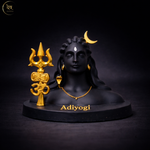
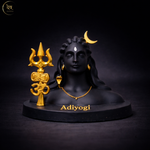
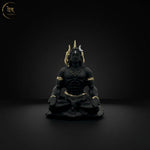
Many families like to keep a murti before them as they remember a katha. In the Shiv collection at Dev Tattva, you will find handcrafted Shiva murtis, such as the seated Shiv murti with trishul in black and gold, which suits a home mandir or a study table. For those who like a larger form, the Adiyogi Shiva idol with trishul is another thoughtful choice, and since this katha ends with Shiva's judgement, a Shiva murti is a fitting companion for it.
Some devotees also keep a small murti on the car dashboard as a reminder to begin a journey with a prayer. Dev Tattva makes many of its murtis in sizes meant for exactly this. A murti does not do the work of devotion for us. It is a gentle sign to pause, remember and bow.

And if you are looking for a gift for someone who loves these old stories, a handcrafted murti paired with the telling of a katha is a gift of meaning, not only of an object. Dev Tattva's idols are made for homes, desks and mandirs where such stories are told.

Frequently Asked Questions
Did Vishnu use the Sudarshan Chakra to kill Jalandhara?
No. In the Shiva Purana telling, Vishnu fought Jalandhara with his sword Nandaka while riding Garuda. The demon was beheaded by Shiva with a discus made from Shiva's own toe. Other Puranic versions may vary, so it is wise to say according to which text or family tradition you are speaking.
Who killed Jalandhara, Shiva or Vishnu?
Shiva ended Jalandhara. It had been foretold that only Shiva could do so. Vishnu's part was to fight him and to break the source of his strength by deceiving Vrinda, but the final blow was Shiva's.
Why did Vishnu deceive Vrinda?
According to the Shiva Purana telling, Parvati urged Vishnu to act after Jalandhara's insult to her, and the plan had Shiva's instruction. Vrinda's unbroken vow was the source of the demon's strength, so the deception was meant to end the war. The tradition does not call it free of cost. Vrinda's curse followed, and the elders read that curse as an echo of the Ramayana.
How is Jalandhara linked to Tulsi?
Jalandhara's wife Vrinda is remembered in some traditions as the one who became Tulsi after her death, and Vishnu is worshipped as Shaligram beside her. This is the background to Tulsi Vivah. Regional tellings differ in detail, so families often follow the version they grew up with.
May the story of Jalandhara and Vrinda remind you that power must bow to dharma and that faithfulness is never forgotten. If you are preparing a mandir, a study table or a gift, you are welcome to explore the handcrafted murtis at Dev Tattva, and may every prayer you offer be calm and sincere. ॐ नमः शिवाय.

About the author
Pandit Om Prakash Saxena
Pandit Om Prakash Saxena is 94 years old and still active. For the last 72 years he has been involved in pooja, paath and all forms of karmakand, and he is associated with Shanti Kunj, Haridwar.
-
Posted in
Jalandhara, Shiva Purana, Sudarshan Chakra, Tulsi, Vishnu, Vrinda