 All Deities
 Gift & Worship
 Best seller
 About Us
 Contact Us
 Blogs
Weapons of Lord Shiva: Trishul, Pinaka and More
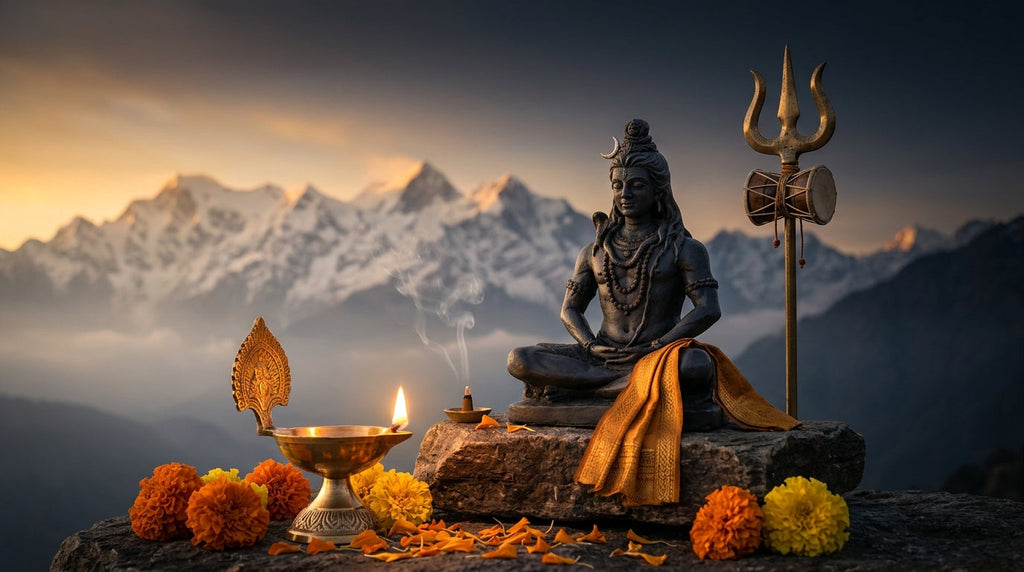
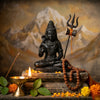
Come, sit close, and picture Mount Kailash in the first light of morning. Snow glows pale gold, the Ganga murmurs in the matted locks of the Lord, and beside the silent yogi a great trident stands upright in the earth, a small drum tied below its prongs.
The weapons of Lord Shiva begin with the trishula, the trident, his chief and best-known weapon. After it the tradition speaks of the Pinaka, his great bow, the Pashupatastra, a celestial missile of terrible power, and the parashu, the axe. The damru drum and the khatvanga staff are also in his hands, though they are carried more as sacred symbols than as arms.
Here at Dev Tattva, families often ask us what each object in Shiva's hands means, so let us walk through the stories one by one, the way the elders told them. Where the tellings differ, I will say so honestly.
The Weapons of Lord Shiva Begin with the Trishula
It is said that no weapon is more closely tied to Mahadeva than the trishula. Its three sharp prongs rise from a long shaft, and in nearly every image and sculpture it is within his reach, often planted upright beside him as he sits in meditation.
How did it come to him? Popular tellings say that Vishwakarma, the divine craftsman, shaped it from the excess radiance of the Sun. You will meet this story in many places, but I will not pin it to a particular Purana, because the sources are not clear. Other traditions simply say that the trident was always his, as much a part of Shiva as the crescent moon on his brow.
The trishula also appears in the katha of Ganesha. In many versions of the story, it is Shiva's trident that falls upon the boy who stands guard at the door, and later the Lord, softened by Parvati's grief, gives the child the face of an elephant. The details change from telling to telling, and that is why I say "in many versions" and nothing firmer.
Notice something in these stories. The trident is never swung about for pride. It appears at moments when a boundary has been crossed, when ego, blind rage or arrogance has to be cut down.

The goddess Durga also carries a trishula in her hands. So the trident is not one deity's property alone; it belongs to the divine power that stands guard over dharma.

The Pinaka Bow: Janaka's Court and Sita's Swayamvara
Now listen to a different scene, in the city of Mithila. King Janaka has announced that his daughter Sita will marry the one who can lift and string the mighty bow of Shiva, kept in his house with great reverence. Princes come from far lands and cannot even move it.
Then the young Rama, travelling with the sage Vishvamitra and his brother Lakshmana, steps forward. The Ramayana tells us that he lifts the bow with ease and bends it, and it breaks with a sound like thunder. The hall falls silent. That is how the swayamvara ends, and how Rama and Sita are joined.
This is the bow that tradition commonly calls the Pinaka, also known as Shiva Dhanush. How it came to rest in Janaka's house is told differently in different places, so I will not choose one version for you. And be careful with the stray modern claim that Rama received the Pinaka from Vishvamitra during his exile. It does not match the story as the tradition tells it.
The origin of the Pinaka itself is also told in more than one way. In one account, Vishwakarma crafted it, and the bones of the sage Dadhichi come into the story. Other accounts give other beginnings. When elders disagree, we honour both and claim neither as the final word.

Tripurantaka: One Arrow Against Three Cities
There is also the story of Tripurantaka, "the ender of the three cities". The asuras, it is said, held three great cities, and the gods turned to Shiva for help.
According to tradition, he took up his bow and loosed a single arrow, and the three cities were destroyed. The tellings add many colourful details, and they vary from text to text, so I leave the Purana unnamed and keep only the beat on which they agree.
What stays with me is that single arrow. Shiva does not fight a long, noisy war. He strikes once, and that is how a wise person deals with a trouble that has grown very large.
The Pashupatastra and Arjuna's Penance
The Pashupatastra is Shiva's most fearsome missile. In the Mahabharata, the great warrior Arjuna knew the war with the Kauravas was coming, and he went to the Himalayas to do tapasya and seek this weapon from Mahadeva himself.
Days passed in hard austerity. Then a wild boar rushed at him from the forest. Arjuna loosed an arrow, and another hunter's arrow struck the beast at the very same moment. A rough forest-dweller, a Kirata, stood there and claimed the kill as his own. They argued, then fought, and Arjuna found that nothing he did could overcome this strange hunter.
At last Arjuna understood that he stood before Shiva. Pleased with the courage and humility of his devotee, the Lord gave him the Pashupatastra.

Here is the part many lists leave out. Tradition says this weapon must never be turned against a lesser foe. The most powerful weapon in the world is meant to stay in its quiver unless the need is truly great. Is that not a teaching in itself? True strength knows what it holds and does not need to prove it.
People also ask whether the Pashupatastra is stronger than the Brahmastra. The elders describe it as among the most terrible of all astras, but such comparisons belong to the poetry of the epics and are not a doctrine to argue over. The tradition also links this weapon with Shiva, Kali and Adi Parashakti in different places.
The Parashu, the Khatvanga and the Sudarshan Chakra Question
The parashu, the battle-axe, is another weapon found in Shiva's hands. Look at old temple sculpture and you will often see it raised in one of his many arms, a sign that he cuts through what binds us.
The khatvanga is a staff topped with a skull, carried by Shiva in some of his fierce forms, and it speaks of his mastery over death and the end of all things. In some temple sculpture you will also see a sword and a noose, each one a different aspect of his power.
One famous form shows these weapons together. Kalantaka, "the one who ends Death", is Shiva who overcomes Yama to save his devotee. In temple iconography he is shown with the trishula, the parashu, a sword and other objects, so you can see them all in a single image of protection.
Many people ask about the Sudarshan Chakra. It is chiefly Lord Vishnu's discus. In one account, Shiva is said to have gifted it to Vishnu, but this is told in more than one way, and for most devotees the chakra simply remains Vishnu's own. It is not usually counted among the weapons of Shiva himself.

What the Weapons of Lord Shiva Symbolise
The elders never read these weapons only as tools of war. Each is a lesson. Take the three prongs of the trishula. Different traditions read them as the three gunas (sattva, rajas and tamas), as past, present and future, or as the three paths of knowledge, action and devotion. None of these readings cancels the others.
The trident held upright shows a mind that has risen above all three. The prongs point to the sky and the shaft stands firm on the earth, so the Lord holds heaven and the world together.
Now the old question: why does Shiva keep the damru together with the trishula? The damru is the drum whose beat is linked, in the tradition of Nataraja, with creation and with sound itself. The trishula stands for dissolution and for the cutting away of what no longer serves. Creation and ending sit side by side in one hand, which is how Shiva sees time, or Kala: not as an enemy, but as a wheel.
The Pinaka and the Pashupatastra teach another thing. Great power in Shiva's hands is always joined to restraint, to penance and to compassion for the devotee. He is Mahadeva, the great god, and also Bholenath, the innocent lord who is easily pleased.
So when you see these symbols on a handcrafted murti, whether it stands in your own mandir or comes from Dev Tattva, read them as a quiet sermon. The weapons are there to teach the heart, not to frighten it.
How Devotees Honour Shiva's Weapons at Home
Many families keep a Shiva murti in the home mandir, on a study table, or on a car dashboard for a quiet moment of remembrance. Traditions vary from family to family and region to region, so follow what your elders do.
When you look at a murti, look at the details with care. A well-made image shows the trishula standing upright, the crescent moon on the brow, and the serpent about the neck. These symbols guide your darshan. As you bow, you remember what each one asks of you: to cut away ego, to keep a steady mind, and to meet time without fear.
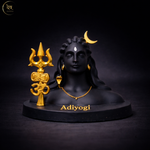
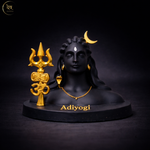
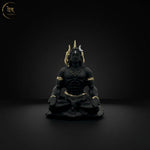
The Shiv collection at Dev Tattva has handcrafted murtis that carry these symbols. On devtattva.com you will find the Adiyogi Shiva idol with trishul in black gold, which shows the Lord in his yogic form, and the sitting Shiv murti with trishul, a compact form for a desk or shelf.

For a car, many families look at the car dashboard murtis from Dev Tattva and choose a form that fits their own bhakti. Whatever you choose, keep the place clean, offer a fresh flower or light a small diya, and chant:
ॐ नमः शिवाय
Om Namah Shivaya
I bow to Shiva.

Frequently Asked Questions
What is Lord Shiva's main weapon?
The trishula, or trident, is regarded as Shiva's main weapon and his most recognised symbol. Its three prongs are read in several ways, including the three gunas and the three paths of knowledge, action and devotion.
What is the name of Shiva's bow?
Shiva's bow is called the Pinaka, also known as Shiva Dhanush. In the Ramayana, Rama breaks it at Sita's swayamvara in Janaka's court. Accounts of how it was made differ between traditions.
What is the Pashupatastra and who received it?
The Pashupatastra is a celestial missile of Shiva. In the Mahabharata, Arjuna receives it after a long penance in the Himalayas, when Shiva appears before him as a Kirata hunter. Tradition says it must never be used against a lesser foe.
Did Shiva give the Sudarshan Chakra to Vishnu?
The Sudarshan Chakra is chiefly Vishnu's discus. One account says Shiva gifted it to him, while other tellings differ. So it is better to see it as Vishnu's weapon, with this one story attached in some traditions.
May Mahadeva's calm and courage stay with your family, and may the symbols in his hands remind you every day to cut away ego and keep your heart steady. When you are ready to bring a murti home, you are most welcome to explore the Shiv murtis at Dev Tattva. Har Har Mahadev.

About the author
Pandit Om Prakash Saxena
Pandit Shri Om Prakash Saxena Ji is a respected and integral member of the Dev Tattva family. At the remarkable age of 94, he continues to remain active, inspiring generations with his profound knowledge, devotion, and lifelong dedication to Sanatan Dharma.
With over 72 years of experience in Puja, Paath, and various traditional Karmakand rituals, he brings decades of spiritual wisdom and practical understanding of Hindu religious traditions. He is also associated with Shanti Kunj, Haridwar, a renowned centre for spiritual learning and practice.
His life is a testament to unwavering faith, selfless service, and the preservation of India's rich spiritual heritage. Through his knowledge and guidance, Pandit Ji continues to uphold the timeless traditions of Sanatan Dharma and share their significance with future generations.