 All Deities
 Gift & Worship
 Best seller
 About Us
 Contact Us
 Blogs
BlogsWhich Divine Weapons Still Guard Our World Today?
The Arsenal of the Gods
In the pre-dawn darkness of Kurukshetra, when the eighteenth day of war has ended and silence finally falls over the blood-soaked earth, Krishna stands alone. In his hand, the Sudarshan Chakra spins slowly, its thousand spokes catching the first light of morning. The weapon that could have ended this war in a single moment had remained sheathed by choice, not weakness.
This is the mystery of divine weapons in our tradition — they are never about destruction alone. They are about the precise application of cosmic law.
When Weapons Become Consciousness
The Vishnu Purana tells us something extraordinary: The weapons of the gods are not separate from the gods themselves — they are extensions of divine consciousness made manifest. This is why Arjuna must fast, meditate, and purify his heart before Shiva grants him the Pashupatastra. The weapon chooses the wielder as much as the wielder seeks the weapon.
I have sat in temples where the priest still performs the daily ritual of shastra puja — the worship of weapons. Not because we glorify violence, but because we understand that every tool of power must be consecrated, every strength must be offered to something greater than the ego that wields it.
In the village of my childhood, the blacksmith would not forge even a simple knife without first offering prayers to Vishvakarma. He understood what we have forgotten — that the act of creating any instrument of power is a sacred responsibility.
The Sudarshan Chakra: The Wheel of Perfect Justice
Watch Krishna's fingers as he summons the Sudarshan Chakra. There is no anger in his gesture, no haste. The weapon appears not as a tool of vengeance but as the physical manifestation of dharma itself — cosmic order taking shape in the material world.
The Bhagavata Purana describes its nature: The Sudarshan Chakra moves faster than thought, sees all directions simultaneously, and strikes only when righteousness demands it. It is not a weapon of war but a wheel of time, cutting through the illusions that bind souls to suffering.
The thousand spokes represent the thousand ways truth can manifest. The central hub represents the unchanging principle around which all change revolves. When Vishnu releases it, he is not attacking an enemy — he is restoring balance to a universe that has tilted toward chaos.
In the great temple at Tirupati, I have seen devotees circumambulate the sanctum exactly 108 times, their feet tracing the same circular path. They are walking the Sudarshan Chakra, becoming the wheel of dharma through their own devotion.
Bring Divine Protection Home
These sacred murtis carry the same protective power that flows through the ancient weapons of the gods


The Trishul: Where Three Worlds Meet
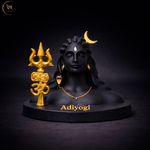
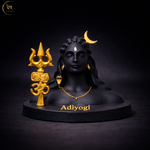
Shiva holds the Trishul not as a weapon but as the axis of existence itself. The three prongs pierce through the three gunas — sattva, rajas, and tamas — the fundamental qualities that weave the fabric of reality. When he raises it, he is not threatening destruction. He is offering liberation from the very forces that bind consciousness to form.
I remember the first time I saw a real Trishul in the hands of a naga sadhu at the Kumbh Mela. The metal was worn smooth by decades of handling, and when he planted it in the earth before beginning his meditation, I understood something that no scripture had taught me directly. The weapon had become a tool of grounding, a way of connecting the infinite consciousness of Shiva to the specific patch of earth where this particular soul was choosing to dissolve his separateness.
The Shiva Purana reveals: The Trishul is the instrument by which Shiva maintains the cosmic dance — creation, preservation, and dissolution spinning in eternal rhythm. Each prong represents not just a function but a mercy. Even destruction, in Shiva's hands, is an act of compassion — the dissolution of forms that have outlived their purpose.
Brahmastra: The Weapon of Ultimate Responsibility
Of all the divine weapons, the Brahmastra carries the heaviest burden. It is not just a weapon of mass destruction — it is the materialization of the creative power of Brahma himself, turned toward the dissolution of what Brahma has created. To invoke it is to take responsibility for unmaking a piece of the universe.
This is why Dronacharya teaches it only to Arjuna and Ashwatthama, and why he binds the teaching with such terrible conditions. The Mahabharata tells us: The Brahmastra can be withdrawn only by one whose heart is pure, whose intention is selfless, and whose understanding encompasses the consequences across all time.
When Ashwatthama releases it in rage after the war, he cannot call it back. His anger has made him unfit to control what he has unleashed. Arjuna, even in the extremity of battle, retains the clarity to withdraw his own Brahmastra when he sees his opponent's inability to do the same. This is the difference between power and wisdom — power acts, wisdom chooses when not to act.
The Gandiva: When the Bow Becomes the Archer
Arjuna's relationship with the Gandiva bow transcends the mechanical. When he draws the string, he is not simply aiming an arrow — he is aligning his individual will with cosmic purpose. The bow was crafted by Brahma himself and carries within its wood and string the accumulated tapas of countless sages.
Watch Arjuna's hands in the moment before he releases the arrow that will kill Karna. There is no trembling, no hesitation, but also no eagerness. The Gandiva has taught him that the highest skill is not in hitting the target but in becoming so transparent to dharma that the arrow finds its mark through divine will rather than personal effort.
The Vana Parva describes this state: When the archer, the bow, the arrow, and the target become one, there is no action — only the natural flow of cosmic order expressing itself through form. This is why Arjuna can kill his beloved teacher Drona and his noble brother Karna without accumulating the karma of murder. He has become the instrument through which justice acts, not the agent who chooses to kill.
Hanuman's Gada: Strength in Service
The mace in Hanuman's hands carries a different energy than any other divine weapon. It is not forged by gods or granted through penance — it is the spontaneous manifestation of devotion itself taking physical form. When Hanuman lifts it, he is not preparing for battle. He is expressing the soul's natural response to any force that would separate it from its beloved.
I have watched village wrestlers touch their gada to their forehead before beginning practice, the same gesture Hanuman makes before leaping across the ocean to Lanka. They understand intuitively what the Hanuman Chalisa teaches: Strength without devotion becomes ego, but devotion without strength cannot serve.
The weight of Hanuman's mace is not measured in physical pounds but in the accumulated force of every prayer ever offered by a devotee in distress. When he swings it against the demons of Lanka, he is not fighting Ravana's army — he is wielding the collective faith of every soul that has ever called out for protection.
The Vel of Murugan: Piercing Through Illusion
In the temples of Tamil Nadu, the Vel — Murugan's divine spear — is worshipped as a deity in its own right. This is not idol worship but recognition of a profound truth: the weapon that destroys ignorance is itself a form of knowledge, deserving of the same reverence we offer to the god who wields it.
The Skanda Purana reveals the Vel's true nature: It is forged from the light of Parvati's third eye and carries within its point the concentrated power of divine wisdom. When Murugan hurls it at the demon Surapadman, he is not killing an external enemy but piercing through the veil of maya that makes the soul forget its divine nature.
The six faces of Murugan see in all directions simultaneously, but the Vel moves in only one direction — straight toward the heart of whatever illusion is causing suffering. This is the precision of divine grace: it never misses its target, and its target is always the liberation of consciousness from its self-imposed limitations.
Living Weapons in a Modern World
These weapons have not disappeared. They have transformed. Every time a mother's fierce love protects her child from harm, the Trishul of Durga is present. Every time a teacher's wisdom cuts through a student's confusion, the sword of Saraswati is at work. Every time justice prevails over corruption, the Sudarshan Chakra continues its eternal rotation.
In the small temple near my home, the priest still performs the evening arati with the same brass lamp his grandfather used. The flame dances in the same pattern, casting the same shadows on the same stone walls. This continuity is itself a divine weapon — the power of tradition to carry sacred truth across the centuries without dilution.
The weapons of our gods are not museum pieces or mythological curiosities. They are living principles, active forces, available to any consciousness pure enough to recognize them and humble enough to serve the purposes for which they were created.
When you next see a child learning to write, watch how carefully they hold their pencil. In that small hand gripping that simple tool, the same relationship exists that connects Arjuna to his Gandiva — the sacred responsibility of wielding any instrument of power with reverence, precision, and dedication to something greater than the self that holds it.