 All Deities
 Gift & Worship
 Best seller
 About Us
 Contact Us
 Blogs
Vishnu the Destroyer? The Katha Behind the Question
Sit close, children, and let me begin with a small correction, given with love. In the common scheme of the Trimurti, Brahma creates, Vishnu preserves and Shiva destroys. So "Vishnu the destroyer" is not the usual picture, yet the question is an old and honest one.
The short answer is this. Vishnu is the preserver, and he destroys only what threatens dharma, such as a tyrant or an age of adharma. Vaishnava tradition goes a step further and teaches that the one Vishnu also draws the whole universe back into himself at the end of a cycle. That is dissolution, not cruelty.
It is a question many families ask when they set up a mandir at home and see Vishnu in one corner and Shiva in another. Let me tell you the katha, and the answer will come by itself. You may also like to look at Dev Tattva afterwards, where handcrafted murtis are made for just such home mandirs.
The Katha of Narasimha: When Vishnu Became Fierce
It is said that there lived an asura king named Hiranyakashipu, whose brother Hiranyaksha had been slain by Vishnu in his boar form, Varaha. Grief turned into hatred. The king went into long and terrible austerities, until Brahma himself appeared and offered him a boon.
Hiranyakashipu was clever. He asked that he should not die by man or animal, neither inside a house nor outside it, neither by day nor by night, neither on the earth nor in the sky, and by no weapon. He thought he had closed every door that death could use. From that day he ruled like a god, and he forbade anyone in his kingdom to speak the name of Vishnu.

But in his own palace a child was growing up with that very name on his lips. The boy was Prahlada, the king's son, and he loved Narayana the way a little one loves the lap of his mother. The tradition tells us that the father tried to frighten, punish and persuade him, and the boy only grew calmer.
Then came the day of the great assembly. The king, red with anger, asked his son where this Vishnu of his lived. Prahlada answered gently that Vishnu is everywhere. Mocking him, the king pointed at a mighty pillar of the hall and asked if Vishnu was in that too, and struck it with his fist.
Listen to what happened next. The pillar split with a roar, and out of it came a form that was neither man nor beast: Narasimha, with the body of a man and the face and claws of a lion. It was the hour of twilight, which is neither day nor night. Narasimha carried the king to the threshold of the hall, neither inside nor outside, and laid him across his thighs, neither earth nor sky. With his claws, which are no weapon of any smith, he ended the tyrant.
Every condition of the boon was honoured, and yet the boon was defeated. That is the quiet lesson of the katha. In many tellings the devas dared not come near the blazing form, and it was the child Prahlada who walked forward in love, and the fury grew still. Here Vishnu destroys, but he does it to protect a devotee, and he does it without breaking his word to Brahma.
Think about what the story is really saying. A man who believed he had made himself untouchable met the one power that no clever bargain can close out. Pride built a fortress, and faith in a child's heart outlasted it.
Kalki and the End of the Age
The second form that people name when they say "destroyer" is Kalki, the avatar that tradition says is yet to come. The elders tell us that when the age of Kali has grown dark, with truth forgotten and power in the hands of the unjust, Vishnu will appear to restore dharma. In popular tellings and in hymns to the ten avatars, he is pictured with a blazing sword, bright as a comet, and riding a white horse.
Here I must be careful, because the sources do not agree on every detail. Where he will be born, the name of his horse, his teachers and the exact shape of his battles are told differently in different texts and in different regions. What they share is the meaning: a long night of adharma ends, and a new age of truth begins.
Notice that even Kalki is not a destroyer of creation. He is a physician of the age, so to speak, cutting out only what has turned rotten. And the scriptures speak of spans of time so vast that no family need lose sleep over it. They ask us to live well today.

What Krishna Meant by "I Am Time"
Many people reach this topic through a famous line about a "destroyer of worlds", which popular culture later borrowed in the modern age. The source is the Bhagavad Gita, where Krishna, whom the tradition reveres as an avatar of Vishnu, shows Arjuna his vishvarupa, his universal form, on the field of Kurukshetra. Arjuna sees all beings rushing into those fiery mouths, and he trembles and asks who this is.
The answer is in Bhagavad Gita 11.32:
कालोऽस्मि लोकक्षयकृत्प्रवृद्धो लोकान्समाहर्तुमिह प्रवृत्तः
Kālo'smi lokakṣayakṛt pravṛddho lokān samāhartum iha pravṛttaḥ
"I am Time, the mighty destroyer of the worlds, engaged here in withdrawing them."
Read it slowly. Krishna does not say, "I am a cruel being who enjoys ruin." He says he is Kala, Time itself, which carries every birth to its end. Armies, kings and kingdoms all pass, because that is the nature of time. The verse is meant to teach Arjuna that he is only an instrument, and to lift his eyes from his fear toward duty and surrender.
Why "Vishnu the Destroyer" Really Means Dissolution
Now we can return to the Trimurti. Brahma, Vishnu and Shiva are three faces of one divine work: making, holding and withdrawing. In the popular scheme, withdrawing belongs to Shiva, and his dance and his fire are seen as a clearing of the ground so that something new may rise.
The Vaishnava traditions see the same work in a different light. They hold Vishnu to be the one supreme being who creates, sustains and dissolves the universe. The Vishnu Purana, as it is commonly summarised, has the goddess Earth praise him as creator, preserver and destroyer, and says he takes the forms of Brahma, Vishnu and Rudra for these tasks. In popular tellings, between one creation and the next, he rests on the serpent Shesha upon the still cosmic waters.
The Shaiva traditions place Shiva at that highest seat, and the Shakta traditions the Devi. This is why wise elders do not quarrel over "who is more powerful." Different families have loved the One through different doors, and the scriptures of each speak of their own beloved in the highest terms.

So why does the word "destroyer" mislead? The Sanskrit idea is pralaya, a dissolving, like salt in water or a river entering the sea. It is rest and renewal, not rage. Even when Vishnu takes up a fierce form like Narasimha, the target is always adharma, and the purpose is always to protect and to restore.
The Symbols in Vishnu's Hands
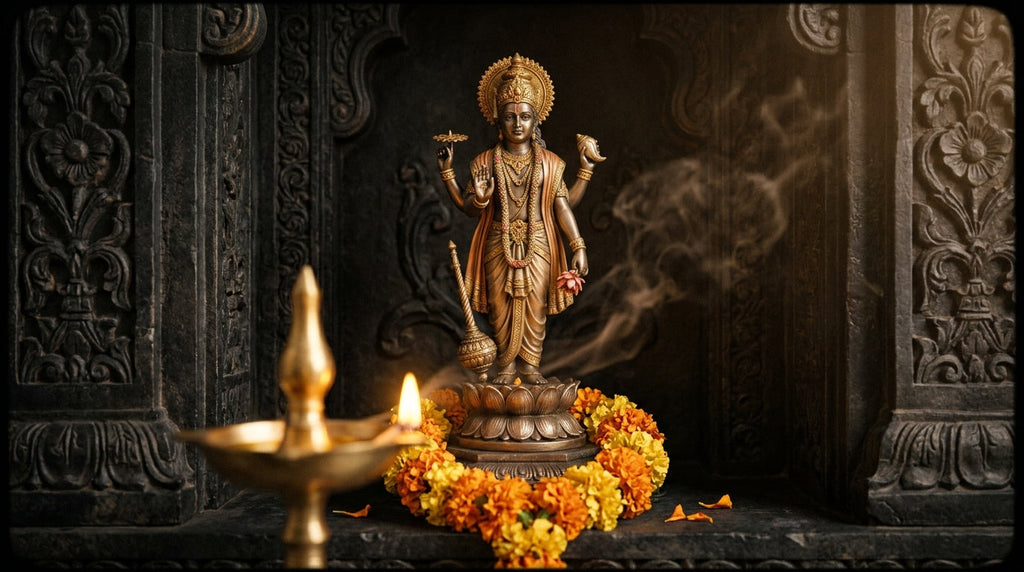
Look at a murti of Vishnu and you will see four hands, each carrying a meaning. In the upper hand is the Sudarshana chakra, the discus, which many read as the wheel of time and of dharma, turning without rest and cutting through falsehood. In another hand is the gada, the mace, named Kaumodaki in the tradition, a sign of strength in service of order.
The conch is Panchajanya, whose sound is said to announce dharma and to call the faithful. The lotus, padma, stands for purity and for a life that is in the world and yet untouched by its mud. Together they show a god who holds power and gentleness in the same four hands.

Notice also how Vishnu is usually shown. His face is calm, his posture is steady, and a smile rests on his lips. Even the weapons in his hands are held as tools of protection. The fierce forms like Narasimha are the exception, taken up for a moment of need, and then the calm returns.
This is a good thing to remember whenever you look at any murti, whether it comes from a temple workshop or from Dev Tattva. The image is not there to frighten us. It is there to turn the mind toward steadiness.
Which Form of Vishnu Do Devotees Keep at Home?
Families ask this a great deal, and the answer depends on the heart and on family custom. A serene, standing Vishnu, or the pair of Lakshmi and Narayana, is the form most often kept in a home mandir, because it brings a feeling of calm and steadiness. Narasimha is loved as a guardian form, and many devotees pray to him in times of fear or difficulty, but some households prefer to keep him in a temple rather than at home. Customs vary by region and by sampradaya, and there is no single rule.
Dev Tattva makes handcrafted murtis for home mandirs, desks and car dashboards, and its present collection speaks to this very family of stories. Ram is revered in tradition as an avatar of Vishnu, and you can find the peaceful Ram Lalla face idol there. So is Hanuman, whose idol with Ram in his heart shows devotion to Vishnu's avatar in its purest form. Since Shiva is the one most often named as the destroyer, those who wish to keep both faces of the divine will find a Shiv collection as well.

A gentle word on placement. Whichever form you choose, keep the murti clean, on a firm and level seat, a little above the floor, and never somewhere it may be knocked about or treated carelessly. If you wish to place one on a dashboard, see the car dashboard collection at Dev Tattva, and use a stable base so the murti stays secure. For a desk or a gift, simplicity is best: a small diya, a flower, and a quiet moment of thanks.

The simplest daily worship of Vishnu is the mantra:
ॐ नमो नारायणाय
Om Namo Narayanaya
"I bow to Narayana."
Offer a tulsi leaf if you have one, light a lamp, and say it with a quiet mind. No elaborate ritual is needed, only love. Dev Tattva's murtis are meant to be companions for this kind of simple, daily remembrance.

Frequently Asked Questions
Is Vishnu the destroyer or the preserver?
In the common Trimurti scheme, Vishnu is the preserver and Shiva is the destroyer. The Vaishnava traditions teach that Vishnu himself performs all three tasks of creation, preservation and dissolution. In both views, whatever Vishnu destroys is adharma, not the world.
Which avatar of Vishnu is the destroyer?
People usually name Narasimha, who ended the tyrant Hiranyakashipu, and Kalki, the avatar of the future who is to end the age of adharma. Others point to Krishna's words as Time in the Gita. All of these are Vishnu acting to restore dharma, and none of them is a separate god.
Did Krishna say he is the destroyer of worlds?
Yes, in a manner of speaking. In Bhagavad Gita 11.32, he reveals himself to Arjuna as Kala, Time, the great force that withdraws the worlds. It is a teaching about time and duty, not a declaration of cruelty.
Who is more powerful, Vishnu or Shiva?
Tradition does not give one answer. Vaishnavas see Vishnu as the Supreme, Shaivas see Shiva, and many families worship both with equal devotion, perhaps with a Ram and a Shiva murti from Dev Tattva sitting side by side. The elders would say that the question itself matters less than the love with which we bow.
May Narayana's calm and Shiva's strength both rest in your home, and may every story you hear leave your heart a little lighter. When you are ready to bring a murti into your mandir, you are welcome to visit Dev Tattva's temple collection and choose one with a quiet heart. Jai Shri Hari, and Har Har Mahadev.

About the author
Pandit Om Prakash Saxena
Pandit Om Prakash Saxena is 94 years old and still active. For the last 72 years he has been involved in pooja, paath and all forms of karmakand, and he is associated with Shanti Kunj, Haridwar.