 All Deities
 Gift & Worship
 Best seller
 About Us
 Contact Us
 Blogs
Senjata Dewa Ganesha: What Ganesha Holds and Why
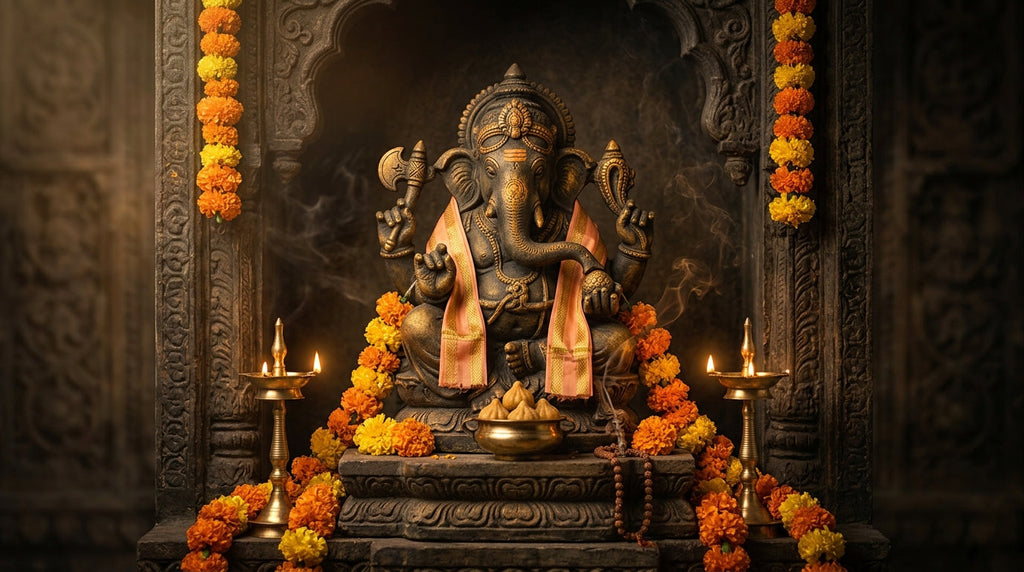
It is said that whenever a family gathers before a murti of Ganpati, some child looks up and asks the question every elder has heard: why does the god of wisdom hold an axe in his hand?
The short answer is this. The senjata (weapons) of Dewa Ganesha are classically the pasha (noose), the ankusha (elephant goad) and the parashu (axe). In Java and Bali, the four-armed Ganesha is usually described with an axe, a rosary, a bowl of modak sweets and his broken tusk. None of these is meant for war. They are tools for cutting ego, holding back the restless mind and guiding the seeker.
Come, let us first hear the katha behind the axe and the broken tusk, and then open each object one by one. Whether you meet Ganesha in a temple, in a museum, or in a handcrafted murti from Dev Tattva, you will begin to see his hands in a new way.
The Katha of the Axe: When Parashurama Came to Kailash
Listen to how the story goes. High in the Himalayas, on Mount Kailash, the air is thin and the snow keeps a silence older than memory. Lord Shiva, so the tellings say, was resting in deep stillness within his abode, and at the door stood his young son Ganesha, keeping watch.
Then came a visitor with a long road behind him. Parashurama, the warrior-sage and a great devotee of Shiva, had climbed the mountain to bow before his teacher. In the tradition, his fearsome axe is remembered as a gift from Shiva himself.
Ganesha did not let him pass. He was guarding his father's rest, and he held his ground. Parashurama, used to being obeyed, grew heated. Soon it was no longer a simple request but a contest, the sage with his blazing temper on one side and the boy with the calm of the mountain on the other.

At last, according to popular tellings, Parashurama hurled the axe. Ganesha knew that weapon. It was his own father's gift, and to turn it aside would have felt like refusing Shiva's blessing. So he let it come, and it struck his tusk, and the tusk fell to the ground.
A hush fell over Kailash. Parashurama, seeing what his pride had done, stood stricken. The tellings differ on what came after, and they differ from region to region and family to family. In many, the axe remains with Ganesha, which is why you see it in his hand.
Notice what the story leaves us with. The very axe that cost him his tusk became one of his own implements. What once wounded him, he carries without bitterness.
The Tusk That Became a Pen
There is a second story about the same tusk, and the tradition keeps both side by side. In popular tellings, the sage Vyasa had the great epic Mahabharata shaped in his mind and needed a scribe who could keep pace with him. He turned to Ganesha.
Ganesha agreed on one condition: once the writing began, the pen must never stop. Vyasa accepted, and set a condition of his own. Ganesha must understand every verse before he wrote it down. So, the story goes, whenever Vyasa needed a moment to compose, he gave a verse so knotty that Ganesha paused to ponder its meaning.
Then, in the telling, Ganesha's writing instrument broke. Rather than let the work halt, he broke off his own tusk and went on writing with it. The tusk became a pen, and the epic flowed on without a pause.
Two stories, one tusk. In the first it is given up out of respect for a father's gift, in the second for the sake of sacred knowledge. Both carry the same lesson: Ganesha gives up what is his own for something greater than himself.

Senjata Dewa Ganesha: The Classical List of What He Holds
In the dhyana (meditation) verses and in temple iconography, three implements are placed in Ganesha's hands again and again: the noose, the goad and the axe. Other objects appear beside them in different forms. Because descriptions vary from lineage to lineage and region to region, think of this list as a common core and not one fixed rule.
- Pasha (पाश), the noose: a rope with a loop, which restrains and draws close.
- Ankusha (अंकुश), the goad: the hooked rod a mahout uses to guide an elephant.
- Parashu (परशु), the axe: the blade that cuts through what binds.
- Modak (मोदक), the sweet: the dumpling he is said to love, often held in a bowl or in the trunk.
- Danta (दंत), the broken tusk: held in one hand, like a pen.
- Padma or akshamala, the lotus or rosary: seen in some forms alongside or in place of another object.
A four-armed Ganesha holds four of these, and the choice depends on the form being shown. Many forms have more arms. Some tantric forms, such as Uchchhishta Ganapati, are described in certain texts with a bow and arrow along with the noose and goad, and other descriptions add a mace or a discus. The list changes with the form (swaroop) of Ganesha being worshipped, and that is no contradiction.

Why Does a God of Wisdom Carry Weapons?
Here is the heart of the puzzle. The English word "weapon" and the Indonesian senjata both carry a picture of fighting. Ganesha is not a fighting god in that sense. In Hindu tradition the objects in a deity's hands are called ayudha, and each one is a symbol first and an instrument second.
Think of a mahout leading an elephant down a village lane. The goad does not hurt the great animal. It steers him. The rope keeps him from wandering where he should not. Ganesha wears the head of an elephant, and many teachers read this as a hint that he is the master of that strongest and most wandering of creatures, the mind.
So the ankusha guides the mind toward the right path, and the pasha holds it back from what drags it down. Traditions read the noose in more than one way. Some see it as the bond of attachment that Ganesha loosens. Others see it as the cord with which he draws the devotee close to himself. Both readings are loved by devotees.
This is why a peaceful god may hold such implements without any contradiction. They are tools of discipline, not of conquest.
The Axe, the Rosary and the Sweet: Reading Each Hand
The axe. The parashu cuts. Elders explain that it cuts obstacles, and also the quieter ropes of attachment and ego that we tie around ourselves. Remember the katha: Ganesha honoured the axe even when it cost him his tusk. An axe held in humility is a very different thing from an axe raised in anger.
The rosary. The string of beads speaks of japa, steady repetition and remembrance. It is read as the lesson that learning is never finished. The scribe of the Mahabharata who holds a rosary is telling us that knowledge and devotion walk together.
The bowl of modak. Modak is a sweet dumpling, and Ganesha is lovingly called its devotee. Tradition reads the sweet as the reward that waits at the end of sincere effort, the inner joy that comes from understanding. A bowl of it in his hand is an image of sweetness for the one who keeps going, not a guarantee of any outcome.
The broken tusk. One tusk whole, one broken: Ganesha is Ekadanta, the one-tusked. Whether we remember the meeting with Parashurama or the writing of the epic, the broken tusk speaks of sacrifice. It also reminds us that the divine is not measured by the world's idea of a perfect form.

Senjata Dewa Ganesha in Java and Bali
Indonesia has loved Ganesha for a very long time. Carved in stone and cast in bronze, his images stand in museums and temples across Java and Bali, and he is honoured there as a remover of obstacles and a patron of learning. The four-armed statue is commonly described as holding an axe, a rosary, a bowl of modak and the broken tusk.

You may notice that this list is not the same as the classical Indian one of noose, goad and axe. These are two ways of describing the same god, not two errors. Each tradition chose which symbols to show in the hands, and the axe appears in both. Readers who mix the two lists into one long list often end up confused, so keep a simple rule in mind: noose and goad point to one style of description, while rosary and sweet bowl point to the other.
When you look at any murti, count the hands and see what each holds. It is a quiet way of reading the story the artist chose to tell.
The Mouse, the Serpent and Other Companions
Beyond the hands, Ganesha's whole form teaches. His mount is the tiny mouse, Mushika, and a god so great riding so small a creature has always charmed devotees. Many teachers read the mouse as the restless, nibbling mind, carried and mastered by Ganesha.
A serpent often appears around his belly or as his sacred thread, and his large belly is said to hold the joys and sorrows of the world with patience. These are traditional readings, and families receive them in their own ways.
Honouring Ganesha at Home, on the Desk and on the Dashboard
How does one honour Ganesha simply? Keep his murti clean, offer a fresh flower or a little durva grass, light a small lamp, and place a sweet before him. Then say the mantra that every Hindu child learns:
ॐ गं गणपतये नमः
Om Gam Ganapataye Namaha
I bow to Lord Ganesha, the remover of obstacles.
Many families also recite a well-loved prayer before any new beginning:
वक्रतुण्ड महाकाय सूर्यकोटि समप्रभ।
निर्विघ्नं कुरु मे देव सर्वकार्येषु सर्वदा॥
Vakratunda Mahakaya Surya-koti Sama-prabha, Nirvighnam Kuru Me Deva Sarva-karyeshu Sarvada.
O curved-trunked, mighty-bodied one, of the brilliance of a million suns, make my undertakings free of obstacles, always.

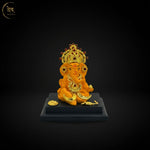
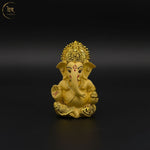
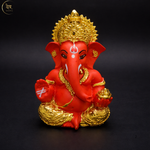
If you are choosing a murti, look at the hands as you now know how to read them. See whether the axe, the sweet and the tusk are clearly shaped, and whether the face is calm. Handcrafted work shows in these small details. At Dev Tattva, the Ganesh collection brings together murtis for the home mandir, and a piece like the Gold Plated Crown Ganesha Idol with Base suits a quiet shelf or altar corner.
Some families like to keep a small Ganesha where the day begins and where journeys begin. Dev Tattva offers compact murtis in its car dashboard collection for travellers who start every drive with a prayer. A student may prefer one on the study table, where the rosary's lesson of steady learning is easy to remember.
Place him in a clean, raised spot, never on the floor, and let the family decide the ritual that suits them. Traditions vary by region and household, and what matters is sincerity.

Frequently Asked Questions
What are the senjata (weapons) of Dewa Ganesha?
Classically they are the pasha (noose), ankusha (goad) and parashu (axe). In Java and Bali the statue is commonly described with an axe, rosary, modak bowl and broken tusk. Rarer forms add a bow, arrow, mace, discus or lotus. They are symbols of inner discipline, not tools of war.
What does the axe in Ganesha's hand mean?
The axe stands for cutting through obstacles and through attachment and ego. In popular tellings, Ganesha let the axe of Parashurama strike him out of respect, because it was Shiva's gift. Tellings differ on how it came to rest in his hand, and families receive the story in their own ways.
Why does Ganesha have a broken tusk?
Tradition tells two stories. In one, the tusk broke when Ganesha honoured the axe thrown by Parashurama at Kailash. In the other, Ganesha broke it himself to keep writing the Mahabharata for Vyasa. Both speak of sacrifice for something greater.
Which Ganesha murti is suitable for home or car?
Any form is welcome as long as it is made and kept with respect. For the home mandir, a seated murti on a base is common, while a smaller one suits a dashboard or desk. Dev Tattva makes handcrafted Ganesha murtis in several sizes, so you can choose the one that feels right to your family.
May Ganapati, who holds the rope, the goad and the axe with such gentleness, guide your mind and clear your path in everything you begin. When you are ready to welcome him into your home, you will find his murtis at Dev Tattva. Ganpati Bappa Morya.

About the author
Pandit Om Prakash Saxena
Pandit Om Prakash Saxena is 94 years old and still active. For the last 72 years he has been involved in pooja, paath and all forms of karmakand, and he is associated with Shanti Kunj, Haridwar.