 All Deities
 Gift & Worship
 Best seller
 About Us
 Contact Us
 Blogs
Sudarshan Chakra and Shumbha Nishumbha: The Truth
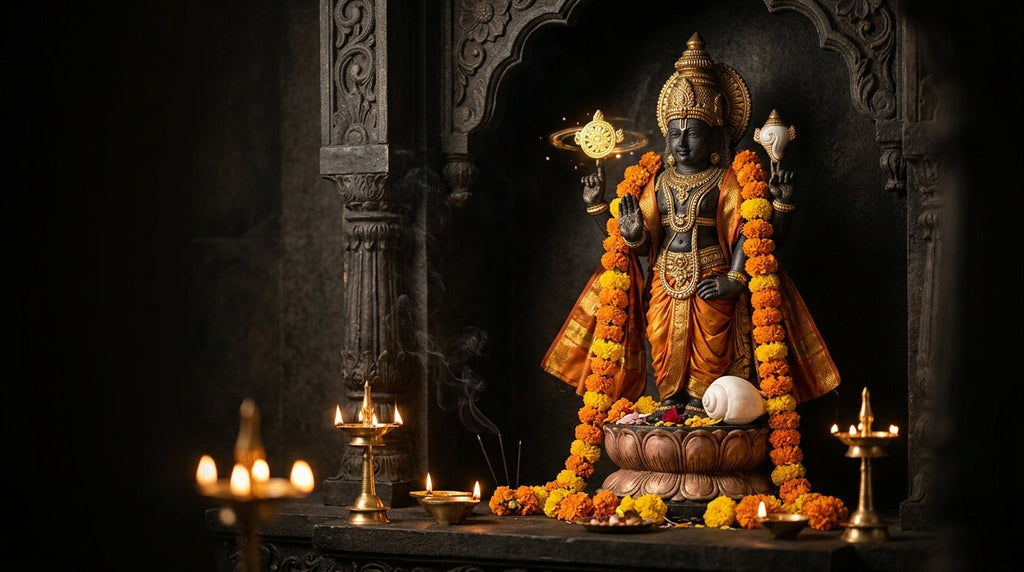
Come, sit close, and let me untangle a knot that many families carry. People often ask whether Vishnu's Sudarshan Chakra was the weapon that destroyed the asura brothers Shumbha and Nishumbha. As the Devi Mahatmya tells it, the Goddess herself, called Ambika, Kaushiki or Chandika, slew them, and the Sudarshan Chakra is not the weapon that ended them.
Yet the question is not foolish, because Vishnu's chakra does stand near this story in a quieter way. To see how, we must hear two kathas: the war of the Goddess and the gift of the disc. Many devotees come to Dev Tattva looking for a murti and a story together, so let us make the answer clear and complete.
The Katha of Shumbha and Nishumbha: Who Truly Defeated Them
It is said that there lived two brothers, Shumbha and Nishumbha, mighty among the asuras. They performed fierce tapasya, and in the popular tellings Brahma granted them a boon that made them almost impossible to defeat. The exact wording of the boon differs from telling to telling, and some versions say that only a woman could bring them down.
Armed with that strength, the brothers marched on the three worlds. They took the throne of Indra, seized the share of the yajnas, and drove the devas from heaven. Imagine the gods, once radiant, now wandering like beggars through forest and hill.
In their despair they remembered the Goddess. They went to the slopes of the Himalayas and sang her praises. The verse that every Navratri devotee knows comes from the Devi Mahatmya, which is part of the Markandeya Purana.
या देवी सर्वभूतेषु शक्तिरूपेण संस्थिता।
नमस्तस्यै नमस्तस्यै नमस्तस्यै नमो नमः॥
Ya Devi sarvabhuteshu shakti-rupena samsthita, namastasyai namastasyai namastasyai namo namah.
To the Goddess who dwells in all beings in the form of power, I bow to her again and again.
According to the tradition, Parvati came to the river to bathe, and from her own body a radiant goddess appeared. She is known as Kaushiki, or Ambika. Her beauty and calm stood on the mountain like a lamp in a dark room.
Chanda and Munda, the servants of the brothers, saw her and ran to carry the news to Shumbha. The king sent messengers and proposals, and each time the Goddess answered with calm firmness. She would meet them only in battle. So the asura armies came, and the mountain shook with their drums.

Chamunda, Raktabija and the Final Duel
When Chanda and Munda charged at her, the Goddess grew dark with anger. From her brow came Kali, fierce and wild-haired, who struck down the two commanders. Because she brought their heads to Ambika, she is praised as Chamunda. It is one of the best loved moments of the whole story.
Then came Raktabija, the demon whose every fallen drop of blood became another warrior as strong as himself. The battlefield filled with copies of him. Kali opened her mouth wide and drank the blood before it touched the ground, and the cycle broke. The tellings agree on this, and it is why Kali stands so terrible and so necessary in this tale.
Nishumbha fell, and Shumbha, alone and furious, faced the Goddess. He taunted her, saying that she fought only with the strength of others. The Goddess answered that all those powers were her own forms. As the tradition describes it, the goddesses who stood beside her merged into her, and she stood alone before him.
The last duel was long and loud, with weapons flashing across the sky. In the end the Goddess struck Shumbha down, and the heavens became calm again. The devas returned to their homes, and flowers rained on the mountain.
Notice that nowhere in this telling does Vishnu step forward to hurl his disc. The victory belongs to Devi, so that even the gods may learn that their own power rests upon hers.
Where the Sudarshan Chakra Does Touch the Devi's Story
So why do people join Vishnu's chakra to this war? There are two understandable reasons.
The first is the earlier episode of Mahishasura, also in the Devi Mahatmya. There the radiance of the gods gathers into the form of the Goddess, and each deity gives her a weapon. Shiva's gift is a trident, and Vishnu's gift is described as a chakra. Some descriptions of Kaushiki also list a Sudarshana disc among her weapons. A devotee who sees such a picture and then hears of Shumbha and Nishumbha can easily knit the two tales into one.
The second reason is the Matrikas, the divine mothers. In the war against the brothers, the shaktis of the gods come to fight beside the Goddess, and Vaishnavi is the shakti of Vishnu. In temple pictures and popular retellings she is often shown with a disc in her hand. So the chakra is present in spirit, carried by his power, and not hurled by Vishnu himself.
The simplest way to hold both truths is this. Vishnu's power stands with the Goddess, but the Goddess herself is the one who ends Shumbha and Nishumbha.

How Vishnu Received the Sudarshan Chakra: Four Tellings
The word Sudarshana means auspicious vision, or a good sight. The disc is described with 108 serrated edges, and it is shown spinning on the forefinger of Vishnu's raised hand, not held tight in a fist. Now listen, for tradition does not tell one single story of how he came to have it. The tellings differ, and a wise elder tells them side by side.
- The gift of Shiva. In some Shaiva traditions, Vishnu worshipped Shiva with a thousand lotuses. When one lotus was missing, he offered his own eye, which is why he is called Kamalanayana, the lotus-eyed one. Pleased, Shiva gave him the chakra. Which Purana carries this story varies among tellings, so I will not name one.
- The work of Vishwakarma. In another telling, the divine craftsman Vishwakarma shaped the disc from the radiance of the Sun. The source text for this is not firmly fixed.
- The gift of Agni. The Mahabharata tells of the burning of the Khandava forest, where Agni gave Krishna the chakra and gave Arjuna the Gandiva bow. Here the chakra comes to Vishnu in his form as Krishna.
- The wheel of time. Behind all these stories lies an older Vedic picture of Vishnu's wheel, which devotees read as the turning of time itself.
None of these contradicts the others for a devotee, because each speaks of the same truth. The chakra is a gift of grace, and it is also the very nature of the Lord. Different families remember different doors into that truth, so please do not argue that one telling alone is correct. Say, as the elders do, that traditions vary by region and family.

What Vishnu's Chakra and Shumbha Nishumbha Teach Us
The chakra spins on a finger, not in a closed fist, and this is no small detail. Power that is clutched becomes pride, and power that turns lightly stays in the service of dharma. The disc is also a picture of time, which keeps turning and brings every proud kingdom to its end.
Its name, auspicious vision, hints at something more. The chakra is said to cut through what is false and leave what is clear. Seen this way, it is as much a weapon against delusion as against enemies.
Now think of the two brothers. Shumbha and Nishumbha are often read as voices inside us. One is the proud claim, "I did this, and it is all mine." The other is the quiet doubt, "I cannot do this, and neither can anyone else." Several teachers read them in this inner way, as ego and doubt. They conquer the heavens of the mind, and only the awakened power within, the Goddess, can bring them down.
The story also warns us about boons. Brahma's blessing made the brothers strong, but they used it to take what was not theirs. Strength without humility invites its own undoing. And when the gods themselves were helpless, they did not turn to pride but to prayer.
There is a gentle lesson in how Devi and Vishnu relate. In many traditions the power of Vishnu lives in the Goddess, and the Goddess in turn is the power behind every deity. So the divine does not compete with itself. The weapons of the gods are different hands of one shakti.

Honouring the Sudarshan Chakra and the Goddess Today
How does a family bring all this into daily life? Very simply. Light a diya at the home mandir, offer a fresh flower, and sit quietly for a few moments. A devotee of Vishnu may chant:
ॐ नमो नारायणाय
Om Namo Narayanaya
I bow to Lord Narayana.
A devotee of the Goddess may chant the verse of the Devi Mahatmya given above, especially in Navratri, when she is worshipped for nine nights. Festival dates change every year, so please check a trusted panchang for them.
Another occasion is Vaikuntha Chaturdashi, when Shiva and Vishnu are honoured together, and it recalls the story of the lotus offering. Families who follow that tradition also remember the Sudarshan Chakra on that day, though customs differ from place to place.
On the question of idols, a murti is a point of focus, not a magic charm. Keep it in a clean, quiet corner of the home, and follow whatever direction your family has always followed. Devotees who visit Dev Tattva will find handcrafted murtis made to sit with dignity in a mandir, on a study desk or on a dashboard. The temple collection is a good place to begin for the home shrine.
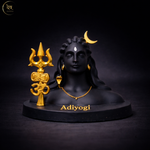
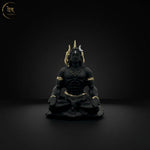
I will be plain with you: Dev Tattva does not at present carry a Vishnu murti. But since this katha also honours Shiva, who gave the chakra in one telling, many families keep a figure like the Shiv murti in black and gold near their prayer space. Those who travel often can look at the car dashboard collection, where small idols remind the driver to fold his hands before a journey.


Frequently Asked Questions
Did Vishnu's Sudarshan Chakra kill Shumbha and Nishumbha?
No. In the Devi Mahatmya, the Goddess, called Ambika, Kaushiki or Chandika, kills both brothers. The Sudarshan Chakra belongs to a different set of stories, though a disc from Vishnu is described among the Goddess's weapons in the Mahishasura episode.
Who killed Shumbha and Nishumbha?
The Goddess did. According to the tradition, Kali dealt with Chanda, Munda and Raktabija, and then Nishumbha and Shumbha fell to the Goddess. The other goddesses who fought beside her are described as her own powers.
Who gave Vishnu the Sudarshan Chakra?
Traditions differ. Some say Shiva gave it after Vishnu's lotus and eye offering, some say Vishwakarma shaped it from the Sun's brilliance, and the Mahabharata tells of Agni giving it to Krishna at Khandava. Each family honours the telling it has received.
Can I keep a Vishnu idol at home or on a car dashboard?
Yes, as a symbol of devotion, kept clean and treated with respect, and many families do so. Customs vary, so follow your own family tradition. For a dashboard, the car dashboard collection at Dev Tattva shows the idols that are available.
May the vision of Lord Vishnu keep your mind clear, and may the Goddess keep your family in her care. If you wish to bring a murti home for a loved one, Dev Tattva's gifting collection is a gentle place to look. Jai Mata Di, and Om Namo Narayanaya.

About the author
Pandit Om Prakash Saxena
Pandit Om Prakash Saxena is 94 years old and still active. For the last 72 years he has been involved in pooja, paath and all forms of karmakand, and he is associated with Shanti Kunj, Haridwar.
-
Posted in
Devi Mahatmya, Hindu mythology, Navratri, Shumbha Nishumbha, Sudarshan Chakra, Vishnu