 All Deities
 Gift & Worship
 Best seller
 About Us
 Contact Us
 Blogs
Tirupati Balaji Story: Why Vishnu Came to Tirumala
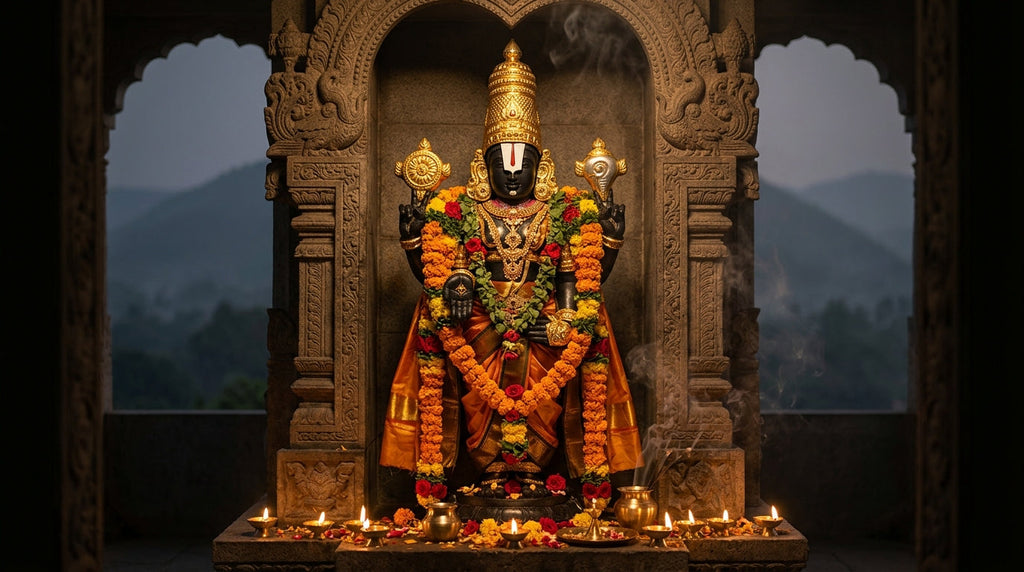
It is said that on the seven hills of Tirumala the Lord stands even now, waiting out the long age of Kali Yuga. Come, sit with me, and I will tell you why he came there.
Tirupati Balaji is Lord Vishnu in the form he took on the Venkata hill at Tirumala, where he is also called Venkateswara and Srinivasa. The popular katha says he came to earth after Goddess Lakshmi left Vaikuntha, lived in an anthill, married the princess Padmavati, and borrowed wealth from Kubera for the wedding, promising to repay it by the end of Kali Yuga.
That is the short answer. The long answer has a sage, a cow, a forest and a wedding, and it deserves to be heard slowly. Here at Dev Tattva, where we make handcrafted murtis for home mandirs, this is a katha many families ask to hear, so I tell it as the tradition tells it, and I will say plainly where the tellings differ.
Who Is Tirupati Balaji? The Many Names of the Lord
Tirupati is the town at the foot of the hills. The temple itself stands higher up, at Tirumala, on a ridge that devotees count as seven peaks. Tradition calls the range Seshadri, the hill of the serpent Shesha, on whom Vishnu rests.
The Lord of this hill carries many names. Venkateswara means the Lord of the Venkata hill. Srinivasa means the one in whom Shri, Goddess Lakshmi, dwells. And Govinda is the cry that rolls up the pilgrim path from a thousand throats at once.
And Balaji? Here the elders are honest about a small gap. Balaji is a loved and widely used name today, but it is a popular name rather than the one the old accounts of the hill use. Families say it with great affection, and that is reason enough. Still, it is good to know that Venkateswara and Srinivasa are the names that belong to the hill itself.
The legend of the hill is told in several Puranic traditions, and the Sri Venkatachala Mahatmya is often named as the most accepted account. Even the old Tamil poem Silappadikaram speaks of a hill called Tiruvengadam, the northern edge of the Tamil lands, with a deity standing on it. So devotion on this hill is very old, even if no one can name its first day with certainty. I will not give you founding dates, because the ones I have seen cannot be confirmed.

The Katha Begins: Sage Bhrigu and the Test of the Three Gods
Listen to how the story goes. Long ago, a gathering of sages sat before the sacred fire, and a question rose among them as the smoke of ghee and sandalwood drifted upward. Of the three great gods, Brahma, Shiva and Vishnu, who is the greatest?
To find the answer, the sages sent Sage Bhrigu, a man known for his tapas, to test the three in turn. It was a strange errand. Imagine a sage walking alone through the worlds, his staff in his hand, carrying a question no one had dared to ask the gods themselves.
According to tradition, Bhrigu did not find at the first two abodes the welcome that a sage expects. The tellings differ on the details, and the elders do not fuss over them. What matters is that when he reached Vaikuntha, he was already weary and vexed.
There lay Vishnu, resting on the great serpent Shesha, with Lakshmi beside him. And Bhrigu, in his irritation, struck the Lord on the chest with his foot. It is the very place where Lakshmi is believed to dwell.
What would you have done? Most of us would have flared up in anger. But the tradition says the Lord was not angered. He rose gently, and treated the sage with courtesy and care. That quiet forbearance was Bhrigu's answer, and the sages knew then who was greatest in patience and humility.
Why Lakshmi Left Vaikuntha
The sage had his answer, but the story does not end there. Lakshmi had been hurt. The Lord's chest is her home, and it had been struck by a sage's foot, while her Lord said nothing in her defence. In the popular telling she left Vaikuntha in sorrow.
Without her, Vaikuntha was no longer itself. The elders say the Lord could not rest, and he came down to earth to seek her. This is how the Lord of the three worlds is said to have arrived in the south, wandering the forests like a seeker, with no palace and no attendants.
Is it not a tender thing? God himself, in the story, goes looking for the one he loves. It reminds us that even the gods have homes that can feel empty, and that a household is not made of walls but of the people in it.

The Anthill, the Cow and the Cowherd
He came at last to the Venkata hill, where the forest was quiet and the air was cool. According to the popular telling, he made his dwelling inside an anthill, and there he stayed, still and unseen. How long did he wait? Traditions differ, and it does not change the heart of the story.
Now the katha brings in a cow. It is said that a cow used to climb the hill each day and let her milk flow upon the anthill, feeding the Lord within. When she returned home in the evening, her udder was empty, and her owner could not understand why.
The cowherd followed her one day, and saw the cow standing over the mound, her milk pouring out upon it. Shocked and angry, he raised his axe. The tellings say the Lord was struck by that blow, and that he rose from the anthill to meet the man.
What follows is told in many ways. Who the cowherd was, who the king was, and what became of them differ from one telling to another. I would rather say so plainly than pretend there is one fixed version. What every telling keeps is the picture of a cow, an anthill, and a Lord who accepts hurt without answering back, just as he did when the sage kicked him.

Padmavati, the Elephant and the Royal Wedding
Now comes the part children love. In the kingdom near the hills, tradition says, a princess named Padmavati was born. Her name means one born of the lotus, and many devotees understand her as Goddess Lakshmi herself, returned to the Lord in another form.
In popular tellings, the Lord and Padmavati meet in the forest, and a wild elephant is part of that meeting. There are different versions of how the chase went and who said what. The elders smile at this part, because even the Lord of Vaikuntha is shown here as a little shy, a young man who has found the one he was looking for.
The meeting led to a marriage. The families gathered, and the wedding is remembered as a grand one, with a feast and every ceremony in its place. The Lord, who had come to the hill with nothing but his anthill, was now to be a bridegroom.
Notice what the story does here. Lakshmi had left in hurt, and Padmavati comes into the Lord's life as joy. The quarrel that began with a kick ends with a wedding, and the reconciliation is complete. For many families, this is the reason Balaji is spoken of with so much warmth.

Kubera's Loan: Why the Lord Is Believed to Be in Debt
A wedding needs money, and the Lord, living in an anthill, had none. So the katha says he turned to Kubera, the treasurer of the gods, and asked for a loan to meet the costs. Kubera agreed, and the Lord promised to repay it by the end of Kali Yuga.
How large was the sum? Here I must be honest again. Different sources give different amounts, and some give figures so large they sound like a joke. I would not trust any single number, and I would be wary of anyone who offers one as settled fact. The loan story is widely told as the local tradition of the hill, but where exactly it first appears in the old texts, I cannot say with certainty.
Many devotees understand the offerings made at Tirumala as a way of sharing in that repayment. That is a belief of the heart, not a ledger. Has the Lord repaid his loan yet? No one can say, and the question is part of the story's charm. He promised to repay by the end of this age, and the age is not over.
You may hear some retellings that add other characters or small miracles. When a detail comes only from a film or a single website, I leave it with the folk storytellers rather than offer it as part of the katha.

What the Tirupati Balaji Story Teaches
Every katha has a seed hidden inside it. Let me show you the seeds I see in this one.
The first is humility. When Bhrigu kicked him, the Lord did not punish. He met the sage with gentleness. That is the greatness of Vishnu in this story: a strength that has nothing to prove.
The second is that a word, once given, must be kept. A loan was taken and a promise was made, and even the Lord of the universe is shown as a bridegroom who takes responsibility for his wedding. That makes him feel close rather than distant. Please do not read this as a money lesson or a promise of returns on offerings. The elders never told it that way. The point is trust and faithfulness.
The third is the mending of a hurt. Lakshmi left in pain, and in the end she is bound to the Lord's heart again, through Padmavati. The story says that even a quarrel among the gods is healed by patience and love. Every household that has had a hard silence between two people knows what that means.
The fourth is the mercy of Kali Yuga. This age, the elders say, is a hard one, with little time for long penance. So the Lord is believed to stand on a hill where anyone can come, rich or poor, and simply say his name. That is why the call of Govinda is so loved.
Why Devotees Offer Hair and Gifts at Tirumala
Many pilgrims to Tirumala offer their hair to the Lord. The popular reasoning is that hair stands for vanity and the sense of self, and that giving it up is a way of laying down pride before him. Since the Lord set aside every trace of anger in Bhrigu's story, the offering feels fitting. Families follow it in different ways, and no one is required to do it.
People also offer money, flowers and gold, and the temple is often spoken of as one of the wealthiest in the world. I would speak gently about that claim. Figures change and are hard to check, and the heart of the offering is not in the total. A coin placed in love and a garland made at home are the same in the Lord's eyes, as the elders say.

How Devotees Honour Balaji at Home Today
You do not need to climb seven hills to remember Venkateswara. Many families keep a picture or a murti in the home mandir and say his name on Saturdays, a day many Vaishnava families associate with him. Customs vary by region and family, so follow what your own elders do.
The mantra most people use is simple:
ॐ नमो वेङ्कटेशाय
Om Namo Venkatesaya
I bow to Lord Venkatesha.
Light a small lamp, offer a flower or a tulsi leaf if your family does so, and say his name with a quiet heart. A call of "Govinda, Govinda" is as welcome as any longer prayer.
It also helps to know what you are looking at when you see his image. Devotees describe him standing upright, wearing a crown and a tall tilak, with the conch and discus of Vishnu in his upper hands. Lakshmi is believed to rest upon his chest, which is why he is called Srinivasa.

At Dev Tattva, we craft murtis for the places where families wish to keep the divine close. A murti for the home temple sits in the mandir, where it can be offered a flower each morning. A small murti for the car dashboard keeps a prayer with you on the road, and a murti as a gift is a thoughtful way to share the faith with a new home.
I should say plainly that the Dev Tattva collection does not include a Balaji murti at present. But Lord Rama is also an avatar of Vishnu, and the Ram Lalla idol brings Vaishnava devotion to your altar in a small, handcrafted form. Whatever form you keep, give it a clean place, a small lamp, and a moment of your time each day.
Frequently Asked Questions
Which god is Tirupati Balaji?
Tirupati Balaji is Lord Vishnu in his form as Venkateswara, also called Srinivasa. He is worshipped at Tirumala, on the hills above Tirupati. Balaji is a popular and affectionate name for him.
Why did Balaji take a loan from Kubera?
According to the popular katha, he needed funds for his wedding with Padmavati. Kubera lent the money, and the Lord promised to repay it by the end of Kali Yuga. The sum is told differently in different sources, and devotees treat the story as a matter of faith, not accounting.
Why do devotees donate hair at Tirupati?
Devotees understand it as an offering of pride and self to the Lord. It is a custom of devotion that varies by family, and no one is required to follow it. A heartfelt prayer at home is welcome in the same spirit.
Why did Sage Bhrigu kick Vishnu?
In the katha, Bhrigu had been sent to find which of the three great gods is greatest. After a weary and vexing journey, he struck Vishnu's chest with his foot. The Lord answered with gentleness, and that calm is the heart of the story.
A Closing Blessing
May Venkateswara's hill stay in your heart, wherever you live, and may the sweet cry of Govinda be on your lips when you rise and when you rest. If this katha has made you want to bring more devotion into your home, you are welcome to look through Dev Tattva and find a handcrafted murti that suits your mandir. Om Namo Venkatesaya.

About the author
Pandit Om Prakash Saxena
Pandit Om Prakash Saxena is 94 years old and still active. For the last 72 years he has been involved in pooja, paath and all forms of karmakand, and he is associated with Shanti Kunj, Haridwar.
-
Posted in
hindu stories, kubera loan, padmavati, tirupati balaji, venkateswara, vishnu katha