 All Deities
 Gift & Worship
 Best seller
 About Us
 Contact Us
 Blogs
Indra Dev's Weapon Name: The Story of the Vajra
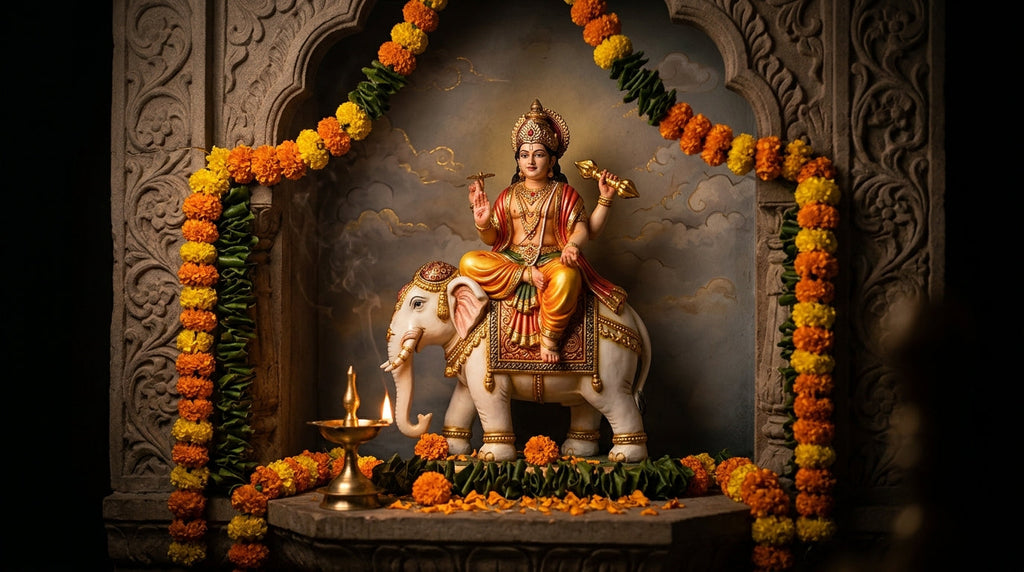
Picture a dry summer sky, heavy and silent, with the cracked earth waiting for rain. The elders say this is where the story of Indra's weapon begins.
Indra dev's weapon is the Vajra, the thunderbolt, also called Vajrayudha, which means the vajra weapon. In the Puranic tradition it was forged from the bones of the sage Dadhichi, who gave up his life so that the devas could be saved. The Rigveda, the oldest voice we have, gives the making to the divine craftsman Tvashtr.
Sit with me, and I will tell you the katha the way it has been told for generations. We at Dev Tattva love such stories, because every weapon in a deity's hand carries a tale behind it.
Indra Dev's Weapon: The Vajra and Its Many Names
Indra is the king of the devas, lord of clouds, thunder and rain. He rules the heavenly kingdom of Svarga from his city Amaravati, and he rides the great white elephant Airavata. In his hand, in almost every telling, is the Vajra.
The word vajra (वज्र) is usually translated as thunderbolt. Old poetry also calls the weapon Vajrayudha (वज्रायुध), and Indra himself is called Vajrin or Vajrabhrit, the one who bears the vajra. These names are not decoration. They tell you that, for the people who first praised him, the king of heaven and his thunderbolt could hardly be spoken of apart.
Many people search with the word astra, and that is quite natural. In everyday katha we say astra for any divine weapon, though a scholar may tell you that the Vajra is more exactly an ayudha, a weapon held in the hand.
You may also read online that Indra holds other great divine weapons, with names taken from the Puranas. Such claims are often repeated without a clear source, so I will not place them beside the Vajra as settled fact. What the traditions agree on is this: when the sky-king is shown, the thunderbolt is in his grip.

The Katha of Vritra and the Thirsting Earth
Listen to how the story goes. In the Vedic hymns, the waters of the world were once held captive. A great serpent named Vritra lay coiled around them, and the rivers could not run to the fields. The land waited, and the people waited, and no cloud would break.
Why does the oldest story begin with thirst? Because for those who first sang these hymns, rain was never a small matter. A season without water meant empty granaries and hungry cattle. The one who set the waters free was the one who saved the year.
Indra rose against Vritra. According to the Rigveda, he struck the serpent with the Vajra that Tvashtr had made, and the waters were released. The rivers poured down like cattle let out of a pen. That image of freed waters is the heart of the oldest telling.
The Puranas tell the same battle with more drama and more people in it. In the Bhagavata Purana, Vritra is born of a sacrifice performed by Tvashta, who wanted a son strong enough to end Indra. The elders say that a slip in the chanting of the mantra changed its meaning, so that the child who rose from the fire was not quite what the father had wished. Such is the way of words spoken before a sacred flame: they carry weight.
Vritra grew huge and strong, and in many tellings he had received a boon. No weapon of stone, wood or metal could kill him. The devas fought him and could not win, and their hearts grew heavy.
Can you imagine it? The gods themselves, tired and uncertain, unsure where to turn. They went to Lord Vishnu for counsel, and the Bhagavata Purana says he told them to seek out a sage named Dadhichi.
Dadhichi's Gift: How the Vajra Was Made
Dadhichi lived in a quiet forest hermitage, where the smoke of the sacred fire rose each morning among the trees. He was a sage of great tapas, the long discipline of a life given to prayer and knowledge. The devas came to him with folded hands and heavy hearts.
They did not ask for his blessing alone. They asked for something far harder. The weapon that could end Vritra, they said, could be made from the bones of a sage who had lived a life of pure austerity.
And here the tradition shows us something remarkable. Dadhichi did not argue or bargain. He heard the need of the worlds, and he agreed. Through yoga, the tellings say, he let his life breath leave his body, and the sage who had given knowledge all his life gave his very bones.
Some tellers pause at this point, because it is a grave moment. A company of gods stands at the door of a hermitage and asks a gentle sage for his life. Nobody in the katha treats it lightly. That is why Dadhichi is remembered with such honour, as one who gave when giving was hardest.
Then Vishwakarma, the celestial architect, took up the task. In the Puranic version, he fashioned the Vajra from the sage's bones. A weapon born of sacrifice, not of greed, now lay in Indra's palm.

Indra faced Vritra once more. The sky darkened and the earth shook as the two met. Indra hurled the Vajra, and Vritra, who was safe from every ordinary weapon, fell to the thunderbolt made of a sage's bones. The waters ran free, and the rain came.
The Mahabharata also tells of Dadhichi's bones and of the Vajra made from them, in more than one place, including the Vana Parva and the Shanti Parva. The telling carries the same moral weight. The weapon of the king of heaven was won by a gift, not a theft.
Who Made the Vajra? The Versions Side by Side
Families often ask me, with some worry, whether the stories contradict one another. They differ, and that is no sin. Different books and different centuries remembered the tale in different ways, and the tradition has always held them together with respect.
- The Rigveda: Tvashtr, the divine craftsman, makes the Vajra for Indra. Dadhichi's bones are not part of this oldest picture.
- The Puranic and Mahabharata tradition: Dadhichi gives his life, and Vishwakarma forges the Vajra from his bones. This is the version most people know today.
- A Mahabharata-linked variant: in some tellings, Brahma makes several weapons from the sage's bones, and the Vajra is only one among them.
You may notice that Tvashtr and Vishwakarma are both craftsman figures, and later tradition often draws them close together. So when a grandmother says Vishwakarma made it, and a Vedic scholar says Tvashtr, neither need correct the other. Each is telling the tale from a different distance in time.

What Does the Vajra Look Like?
Here the tradition is not of one mind. Some pictures show a short club with a ribbed or knobbed head. Others show a rod with two ends, each split into prongs. A few descriptions suggest something between a mace, a spear and a sword.
In temple art, the most familiar form has a central shaft with prongs curving inward at both ends, like a closed lotus bud. It is shown in Indra's raised hand, often with flashes of lightning around it. Do not be troubled if the picture in your calendar differs from the one in your village temple. Each sculptor held the idea of the thunderbolt in his own memory.
One more point of clarity. The Buddhist vajra and the ritual vajra scepter used in some traditions share the name and the double-ended shape. They carry the same root idea of something hard as diamond and bright as lightning, but each is used and understood within its own tradition.
The Meaning of the Vajra: Strength Born of Sacrifice
The word vajra carries two meanings at once: the thunderbolt and the diamond. A diamond cannot be scratched by lesser stones, and lightning cannot be held back by a wall. Together they speak of a power that does not break.
But the deeper teaching, as the elders explain it, lies in where the Vajra came from. It did not come from a mine or from a battle. It came from a life that had been given freely. The strongest weapon of the heavens was made from a sage's sacrifice.
Think about what this tells a family. Real strength, in the Hindu view, is not just force. It is firmness of purpose joined with generosity. Many readers also see the Vajra as the sharpness of knowledge, which cuts through ignorance the way lightning cuts through a dark sky.
And look at Vritra, too. He is often read as the drought, the hoarding of what should flow to all. When the waters are freed, the story reminds us that the world's gifts are meant to be shared. That is a gentle thought to carry into any season.
Notice also what the Vajra is used for in this katha. It is not raised for pride or for conquest. It is raised so that rivers may run, and so that the devas and the people who depend on them may live. A weapon held for the sake of others is a different thing from a weapon held for oneself.
Other Stories of the Vajra: Garuda and Little Hanuman
The Vajra appears in more tales than the battle with Vritra. In some Puranic accounts, Garuda, the great eagle, was struck by Indra's Vajra and survived. Out of respect for the weapon and for Dadhichi's gift, he let a single feather fall. From this, tradition says, he came to be called Suparna, the one with the beautiful feather.
Then there is the tale children love best. In popular tellings, little Hanuman saw the red morning sun and took it for a ripe fruit. He leapt into the sky to catch it, and Indra, fearing for the order of the heavens, threw the Vajra. It struck the child on the jaw, hanu in Sanskrit, and from this the name Hanuman is explained.
Versions differ in the details, and I will not pretend that one telling is the only true one. But the heart of the tale is warm and widely shared. A child's innocence meets a king's duty, and the story is remembered with affection.
Families who love this story often keep a Hanuman murti near the study table or the home mandir. You can see the Hanuman idols from Dev Tattva, which show him in his strength and his devotion, long after that morning in the sky.

Indra's Other Companions and Gifts
The Vajra does not stand alone in Indra's picture. Airavata, the white elephant who carries him through the clouds, is part of the vision of the sky-king. After a monsoon shower, many Indians still call the rainbow Indradhanush, Indra's bow, a lovely name that shows how deeply he lives in everyday speech.
Even the Param Vir Chakra, India's highest military honour, carries the image of the vajra. A symbol born in a Puranic katha now sits on a medal for courage. That is how living a tradition can be.
Other weapons of Indra, when you meet them in later books, differ from text to text. Here I have kept to the Vajra, the one that every tradition shares.

How Devotees Honour Indra and the Vajra Today
Indra is not worshipped in homes as widely as Ganesha, Shiva or Vishnu, yet he is remembered in the Vedic hymns, in prayers for rain and in the stories we tell our children. Many families simply tell his katha on a rainy evening and thank the clouds for the water.
If you wish to offer a prayer, a simple salutation is enough: ॐ इन्द्राय नमः (Om Indraya Namah), which means I bow to Indra. Say it with a calm mind, light a diya, and offer a few flowers. Practices vary by family and region, so follow what your elders have taught you.
Many homes keep murtis of the deities whose weapons we most often see in daily life. Shiva carries his trishul, and Hanuman carries his gada. In the Shiv collection at Dev Tattva, you will find handcrafted forms of Mahadev with the trishul, meant for the home mandir.
Dev Tattva does not offer an Indra murti at present, so I will not tell you to look for one here. But if you want a small murti for the car, you can look through the car dashboard collection. And if you are choosing a gift for a housewarming or a birthday, the gifting collection is a good place to begin.
Keep any murti or sacred symbol in a clean, quiet place, a little above the floor. Wipe it gently, offer a flower now and then, and let your children ask about it. The best way to honour a weapon from a katha is to teach the story behind it.
On a rainy evening, you might gather the children and tell them about the thirsting earth, the sage in the forest and the thunderbolt made from his gift. Let them ask why Dadhichi agreed. Their questions will often take you closer to the meaning than any lecture.


Frequently Asked Questions
What is Indra dev's weapon called?
Indra's weapon is called the Vajra (वज्र), usually translated as thunderbolt. It is also known as Vajrayudha, and Indra is called Vajrin or Vajrabhrit as the bearer of the vajra.
Who made Indra's Vajra, and what is it made of?
The Puranic and Mahabharata tradition says it was forged by Vishwakarma from the bones of the sage Dadhichi. The Rigveda credits Tvashtr as its maker, and one variant has Brahma making several weapons from the bones. Traditions differ, and all are respected.
Why did Dadhichi give his bones for the Vajra?
The devas were threatened by Vritra, who could not be slain by ordinary weapons of stone, wood or metal. On Vishnu's advice, they approached Dadhichi, and he gave up his life through yoga so that a weapon could be made from his bones. The tale is a lesson in selfless giving.
Is Indra's Vajra the same as the Buddhist vajra?
They share a name and a double-ended shape, and both draw on the idea of diamond-hard, lightning-bright strength. But the Vajra of Indra is a weapon in Vedic and Puranic story, while the Buddhist vajra is a ritual symbol with its own meaning in that tradition.
A Blessing Before You Go
May the story of Dadhichi's gift stay with you longer than the name of any weapon. True strength, the katha reminds us, is the kind that serves others. If you wish to bring a handcrafted murti into your own sacred corner, you are welcome to browse the temple collection at Dev Tattva, and may your home always be filled with calm, kindness and timely rain.

About the author
Pandit Om Prakash Saxena
Pandit Om Prakash Saxena is 94 years old and still active. For the last 72 years he has been involved in pooja, paath and all forms of karmakand, and he is associated with Shanti Kunj, Haridwar.
-
Posted in
Dadhichi, divine weapons, Hindu mythology, Indra, Vajra, Vritra