 All Deities
 Gift & Worship
 Best seller
 About Us
 Contact Us
 Blogs
Panchamukhi Hanuman: Story, Five Faces and Meaning
The elders tell us that on one dark night during the war of Lanka, even the sleepers in Rama's own camp were not safe. Out of that night comes the form we call Panchamukhi Hanuman.
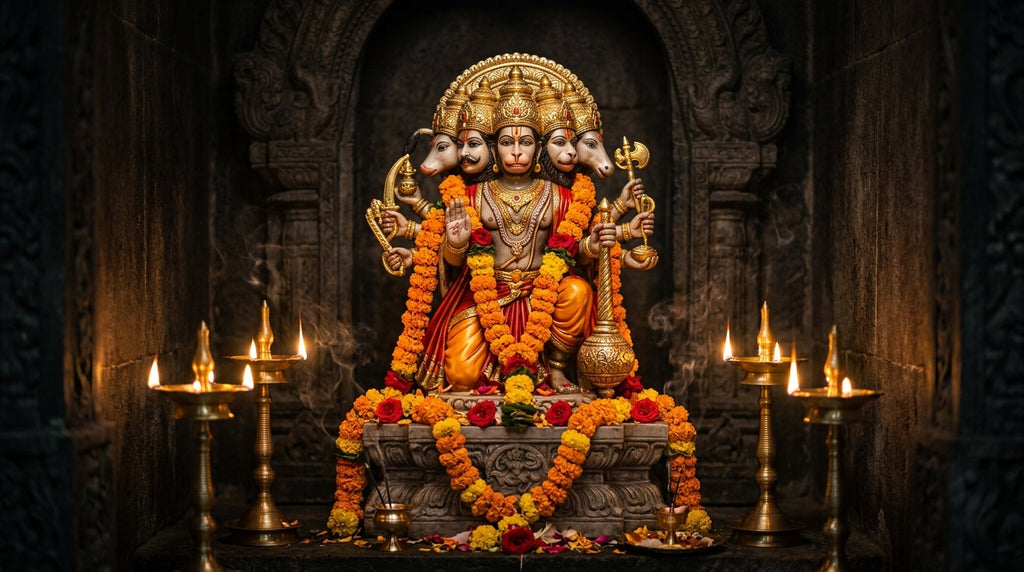
Panchamukhi Hanuman is the five-faced form of Hanuman. In popular tellings of the Ramayana, he took it to rescue Rama and Lakshmana from Ahiravana, the ruler of the underworld, by putting out five lamps at the very same moment. "Pancha" means five and "mukhi" means faced.
Many families ask us at Dev Tattva who this five-headed Hanuman is and what each face means. So let us sit together and hear the katha first, and then the meaning.
The Night Ahiravana Came to Rama's Camp
It is said that the war in Lanka had grown long and bitter. Ahiravana, a master of illusion who ruled Patala, the world beneath the earth, stood on the side of Ravana. He is also called Mahiravana, and the name you hear will depend on the region and the teller.
Picture the camp of the vanaras that night. The fires burned low, the sea murmured in the dark, and Rama and Lakshmana lay sleeping after a hard day. Hanuman kept watch over them, as he always did, with the name of Rama on his lips.
Then Ahiravana came, and he did not come as a stranger. He took the form of Vibhishana, Ravana's brother who had left Lanka and joined Rama. Everyone trusted Vibhishana, and the disguise was so perfect that no one thought to stop him.

By morning, Rama and Lakshmana were gone. Through his magic, Ahiravana had carried them down to Patala. The camp that had been full of hope was now full of silence.
Hanuman did not sit in grief for long. He who had once leapt across the ocean set out to cross the last and darkest distance for his Lord. Down he went, toward the gate of Patala.
The Gate of Patala and the Five Lamps
Listen to how the story goes at the gate. Patala's entrance was guarded by a strange and mighty being, half vanara and half sea creature, who stood firm before Hanuman. This was Makardhwaja.
In popular retellings, a drop of Hanuman's sweat once fell into the sea, and a great sea creature swallowed it. From that drop Makardhwaja was born. So Hanuman, who kept the vow of a lifelong brahmachari, met at that gate a guardian who was, in a way, his own son.
Tellings differ on how the meeting goes. Some say the two fought, some say a few words were enough. What the tellings share is that Makardhwaja served Ahiravana, and that Hanuman went on toward the palace within.

Inside, it is said, the palace was a place of lamps and shadows. Rama and Lakshmana were held there, and time was short. Yet Ahiravana could not be brought down by strength alone, for his life was bound to a secret.
Here comes the heart of the katha. In popular tellings, a woman of that realm named Chandrasena revealed the secret. Ahiravana's life was tied to five lamps, set in five different directions. Only if all five were put out in the same instant could he be defeated.
How could one Hanuman be in five places at once? He did not try. He took the form of Panchamukhi, with five faces looking in five directions, and in the same breath he put out all five flames. Ahiravana fell, and Rama and Lakshmana were free.

The Five Faces of Panchamukhi Hanuman and Their Meaning
Now what are the five faces? The most common scheme, followed by many temples and devotional books, assigns each face a direction:
- Hanuman (east): the familiar vanara face, devoted to Rama. Devotees link it with courage, humility and steady bhakti.
- Narasimha (south): the lion-faced form of Vishnu. It is linked with protection from fear.
- Garuda (west): the eagle, Vishnu's own vehicle. It is associated with warding off poison and harm.
- Varaha (north): the boar who lifted the earth from the waters. It is linked with steadiness and strength to carry heavy burdens.
- Hayagriva (looking upward): the horse-faced form tied to knowledge and the Vedas.
Traditions differ here, and it is good to say so honestly. Some books list the faces by the right and left side of the figure instead of by compass direction. Others describe the colours and the order a little differently. Each follows the lineage of the family or temple that preserves it.
The murti is usually shown with ten arms, carrying weapons and sacred objects, and the details vary from one tradition to another. A devotee should not worry if two images look slightly different. The five faces and the one purpose behind them remain the same.
Why Hanuman Takes the Forms of Vishnu
Have you wondered why the four extra faces belong to a lion, a boar, a horse and an eagle? These are no random animals. Narasimha, Varaha and Hayagriva are forms of Vishnu, and Garuda carries Vishnu wherever he goes. Rama is understood as an avatar of Vishnu.
So when the servant of Rama must save his Lord, he wears the protective forms of the same Lord he serves. It is a beautiful idea. The devotee who gives everything to God finds that all of God's strengths stand behind him.

Some teachers also read the five faces as the five elements and the five senses, a reminder that devotion must gather the whole of a person, not just a part. This is a later way of understanding the form, and it is offered as a teaching, not as part of the story.
Is Panchamukhi Hanuman in Valmiki's Ramayana?
This is among the most common questions, and the plain answer is no. Valmiki's Ramayana does not contain the Ahiravana episode. It comes from later retellings, and the Bengali Krittivasi Ramayana is the one most often named for it.
The five-faced iconography, too, is described by scholars as not part of mainstream Hanuman worship in the earliest centuries. It is said to have grown more visible in the Tantric and devotional streams from around the fifteenth century.
Does this make the story less precious? Not at all. India's great epics have always lived in many tongues and many tellings. Each region has added the stories its own devotion needed. We honour the katha as tradition gives it, and we do not claim more than we know.
What the Katha of Five Faces Teaches
First, devotion finds a way. Hanuman had no ordinary weapon that could defeat a life hidden in five lamps. He had his love for Rama, and the moment gave him the form it needed.
Second, the story speaks of vigilance. Ahiravana succeeded because he wore a trusted face. Families who tell this katha to children often draw from it a simple lesson: look carefully, and do not be fooled by what only appears friendly.
Third, it shows a servant who does not seek credit. Hanuman does not stop to announce his greatness. He does what must be done, and the Lord he serves is safe.
Temples and Devotion to Panchamukhi Hanuman
Panchamukhi Hanuman is worshipped in temples across India and beyond. At Ganadhal in Karnataka, according to the account on Wikipedia, the deity appeared in a devotee's dream, and a self-manifested idol was then found. The saint Raghavendra Swami is said to have had a vision at the same place.
In Karachi, the Panchmukhi Hanuman Mandir is recognised as a heritage site and is believed to be around fifteen hundred years old. Many other temples keep this form too, each with its own local story. We share these as they are told, and a visitor will best learn the details from the priests of each place.

How to Honour Panchamukhi Hanuman at Home
You do not need a grand ritual. Hanuman is known as a deity who is pleased by sincerity, and the elders say a simple puja done with a calm mind is enough. Many devotees offer a diya, a few flowers and a little sindoor, then chant ॐ हनुमते नमः (Om Hanumate Namaha, "I bow to Lord Hanuman") or जय श्री राम (Jai Shri Ram, "Victory to Lord Rama").
Tuesday and Saturday are the days most devotees keep for Hanuman, and the festival of Hanuman Jayanti is observed with special prayers. Its date changes every year, so check a trusted panchang. Reciting the Hanuman Chalisa of Tulsidas, or sitting in silence with Rama's name, is also a loved practice.
About where to place the form, you will hear many opinions. Some families keep the five-faced image facing south or south-west, and some follow the advice of their own pandit or family custom. Others place it wherever the household mandir already stands. These are matters of belief and practice that vary by region, and none of them is a rule for everyone. What matters is that the place is clean, respectful and kept with love.
A few simple habits help. Keep the murti on a clean surface, never on the floor. Dust it gently, offer fresh flowers when you can, and do not place it where it may be knocked over. Whether it sits in a mandir, on an office shelf or on a car dashboard, treat it as a presence you respect.
Some devotees believe the form gives courage in difficult times and shelter from fear. That is a matter of faith, and we say it as faith, not as a promise. Worship is a relationship, and what it brings is for each heart to know.
Choosing a Hanuman Murti: A Gentle Guide
Many readers come to Dev Tattva looking for a murti to keep in the home mandir, to gift, or to carry with them. A good murti is finished with care. Look at the face, because the expression should feel calm and the features should be clear. Check that the base is steady, the paint or plating is even, and the size suits the place where it will stand.
For a car dashboard, a smaller and well-balanced figure is usually practical, and the car dashboard collection at Dev Tattva shows what suits that purpose. For a work desk or study table, a compact murti beside you is a quiet reminder to stay steady, and the office desk collection offers such pieces. Hanuman is also a loved gift for a housewarming or a birthday, or for someone beginning a new journey.
Dev Tattva's catalog does not at present include a five-faced Hanuman murti, so we will not pretend otherwise. What we do offer are handcrafted Hanuman idols, such as the Hanuman idol with Ram in his heart, which shows the very devotion at the centre of this katha. You can see all of them in the Hanuman collection.


Frequently Asked Questions
Why did Hanuman take five faces?
According to popular retellings of the Ramayana, Ahiravana's life was tied to five lamps burning in five directions. To put them all out at once and free Rama and Lakshmana, Hanuman took a form with five faces.
What are the five faces of Panchmukhi Hanuman?
The most common scheme lists Hanuman facing east, Narasimha facing south, Garuda facing west, Varaha facing north and Hayagriva looking upward. Some traditions list them by right and left side instead, so details can differ between temples and books.
Can I keep a Panchmukhi Hanuman idol at home?
Many families do keep this form in the home mandir, and some also keep it in the office. Customs about direction and placement vary by region and family, so it is wise to follow your own tradition or ask your family pandit. Keeping the murti clean and treating it with respect matters most.
Who killed Ahiravana, and is the story in Valmiki's Ramayana?
In the popular tellings, Hanuman defeated Ahiravana by extinguishing the five lamps at once. The episode is not in Valmiki's Ramayana. It comes from later retellings, such as the Krittivasi Ramayana of Bengal.
May Hanuman, who keeps watch over every devoted heart, bless your home with courage, humility and the sweet name of Rama. When you are ready to bring a murti home, you are always welcome to visit Dev Tattva and choose one made with care. Every family that comes to devtattva.com is, to us, a family sitting in the same katha.

About the author
Pandit Om Prakash Saxena
Pandit Om Prakash Saxena is 94 years old and still active. For the last 72 years he has been involved in pooja, paath and all forms of karmakand, and he is associated with Shanti Kunj, Haridwar.
-
Posted in
ahiravana, five faces, hanuman, hindu culture, panchamukhi hanuman, ramayana