 All Deities
 Gift & Worship
 Best seller
 About Us
 Contact Us
 Blogs
Who Is the Father of All Gods in Hinduism? A Katha
Picture a stillness before there was any sky. There was only water, and on the water a faint golden glow. The old katha begins there, and so does our answer.
In Hindu tradition, the one most often called the father, or grandfather, of all beings is Brahma the creator, who grew out of the older Vedic figure Prajapati, the "lord of creatures". Yet no single answer is accepted by every tradition. Vaishnavas, Shaivas and Shaktas look to Vishnu, Shiva or Devi, and Vedanta speaks of one Brahman behind all the names.
So sit close and hear it the way elders tell it. At Dev Tattva we share it in that spirit: slowly, with respect, and never pressing one family's belief on another.
The Golden Germ in the Waters: Where the Katha Begins
The oldest voice we have is the Rig Veda. In its tenth book there is a hymn known as the Hiranyagarbha hymn, the hymn of the golden germ. It names no temple and no throne. It sings of something shining that arose in the beginning, resting in the waters of creation.
हिरण्यगर्भः समवर्तताग्रे भूतस्य जातः पतिरेक आसीत्
Hiranyagarbhaḥ samavartatāgre bhūtasya jātaḥ patir eka āsīt
In the beginning arose the golden germ; once born, he was the one lord of all that exists.
This golden being is linked with Prajapati, the first-born, the lord of creatures. In some Vedic tellings, Agni, Indra and Soma came from his first breaths, while the asuras came from his downward breath. Notice what the story does. It does not make the gods self-born and eternal. It says they have a beginning, and that the beginning is one glowing source.
The Brahmana texts, which explain the Vedic sacrifice, tell another striking thing. Prajapati offers himself in the first yajna, the first sacrifice, and the gods and beings follow. The father of beings, in this vision, is also the one who gives himself so that the world may live.

Later, in the Puranas, the golden germ is told as a golden egg, and Brahma takes form from it. The names change from text to text, but the memory is the same. Before the many, there was one.
The Lotus from Vishnu's Navel: Brahma Opens His Eyes
There is a second telling, dear to Vaishnava families. Listen to how it goes. The worlds have dissolved, and the great waters lie quiet. On those waters rests Lord Vishnu, in deep and peaceful stillness.
From his navel rises a lotus. Petal by petal it opens, and in its centre sits Brahma. According to tradition, he is the four-faced creator, and the four Vedas are linked with his four mouths. From him the work of making the worlds begins.
The Puranas say that Brahma first brings forth the manasaputras, the mind-born sons, and the seven great sages are counted among those he creates. Then come the Prajapatis, the lords of creatures, through whom the families of beings grow.

Here the Vedic picture and the Vaishnava picture seem to differ. In one, Brahma comes from a golden egg. In the other, from a lotus that grows out of Vishnu. The elders do not quarrel over it. They say each family hears the version of its own sampradaya, its own line of teaching, and both point to a source before the creator.
The Shakta tradition adds its own scene. In the Devi Mahatmya, which sits inside the Markandeya Purana, Brahma praises the Goddess as the source of the bodies of the three gods. So even the creator, in this telling, bows to a greater Shakti.
From Brahma to the Devas: Why He Is Called the Grandfather
Why do people call Brahma Pitamaha? The word पितामह means the father's father. He is the elder one step back, the one whom the whole family traces itself to.
The Puranic chain runs like this. Brahma creates the mind-born sons and the seven sages. The Prajapatis carry creation forward, and many lines of beings descend through them. Brahma is the grandfather because he stands at the head of that family, not because he sits on a throne above all others.
Be aware that the lists differ. Some texts count seven Prajapatis, some ten, some twenty-one, and the names change between Puranas. The elders never insist on a single list. What every list shares is the shape of the story: one source, then sages, then the many families of the world.
This is also why the question has a gentle trap inside it. "Father of all gods" sounds like one question. In truth the tradition answers several at once, and it helps to pull them apart.

Creator, Supreme, Ancestor: Three Questions, Three Answers
Most confusion fades when we ask three separate things. Who made the world? Who stands at the head of the family of beings? And who is the highest of all? A family can hold a different answer to each, and the tradition does too.
- The creator. In the Puranic order of the Trimurti, Brahma creates, Vishnu preserves and Shiva dissolves. Making is Brahma's task, so he is the "father" in the story of creation.
- The ancestor. This runs through Prajapati, the mind-born sons and the Prajapatis. It is a family tree, not a ranking.
- The supreme. This is a question of devotion and philosophy. Each sampradaya answers it from its own scriptures and its own heart.
So when a young person says "Brahma made everyone", the better reply is gentle. Yes, in the creation story. That is a separate matter from who is worshipped as the highest. The word "father" does not settle the word "supreme".
What Vaishnavas, Shaivas and Shaktas Say
Now we come to the part where families sometimes raise their voices at dinner. Let us hear each tradition with respect, one after another.
For Vaishnavas, Vishnu or Narayana is the source, and Brahma is born from his lotus, as in the katha above. The first canto of the Bhagavata Purana ranks Vishnu above Brahma and Shiva through the three gunas. In the Vana Parva of the Mahabharata, the child Narayana tells the sage Markandeya that he is all the gods.
For Shaivas, Shiva is the highest, the one from whom all else arises. In the Anushasana Parva of the Mahabharata, Bhishma speaks of Shiva as the maker of Brahma. Families who bow to Shiva murtis in their mandirs follow that long line of devotion.
For Shaktas, it is the Divine Mother who stands before and beyond the three gods, and the Devi Mahatmya shows Brahma himself praising her.
Three paths, three sets of scripture, one very human longing. The wiser elders say we need not rank them, for each sampradaya describes the same ocean from a different shore.

And Vedanta says something larger still. The Rig Veda gives us a line many families know by heart.
एकं सद् विप्रा बहुधा वदन्ति
Ekaṁ sad viprā bahudhā vadanti
The Truth is one; the wise speak of it in many ways. (Rig Veda 1.164.46)
Hear this carefully. It does not say that all the gods are one person in different clothes. It says the One reality is approached through many names. That single line has helped Hindu homes live together in peace for a very long time.
Brahma and Brahman: Two Words, Two Meanings
Here is the mix-up I most want to clear. Brahma (ब्रह्मा) is a deity, the four-faced creator of the Puranas. Brahman (ब्रह्मन्) is the ultimate reality of Vedanta, without form and beyond birth and death. They sound alike, but they are not the same.
Brahma is a figure in the story, born from the egg or the lotus. Brahman is not born at all. When the Upanishads speak of Brahman, they speak of that which holds up everything, the gods included. A Vedantin asked about the father of all gods might gently answer that the gods themselves rest in Brahman, which is not a father in the family sense.
The Four Faces and the Swan: What Brahma's Form Teaches
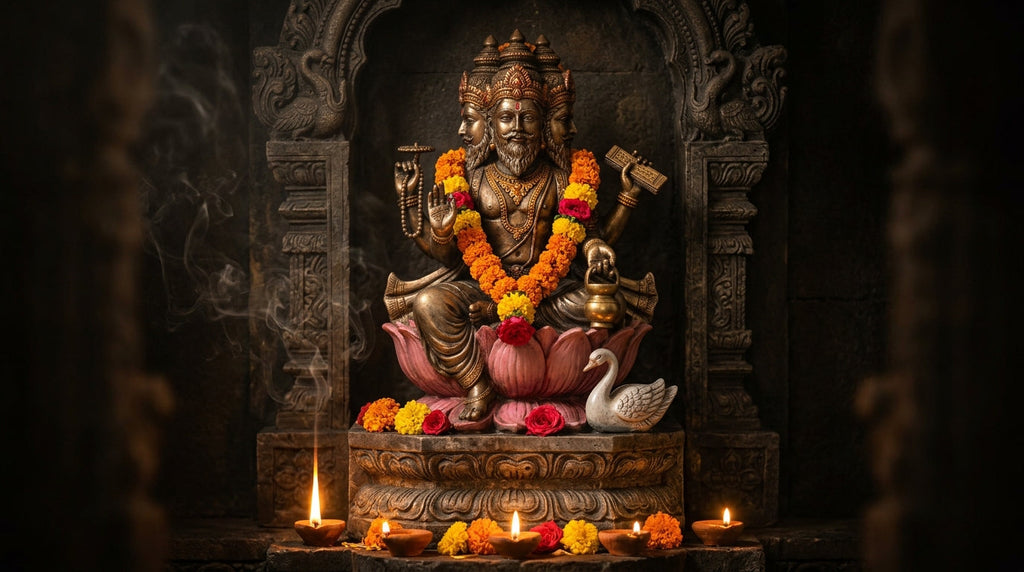
Tradition shows Brahma with four faces, seated on a lotus. In his hands are the Vedas, a rosary called akshamala, and a kamandalu, a water pot. His vahana, the vehicle that carries him, is the swan.
The four faces are linked with the four Vedas. The Vedas in his hands tell us he is the keeper of knowledge. The rosary suggests quiet counting and steady remembrance, and the water pot recalls the waters in which the story began.
Notice the nature of this form. It is not a warrior's, nor a king's. It is the form of a maker and a teacher. Perhaps that is why the old texts call him the grandfather: patient, learned, and a little distant, like an elder who has given his blessings and now watches the family grow.
Why Brahma Has So Few Temples, and What Pushkar Means
Many people ask why Brahma is rarely worshipped in temples. It is true that temples devoted to him are rare. The best-known exception is Pushkar in Rajasthan, beside its sacred lake, where pilgrims come to bathe and offer prayer.
Tellings differ on the reason for this, so I will not rest it on any one tale. What we can say is that Brahma is honoured in the scriptures and at Pushkar, while devotion in most homes flows towards Vishnu, Shiva, Devi and their many forms. Brahma idols are also uncommon in household mandirs.

How Families Honour the Father of the Gods Today
So what does a household do with all this? The traditional answer is the idea of the ishta-devata, the deity dear to your heart and your family. One home may hold Shiva closest, another Hanuman, another Ganesha. None is wrong, and none is made smaller by the others.
A home shrine can hold several deities at once. Many families keep Ganesha at the front, since he is invoked first in any undertaking, and place others around him according to their own line of worship. Dev Tattva offers handcrafted murtis for the home mandir, the car dashboard and the office desk, and the choice of deity is always the family's own.
If you wish to honour the creator in a simple way, remember him with a quiet thought at sunrise. If the chance comes, visit Pushkar. A student who asks this very question might keep a small murti on the study table and begin the day with a short prayer for clear thinking.
A murti is not a decoration. It is a form on which the restless mind learns to rest. A devotee who places a Shiv murti in black and gold in the mandir does what the Vedic sage did with the golden germ: gives the Infinite a shape the heart can bow to. Dev Tattva is happy to be a small part of that practice in many homes.


Frequently Asked Questions
Who is the father of all gods in Hinduism?
Brahma, the creator, is most often called the grandfather (Pitamaha) of beings, and he grew out of the Vedic Prajapati, the first-born lord of creatures. Traditions differ, though. Vaishnavas place Vishnu above him, Shaivas place Shiva, Shaktas place Devi, and Vedanta speaks of Brahman.
Who created Brahma, Vishnu and Shiva?
There is no single answer. In one Puranic telling Brahma comes from a golden egg, in another from a lotus growing from Vishnu's navel. Shaiva and Shakta texts name Shiva or Devi as the source of all three, so families answer according to their own sampradaya.
Is Brahma the same as Brahman?
No. Brahma is the four-faced creator deity of the Puranas. Brahman is the formless ultimate reality of the Upanishads and Vedanta, and it is not a god with a family or a story. The words sound close, but their meanings are different.
Who is the supreme god in Hinduism?
It depends on the tradition. Vaishnavas say Vishnu, Shaivas say Shiva, Shaktas say Devi, and Vedanta says the One Brahman. The Rig Veda line that the One is spoken of in many ways holds these views together, and a family is free to follow the deity it loves.
May the grandfather of all beings bless your home with clear sight and a quiet heart. Whichever deity you hold closest, bow to it with love, and let others hold theirs. If you wish to bring a handcrafted murti into your own mandir, you are always welcome at devtattva.com, where Dev Tattva will be glad to serve you. Om Shanti.

About the author
Pandit Om Prakash Saxena
Pandit Om Prakash Saxena is 94 years old and still active. For the last 72 years he has been involved in pooja, paath and all forms of karmakand, and he is associated with Shanti Kunj, Haridwar.
-
Posted in
Brahma, Hindu creation story, Hindu gods, Hiranyagarbha, Prajapati, Trimurti