 All Deities
 Gift & Worship
 Best seller
 About Us
 Contact Us
 Blogs
BlogsWho Was Shiva's Father? The Mystery of Brahma's Creation
The Question That Puzzled Even the Gods
In the cosmic halls where time itself was young, a question arose that would echo through eternity: Who gave birth to the one who destroys time itself?
The sages sitting by the Ganga's edge have pondered this mystery for millennia. Children ask their grandmothers, devotees whisper it in temple courtyards, and even the gods themselves have sought this answer. For when we speak of Shiva's father, we touch something deeper than family trees — we touch the very source of existence.
Brahma the Creator: The Cosmic Father
In the beginning, when darkness was the only truth and silence the only sound, Brahma emerged from the golden egg of creation. The Puranas tell us that from his divine mind, through the power of meditation and cosmic will, came forth the being we know as Rudra — the fierce one, the howling one, the one who would become Shiva.
The Shiva Purana describes this moment with reverence: From Brahma's forehead, between his brows, appeared a child of blue-black complexion, who began to cry. But this was no ordinary child's cry — it was the first sound of cosmic transformation, the primordial roar that would one day dissolve universes.
Brahma, seeing the child weep, spoke with the tenderness only a father knows: "Do not cry, my son." And so the child was named Rudra — the one who cries, the one whose tears would become the storms that cleanse the world.
Yet even as we speak of Brahma as father, the ancient texts whisper of deeper truths. For how can the created truly father the eternal? How can time give birth to that which exists beyond time?
The Paradox of Divine Birth
Here lies the mystery that makes our hearts race and our minds grow still. Shiva is both son and source, created and creator, born and eternal. The Linga Purana reveals this paradox with startling clarity: He who appears to be born is actually the birthless one, manifesting for the sake of cosmic order.
Picture this scene, painted in the colors of eternity: Brahma sits in meditation, his four faces turned toward the cardinal directions. From his concentrated will emerges Rudra, but the moment the child appears, Brahma realizes he has not created something new — he has simply given form to what was always there, waiting.
It is like a potter who believes he creates the clay, not knowing that clay has existed since the earth began. Brahma shapes, but does not create. He gives form to the formless, name to the nameless.
Honor the Eternal One
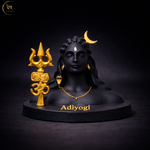
These sacred forms carry the same mystery this story reveals — the divine presence that transcends all origins

The Eleven Faces of the Father's Love
But the story deepens, like a river that reveals new currents the further you wade. Brahma, overwhelmed by the power radiating from this divine child, requested him to divide himself into gentler forms. And so Rudra became eleven — the Ekadasha Rudras — each carrying a different aspect of the cosmic force.
There was Kapali, the fierce protector. Pingala, the golden one. Bhima, the tremendous. Virupaksha, the one with unusual eyes. Vilohita, the red one. Each name carried a universe of meaning, each form a different way the infinite chose to be finite.
Imagine Brahma's wonder as he watched his "son" multiply into these magnificent forms. Like a father watching his child's first steps, not knowing that the child already contains the wisdom of ages. The creator marveling at his creation, not yet understanding that he himself exists within what he believes he has made.
What the Scriptures Whisper
The Vishnu Purana offers another layer to this cosmic mystery. It tells us that the three great forces — Brahma the creator, Vishnu the preserver, and Shiva the transformer — are like three faces of one diamond, each reflecting the same light differently.
In this understanding, to ask "Who is Shiva's father?" becomes like asking "Who is the father of space?" or "Who gave birth to eternity?" The question itself reveals our beautiful human need to understand the infinite through the language of relationship, of family, of love.
The Skanda Purana goes even further, suggesting that the relationship between Brahma and Shiva is like that between the wave and the ocean — the wave appears to emerge from the ocean, but both are water.
The Deeper Truth Behind the Story
What these ancient stories truly teach us is that divine relationships transcend human categories. When we call Brahma "Shiva's father," we are not speaking of biological birth but of cosmic function. Brahma represents the creative principle that gives form to the formless, name to the nameless, story to the eternal silence.
In the villages of Tamil Nadu, old women still sing lullabies that capture this mystery: "The father births the son, but the son was there before the father began." Children fall asleep to this paradox, their dreams somehow understanding what their minds cannot yet grasp.
The relationship between Brahma and Shiva mirrors the relationship between time and eternity, between the manifest and the unmanifest, between the story and the silence from which all stories emerge.
Regional Voices, Universal Truth
In Kerala, the Keralolpatti tells of Brahma meditating so deeply that he forgot himself entirely — and in that forgetting, Shiva appeared. Not as son, but as the awareness in which Brahma's meditation was taking place.
The Bengali tradition speaks of Brahma as Pitamaha — the grandfather principle — suggesting that even fatherhood is too limited a concept for this cosmic relationship. Like a grandfather who sees his own father in his grandchild's eyes, Brahma recognizes in Shiva something older than creation itself.
In the Himalayan caves where yogis still sit in meditation, they understand this story not as mythology but as the direct description of consciousness itself. Brahma is the creative thought, Shiva is the awareness in which that thought arises and dissolves.
The Living Mystery Today
Walk into any Shiva temple at dawn, when the first light touches the lingam and the priest begins the morning prayers. Watch the devotees' faces as they pour milk and water over the sacred stone. In their eyes, you will see the same wonder that filled Brahma when he first beheld his "son."
They are not worshipping a deity with a father and a family tree. They are touching the mystery of existence itself — the force that creates, sustains, and transforms all things, including the very capacity to ask "Who is the father?"
During Maha Shivratri, when millions stay awake through the night chanting Om Namah Shivaya, they are participating in the same cosmic moment when Brahma first spoke to the crying child. The night of Shiva is the night when the question of origins dissolves into the experience of the eternal now.
In the end, perhaps the most beautiful truth is this: Shiva's real father is not Brahma the deity, but the love that moves the sun and stars, the consciousness that dreams all dreams, the silence that gives birth to every sound. And that father — that source — lives not in some distant cosmic realm, but in the very heart of every seeker who has ever wondered about the mystery of existence.
The question "Who is Shiva's father?" becomes the doorway through which we discover our own deepest nature. For in seeking the source of the divine, we find that we ourselves are expressions of that same eternal, unborn, ever-present mystery that the ancients called by many names, but knew as one love.