 All Deities
 Gift & Worship
 Best seller
 About Us
 Contact Us
 Blogs
BlogsWhich Divine Weapons Still Guard the Universe Today?
The Night the Universe Held Its Breath
There was a moment, the Puranas tell us, when all creation stood still. Not from fear, but from recognition. The gods had just witnessed something that would change the very fabric of existence — the birth of the first divine weapon. In that sacred instant, raw cosmic energy took form, becoming not just an instrument of power, but a guardian of dharma itself.
This was no ordinary forging. When the divine weapons came into being, they carried within them the concentrated essence of universal law. Each one became a living force, capable of maintaining the delicate balance between creation and destruction, between order and chaos.
The Sudarshan Chakra — The Wheel That Sees All
In Vishnu's right hand spins a disc of pure light. The Sudarshan Chakra moves faster than thought itself, its thousand spokes cutting through illusion to reveal truth. Sudarshan — the word means 'auspicious vision' — for this weapon sees what mortal eyes cannot perceive.
The fisherman's daughter who lived by the Yamuna once told her grandmother about a strange dream. She had seen a golden wheel spinning above the river, and wherever its light touched, the water became crystal clear. The old woman smiled knowingly. "Child, you have seen the Chakra in your sleep. It cleanses not just water, but the very thoughts of those who are pure of heart."
The Vishnu Purana describes how this divine disc was born from the cosmic fire itself, forged by Vishvakarma, the divine architect. But the Bhagavata Purana tells us something deeper — that the Chakra is not separate from Vishnu, but an extension of his will made manifest. When dharma is threatened, the Chakra moves of its own accord, seeking out adharma wherever it hides.
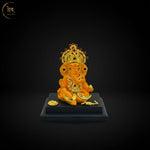
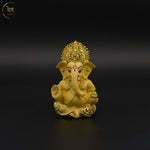
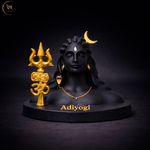
Guardians of Dharma — Sacred Presence for Your Home
These handcrafted murtis carry the same divine protection that flows through the cosmic weapons themselves


The Trishul — Where Three Worlds Meet
Shiva's trident pierces through the veils of existence itself. Its three prongs represent the three gunas — sattva, rajas, and tamas — the fundamental qualities that weave the fabric of creation. But the Trishul is more than symbol. It is the axis around which the cosmic dance revolves.
In the high Himalayas, where the snow never melts and the wind carries whispers of eternity, there stands a temple where no priest has ever served. The local shepherds say that on certain nights, when the moon is dark and the stars shine brightest, a blue light emanates from within. They know better than to approach. They understand that some sacred spaces guard themselves.
The Shiva Purana reveals that the Trishul was not forged but manifested — born from Shiva's own being when he first opened his third eye. Each prong carries a different power: creation, preservation, and destruction. Yet all three work in perfect harmony, for in the cosmic order, these are not opposing forces but complementary aspects of the same divine will.
Brahmastra — The Weapon of Ultimate Truth
There exists a weapon so powerful that its very name makes the wise fall silent. The Brahmastra — the weapon of Brahma — carries within it the force of absolute truth. It cannot be stopped, cannot be deflected, cannot be escaped. For how does one hide from truth itself?
The Mahabharata tells us of Arjuna learning its secret from Dronacharya, but with a warning that echoes through the ages: This weapon must never be used against one who is weaker, for it will destroy not just the target, but the one who wields it unjustly. The young prince who would become the greatest archer of his age understood then that true power lies not in the ability to destroy, but in the wisdom to restrain.
What makes the Brahmastra unique among divine weapons is its consciousness. It chooses its own target based on the purity of intention behind its invocation. The Ramayana describes how even Rama, the embodiment of dharma, recalled the weapon when he realized his opponent was worthy of mercy rather than destruction.
Vajra — The Thunderbolt of Indra
In Indra's hand rests a weapon born from sacrifice itself. The Vajra, shaped like a thunderbolt, was forged from the bones of the sage Dadhichi, who willingly gave his life so that the gods might have a weapon capable of defeating the demon Vritra. This is the profound truth the Vajra carries — that the greatest power comes from the greatest sacrifice.
The weapon appears in different forms across our sacred texts. Sometimes it is described as having a hundred points, sometimes a thousand. But the Rig Veda gives us the deepest understanding: The Vajra is both the hardest substance and the most compassionate force, for it destroys only to protect.
In the monasteries of the Himalayas, monks still carry small replicas of the Vajra during certain ceremonies. They understand that the weapon's true power lies not in its ability to strike down enemies, but in its capacity to shatter the illusions that bind the soul.
Gandiva — The Bow That Sings
Arjuna's bow was no ordinary weapon. Gandiva possessed a voice — it sang as arrows flew from its string, and that song could inspire courage in allies or strike terror in the hearts of the unrighteous. The bow chose its wielder, and once chosen, it would serve with absolute loyalty.
The old weapon-keeper in Hastinapura, whose grandfather had served in Yudhishthira's court, used to tell visitors about the morning after the great war ended. He had found Gandiva lying silent in the royal armory, its golden surface dim. "The bow was mourning," he would whisper. "It knew that the age of heroes had passed."
What the Mahabharata teaches us about Gandiva is that divine weapons are not mere tools — they are companions. They share in the joys and sorrows of their wielders. When Arjuna finally laid down his arms and walked toward the Himalayas, Gandiva returned itself to Varuna, the god of waters, from whom it had originally come.
The Pashupatastra — Shiva's Final Word
Among all divine weapons, none carries the finality of the Pashupatastra. This is Shiva's ultimate weapon, capable of destroying not just physical forms but the very karmic patterns that bind souls to existence. It is said that when this weapon is invoked, even time itself pauses to witness its power.
The weapon appears in our texts surrounded by the most solemn warnings. The Mahabharata tells us that Arjuna received knowledge of this weapon directly from Shiva, but with the understanding that it must never be used except when all of creation itself is threatened. For the Pashupatastra does not merely destroy — it unmakes, returning everything it touches to the primordial state before creation began.
In the Shiva temples of South India, there are certain inner sanctums where only the head priest may enter, and only on the night of Mahashivratri. The local people say these chambers contain not idols, but pure energy — the same force that flows through the Pashupatastra. Whether this is literal truth or sacred metaphor, the reverence it inspires is absolutely real.
The Living Weapons of Today
These divine weapons were never meant to be understood as mere mythology. They represent principles that remain active in our world today. The Sudarshan Chakra still spins wherever truth cuts through deception. The Trishul still stands wherever balance must be maintained between opposing forces. The Vajra still strikes wherever sacrifice transforms suffering into strength.
In the great temple at Tirupati, devotees still offer prayers for protection, knowing that the same divine forces that once manifested as cosmic weapons continue to guard those who walk the path of dharma. In the ashrams of Rishikesh, seekers meditate on these weapons not as instruments of war, but as tools of inner transformation — each one capable of destroying a different aspect of ignorance.
The weapons live on because the principles they embody are eternal. Justice, balance, sacrifice, truth, loyalty, and ultimate transcendence — these are not ancient concepts but present realities. Every time we choose dharma over convenience, we invoke the power of these divine weapons. Every time we stand for truth despite the cost, we become worthy to wield them.
And in the quiet moments before dawn, when the world holds its breath between night and day, those who listen carefully can still hear the distant song of Gandiva, the eternal hum of the Sudarshan Chakra, the cosmic vibration of the Trishul maintaining its perfect balance. The weapons of the gods have never left us. They have simply taken new forms, waiting for hearts pure enough to recognize their presence and hands steady enough to serve their eternal purpose.