 All Deities
 Gift & Worship
 Best seller
 About Us
 Contact Us
 Blogs
7 Chiranjeevi Names: The Seven Immortals and Their Katha
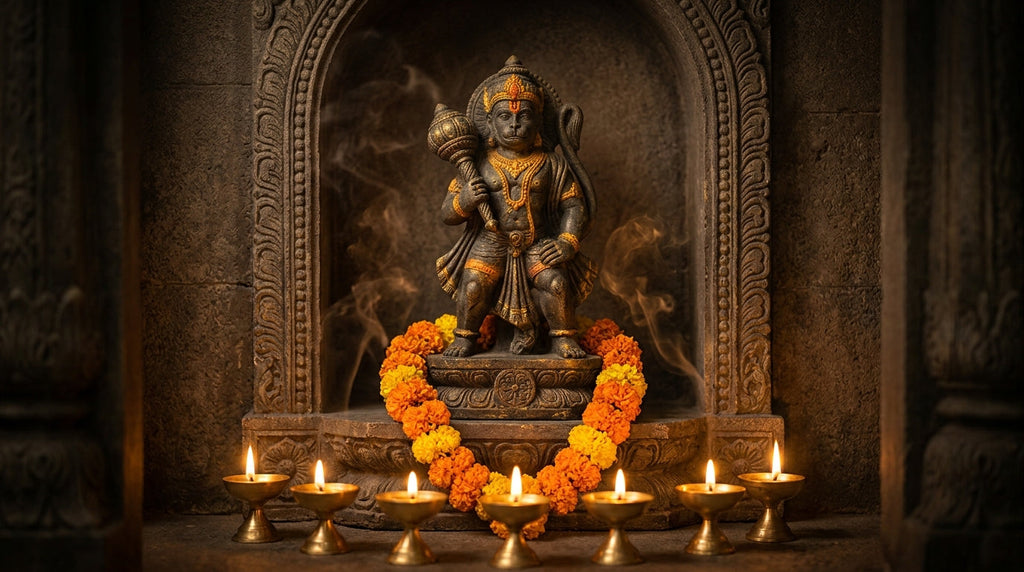
The elders tell us that when the evening lamp is lit and the family settles down together, there is a short verse that grandmothers teach children early. It names seven souls who are called chiranjeevi, the long-lived ones.
The 7 Chiranjeevi names are Ashwatthama, Mahabali (Bali), Vyasa, Hanuman, Vibhishana, Kripacharya and Parashurama. Some traditions add Markandeya as an eighth. Let us walk through each name the way it is told in our homes, through its katha, so that you remember the story and not just the list. A good place to begin such a remembrance is a quiet corner of the home mandir, the kind of corner Dev Tattva keeps in mind when its artisans shape each murti.
Who Are the 7 Chiranjeevi? The Verse and Its Meaning
The word is made of two parts: chira, meaning long or lasting, and jeevi, one who lives. So "long-lived" is closer to the spirit than a plain "immortal". According to tradition, these seven are carried through the present age by a boon, a curse or a duty that is not yet finished. How literally to take this is a matter of faith, and families hold different views.
Here is the verse that gathers them, as it is commonly recited:
अश्वत्थामा बलिर्व्यासो हनूमांश्च विभीषणः।
कृपः परशुरामश्च सप्तैते चिरजीविनः॥Ashwatthama balir vyaso hanumanshcha vibhishanah, Kripah parashuramashcha saptaite chiranjivinah.
Ashwatthama, Bali, Vyasa, Hanuman, Vibhishana, Kripa and Parashurama: these seven are the long-lived ones.
Small differences in wording are heard from region to region. The verse reaches us as a passed-down recitation, so I will not pin it to a single book. A longer form of the recitation adds Markandeya, which is why you will also hear of the Ashta Chiranjeevi, the eight.
Notice how different these seven are. One is a sage, one a king, one a warrior-teacher, one a devotee, one a brother who changed sides, one a royal guru, and one a son carrying a curse. Each has a story, and each story has a lesson.

The Katha of the Seven Chiranjeevi, Part One: Ashwatthama, Bali and Vyasa
Ashwatthama, the Restless Wanderer
Listen to how the story goes. Ashwatthama was the son of Drona, the great teacher of archery to the Kuru princes. He was born with a jewel on his forehead, and he stood on the Kaurava side in the war of Kurukshetra.
When the war was nearly over, the Mahabharata tells us, he entered the Pandava camp at night and killed the sleeping sons of Draupadi. It was a dark deed, done in grief and rage for his fallen father and his fallen king. When the Pandavas pursued him, he released a terrible divine weapon, and Krishna is remembered as the one who protected the unborn child Parikshit from its harm.
Krishna then pronounced a curse on him. In popular tellings, the jewel was taken from his forehead and he was condemned to wander for ages, carrying a wound that does not heal and finding no rest. Ashwatthama's long life is not a gift. It is the weight of a deed. That is why elders say he is the one Chiranjeevi no one envies.
Mahabali, the King Who Gave Everything
Now turn to a very different scene. Bali was an asura king, grandson of the devotee Prahlada, and he was famed for his generosity. His strength grew until even the devas feared for their place in the heavens.
The Bhagavata Purana tells us that Lord Vishnu came to him as Vamana, a small Brahmin boy with an umbrella and a gentle smile. He asked for only three paces of land. Bali's guru warned him that this boy was no ordinary child, but Bali had given his word, and a king of his kind does not take it back.
Vamana grew until one step covered the earth and the second covered the sky. For the third there was no place left, and Bali bowed his own head for the Lord's foot. Pleased by his truthfulness, Vishnu sent him to rule the netherworld of Sutala. In many tellings Bali is allowed to visit his people once a year, a memory kept alive in the festival of Onam in Kerala. The date of that festival changes every year, but the story does not.

Vyasa, the Keeper of Memory
Sage Vyasa, also called Krishna Dwaipayana, was born to the sage Parashara and Satyavati. Tradition honours him as the one who arranged the Vedas into their divisions and composed the Mahabharata. He is also remembered as the compiler of the Puranas.
There is a well-loved story that Lord Ganesha agreed to write down the Mahabharata as Vyasa recited it. This is a popular telling, and not every regional tradition carries it. What all agree on is that without Vyasa, we would have far less to remember. The full-moon day of Guru Purnima is also called Vyasa Purnima, a day to thank every teacher. Its date, too, changes every year.
Part Two: Hanuman and Vibhishana, Two Faithful Hearts of the Ramayana
Hanuman, the Servant Who Is Never Far
Of all seven, this is the name that most homes whisper first. Hanuman, son of Vayu the wind god and Anjana, is remembered as the perfect devotee of Lord Ram. When Sita was carried away to Lanka, he crossed the ocean in a mighty leap, found her in the Ashoka grove, and brought word back to Ram.
How did he become chiranjeevi? In popular tellings of the Ramayana tradition, Hanuman was granted a long life so that he would remain in the world as long as Ram's name and story are sung. The exact telling varies, and I would not fix it to one chapter. But the heart of it is clear: Hanuman is near wherever Ram is remembered.
That is why so many devotees choose a murti of Hanuman with Ram in his heart, as in the Hanuman idol with Ram in Heart from Dev Tattva. It shows the moment of devotion, with the chest opened and the beloved Lord within.


Vibhishana, the Brother Who Chose Dharma
Vibhishana was the younger brother of Ravana, king of Lanka. He was a devotee of Vishnu even in a house of power and pride. When Ravana carried Sita away, Vibhishana urged him to return her with respect.
Ravana would not listen. Vibhishana left Lanka and came to Ram's side, where Ram received him with kindness, and after the war he was crowned king of Lanka. Some people ask whether he betrayed his family. The tradition answers that he chose dharma over blood, and that it was a painful choice, not an easy one.
He is remembered as the one who stood for what was right, even when it cost him his home. Families who love the calm face of Ram often keep a Ram Lalla murti beside Hanuman in the mandir, and Dev Tattva's collection of Ram Lalla idols gathers such forms in one place.
Part Three: Kripacharya and Parashurama
Kripacharya, the Teacher Who Stayed
Kripacharya, or Kripa, was the royal preceptor of the Kuru house, and he taught the Pandava and Kaurava princes. He fought in the Kurukshetra war on the Kaurava side, out of loyalty to the throne he served. Yet he is remembered among the few who came out of that war alive.
His life is a quiet one. He is not a hero of dramatic scenes but a steady teacher, and tradition keeps his name in the verse so that we remember the worth of duty carried faithfully, even through sorrow.
Parashurama, the Warrior Sage
Parashurama, Rama of the axe, is counted as the sixth avatar of Vishnu in the common list of ten. He was the son of the sage Jamadagni and Renuka, and his axe, the parashu, is said in popular tellings to have come from Lord Shiva. In the Puranic accounts he rose against rulers who had misused their power.
After that, tradition says, he withdrew to a life of tapasya on the Mahendra mountain. Tellings differ in many details from place to place, and the elders say to hold such accounts with respect and without argument.

What the Seven Chiranjeevi Teach Us
Why seven? The elders do not agree on one answer, and that itself is a teaching. We can still read some lessons in the pattern.
- Ashwatthama shows that a long life without peace is a burden.
- Bali shows the strength of keeping one's word and of humility before the divine.
- Vyasa shows that knowledge must be kept and handed on.
- Hanuman shows devotion joined with service.
- Vibhishana shows the courage to choose what is right.
- Kripa shows the quiet duty of a teacher.
- Parashurama shows the power of tapasya and the need for restraint.
You will notice the list holds both light and shadow. Some are chiranjeevi by blessing, some by duty, one by curse. In that way the verse is honest about life: length of years is not the same as a good life, and what we do with our days is what the story remembers.
How Devotees Honour the Chiranjeevi Today
The simplest way is the verse itself. Many families recite it in the morning after the bath, as a quiet remembrance of the seven. There is no fixed rule, and customs vary from family to family and region to region.
Others choose one name and make it their own. Devotees of Hanuman light a lamp on Tuesdays and Saturdays and chant ॐ हनुमते नमः (Om Hanumate Namaha, I bow to Hanuman). Those who revere Vyasa offer flowers and gratitude to their teacher on Guru Purnima.
A murti gives the mind a place to rest. Among the seven, the form most often kept at home is Hanuman, and Dev Tattva offers handcrafted Hanuman murtis for the home mandir, the study table and the office desk. For the car, the car dashboard murtis are made in compact sizes, and the Hanuman Sitting Round Tail idol is one such form that devotees may keep in view while travelling.
Dev Tattva currently offers murtis of Hanuman, Ganesha, Shiva and Ram. For the other six names, a simple lamp, a flower and the verse are quite enough. The devotion matters more than the size of the offering.


Frequently Asked Questions
Who are the 7 Chiranjeevi in Hindu mythology?
They are Ashwatthama, Mahabali, Vyasa, Hanuman, Vibhishana, Kripacharya and Parashurama. The verse that names them is recited across India, with small regional variations in wording.
Is Markandeya also a Chiranjeevi?
In some traditions, yes. Markandeya is the young sage devoted to Shiva, and the longer recitation adds his name as the eighth, which is why you may hear of the Ashta Chiranjeevi. The classic list of seven does not include him.
Why is Hanuman a Chiranjeevi?
In popular tellings, Hanuman was granted long life for his devotion to Ram, and it is said he remains wherever Ram's name and story are remembered. The exact telling of the boon differs from one tradition to another.
Are the 7 Chiranjeevis still alive today?
That is a question of faith, and each family answers it in its own way. According to tradition, these seven are said to live on through the present age. Many devotees hold this as a belief, and others read it as a symbol of ideals that do not die.
May the stories of these seven stay with your family as they have stayed with ours for generations, and may the lamp in your home mandir keep burning with steady devotion. If you wish to bring a handcrafted Hanuman murti into your home, you will find a gentle beginning in the Dev Tattva Hanuman collection. Jai Shri Ram, and Jai Bajrangbali.

About the author
Pandit Om Prakash Saxena
Pandit Om Prakash Saxena is 94 years old and still active. For the last 72 years he has been involved in pooja, paath and all forms of karmakand, and he is associated with Shanti Kunj, Haridwar.
-
Posted in
7 chiranjeevi, chiranjeevi, hanuman, hindu mythology, parashurama, shloka