 All Deities
 Gift & Worship
 Best seller
 About Us
 Contact Us
 Blogs
BlogsWho is the Father of Lord Shiva? The Eternal Mystery
The Question That Touches Eternity
A child sits before her grandmother, eyes wide with wonder, and asks the question that has echoed through temples and ashrams for millennia: "Dadi, who is the father of Mahadev?"
The grandmother pauses, her weathered hands still on the prayer beads. How does one explain the unexplainable? How does one speak of the One who exists before existence itself?
This is not merely a question about divine genealogy. It is an inquiry into the very nature of consciousness, time, and the mystery of being itself.
When Brahma Became the Cosmic Father
In the sacred verses of the Shiva Purana, we find one answer that satisfies the mind seeking form and relationship. Here, Shiva emerges from the cosmic consciousness of Brahma during the great act of creation.
Brahma uvaca: aham tvam janayami putra, sarveshvara namostute - Brahma spoke: I give birth to you, my son, O Lord of all, I bow to you.
But even as these words are spoken, something profound happens. The moment Shiva manifests, Brahma himself bows down. The father prostrates before the son. Why? Because in that instant of manifestation, Brahma recognizes that he has not created Shiva - he has simply provided a doorway for the eternal to step into form.
Picture this cosmic moment: Brahma, seated on his lotus throne, deep in meditation on the act of creation. From his concentrated consciousness, a light begins to emerge - not born, but self-revealing. This light takes the form we know as Shiva, but the light itself has no beginning.
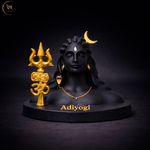
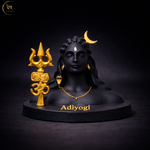
The Adi Yogi Who Needs No Origin
The Linga Purana tells us a different story altogether - one that dissolves the very question of parentage. Here, Shiva appears as the infinite pillar of light, the Jyotirlinga, before which both Brahma and Vishnu stand in wonder.
Neither can find the beginning nor the end of this cosmic column. Brahma flies upward on his swan for thousands of years. Vishnu dives downward in his boar form for eons. Both return, humbled and empty-handed.
From within this pillar, a voice resonates: "I am that which was before the first thought of creation. I am that which will remain after the last star dies. How can the eternal have a father?"
The Eternal Presence in Your Sacred Space
When the heart recognizes the timeless truth of Shiva, it seeks to honor that recognition through devotion

The Paradox of the Self-Born
In the ancient Tamil tradition, Shiva is called Swayambhu - the self-manifested one. The great sage Thirumoolar, in his Thirumandiram, writes of Shiva as the one who dances before creation begins, who exists in the space between thoughts, who is the silence from which all sound emerges.
Here lies the beautiful paradox that our scriptures embrace rather than resolve: Shiva is both the son of Brahma and the father of Brahma. He is both the created and the creator. He emerges from cosmic consciousness and yet is the ground of that very consciousness.
This is not contradiction - this is the nature of the infinite expressing itself through the finite mind's need for relationship and story.
The Cosmic Dance of Relationships
When we speak of divine relationships in our tradition, we are not speaking of biology. We are speaking of cosmic functions, of the eternal play of consciousness with itself.
Brahma represents the creative impulse - the first stirring of the unmanifest into manifestation. In this sense, yes, Shiva emerges from this creative principle. But Shiva as the eternal consciousness is the very ground from which Brahma's creative power springs.
It is like asking: "Which comes first, the dancer or the dance?" The question dissolves when you realize they are one movement expressing itself as two.
What the Sages Really Knew
The great Kashmiri sage Abhinavagupta understood this mystery deeply. In his Tantraloka, he speaks of Shiva as Prakasha - pure consciousness that illuminates itself. This consciousness needs no father because it is the very principle by which fatherhood itself becomes possible.
The rishis who composed our Puranas were not confused about Shiva's origins. They were teaching us something profound about the nature of existence itself. They gave us multiple stories because the truth they were pointing to cannot be captured in a single narrative.
Some stories serve the devotee who needs to see God in relationship - as son, as father, as beloved. Other stories serve the seeker who is ready to dissolve all relationships and merge with the absolute.
The Living Truth in Our Temples
Walk into any ancient Shiva temple in Tamil Nadu, and you will see this mystery carved in stone. The Swayambhu lingas - the self-manifested forms - appear without human installation. They simply emerge from the earth, from rocks, from the cosmic consciousness expressing itself in form.
At Kedarnath, pilgrims bow before a Shiva linga that is said to have appeared on its own. At Somnath, the jyotirlinga is worshipped as the eternal light that needs no kindling. These are not mere legends - they are invitations to experience the self-revealing nature of consciousness itself.
Even today, in villages across India, devotees will tell you of places where Shiva lingas have appeared overnight, where the eternal has chosen to make itself visible without human intervention.
The Question That Transforms the Questioner
Perhaps the real teaching lies not in answering who Shiva's father is, but in what happens to us when we ask the question deeply enough.
When we truly inquire into the source of the eternal, we begin to question our own origins. Who is the father of our own consciousness? What is the source of the awareness that is reading these very words?
The child who asks about Shiva's father is really asking about the mystery of her own existence. The grandmother who pauses before answering knows that the question, held with reverence, will eventually dissolve the questioner into the very mystery she seeks to understand.
In that dissolution, the answer reveals itself not as information but as recognition: I am that which has no father because I am the source from which all fatherhood springs.
This is why our tradition honors both the stories and the silence beyond stories. Both the form of Shiva dancing in cosmic joy and the formless consciousness in which that dance appears.
The father of Shiva is the same as the father of your next breath, the father of the space in which these words appear, the father of the love that seeks to know itself through every question ever asked.
That father has no name because it is the source of all names. It has no form because it is the consciousness in which all forms appear and disappear like waves on an infinite ocean.
And in recognizing this, the child's question receives its deepest answer - not in words, but in the wordless understanding that she and the mystery she seeks are not two.