 All Deities
 Gift & Worship
 Best seller
 About Us
 Contact Us
 Blogs
BlogsWho Created Shiva? The Mystery Beyond Creation
The Question That Dissolves Itself
A young devotee once approached his guru with trembling hands folded in reverence. "Guruji," he whispered, "who is the father of Mahadev? Who gave birth to the one who destroys death itself?"
The old sage smiled, his eyes twinkling like stars reflected in the Ganga. "Beta," he said gently, "you are asking who created the one who exists before creation. It is like asking who lit the first flame, or who spoke the first word into silence."
This question — who is the father of Shiva — has echoed through temple corridors and meditation caves for millennia. But perhaps the question itself reveals something more profound than any answer ever could.
The One Who Was Never Born
In the vast landscape of Hindu cosmology, Shiva occupies a position that defies the very concept of origin. The Shiva Purana declares with crystalline clarity: Shiva is Swayambhu — the self-existent one, born from his own divine will.
Unlike the countless deities who emerge from cosmic unions, divine boons, or the creative will of Brahma, Shiva simply is. He exists in the eternal present tense — never was, never will be, but always is.
Picture the moment before the first dawn. Before Brahma opens his eyes to begin creation. Before Vishnu stirs from his cosmic sleep on the serpent Shesha. In that absolute stillness, in that pregnant void, Shiva dances. He has been dancing there forever, and he will dance there when the last star burns out.
The Eternal Trinity's Timeless Dance
The Brahma Vaivarta Purana offers us a glimpse into this mystery through a story that unfolds outside time itself. Once, Brahma and Vishnu found themselves in heated debate — each claiming supremacy over the other. Their argument shook the foundations of existence until suddenly, a massive pillar of fire erupted between them, stretching infinitely upward and downward.
Vishnu, in his determination, took the form of a boar and dove deep into the earth, seeking the pillar's base. Brahma, equally resolute, became a swan and soared toward the heavens, searching for its peak. Both searched for eons, but neither could find an end to this cosmic column.
Exhausted and humbled, they returned to find Shiva emerging from the pillar — not as someone who had created it, but as someone who was it. The pillar was not Shiva's creation; it was Shiva's very being made manifest.
"I am the beginning that has no beginning," Shiva spoke, his voice like thunder rolling across empty skies. "I am the end that knows no ending. How can that which is eternal have a father?"
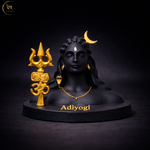
The Eternal Presence in Your Sacred Space
When we understand Shiva's timeless nature, we invite that same eternal presence into our homes and hearts

Beyond the Cycle of Birth and Death
What makes Shiva's fatherless existence so profound is not merely that he has no creator, but what this reveals about the nature of ultimate reality itself. In the Katha Upanishad, we find these words: That which is unborn, eternal, permanent, and primeval is not slain when the body is slain.
Shiva embodies this truth completely. He is Mahakaal — the great time, the destroyer of time itself. How can time have a beginning? How can eternity be born?
Consider the sacred ash that Shiva smears across his body. This vibhuti is not decoration — it is a teaching. It whispers to us that everything born must return to ash, everything created must dissolve. But the one who wears the ash, the consciousness that observes the cycle of creation and destruction, remains untouched.
A village potter once asked his grandfather, "Dadaji, if Shiva has no father, how did he learn to be divine?" The old man, his hands still shaped by decades of working clay, smiled. "Beta, does the sky need to learn how to be vast? Does fire need to learn how to burn? Divinity is not learned — it simply is."
The Paradox of the Destroyer Who Creates
In the cosmic dance of existence, Shiva plays a role that seems contradictory to those who think in linear terms. He is the destroyer, yet without destruction, there can be no new creation. He is the end, yet he enables every beginning.
The Linga Purana reveals this mystery through the symbol of the Shivalinga itself — the formless form, the beginning that has no beginning, the end that knows no ending. The linga represents not a physical form but the very principle of existence that underlies all forms.
In the ancient temples of Tamil Nadu, priests still chant at dawn: He who has no birth gives birth to all. He who has no form takes every form. He who has no father becomes the father of existence itself.
This is why, when we ask "Who is Shiva's father?", the question dissolves into understanding. Shiva is not part of the chain of causation — he is the space in which all causation occurs.
The Living Truth in Sacred Tradition
Even today, in the high Himalayas where Shiva is said to meditate eternally, yogis understand this truth not through philosophy but through direct experience. In the deepest states of meditation, when the sense of individual self dissolves, what remains is not born and cannot die. What remains has no father, no mother, no beginning, no end.
This is why the great sage Adi Shankaracharya wrote: I am neither born nor do I die. I am the eternal witness, the unchanging consciousness in which all change appears. He was not speaking of his individual self, but of the Shiva-nature that exists at the core of all being.
In the sacred geography of India, this truth is carved in stone and sung in rivers. At Kedarnath, where Shiva is worshipped as the eternal lord, pilgrims climb through treacherous mountain paths not to reach a deity who was born somewhere, but to touch that which was never born and will never die.
At Kashi, the eternal city that Shiva holds in his trident, the very ground whispers this secret: death is an illusion, birth is a dream, and what you truly are has no father because it has no beginning.
The Question That Transforms the Questioner
Perhaps the most beautiful aspect of asking "Who is Shiva's father?" is how the question changes us. We begin by seeking information and end by discovering transformation.
When we truly understand that Shiva has no father, we begin to glimpse that the deepest part of ourselves — the consciousness that witnesses our thoughts, our emotions, our experiences — also has no beginning. We are not just bodies that learned to be conscious; we are consciousness that appears to have bodies.
This understanding doesn't come through intellectual analysis alone. It comes through devotion, through meditation, through the gradual dissolution of the ego that insists everything must have a cause, a beginning, a father.
In the villages of India, grandmothers still tell children: "When you can find Shiva's father, you will have found your own true face." It sounds like a riddle, but it is the deepest teaching. The search for Shiva's origin becomes the discovery of our own eternal nature.
The question "Who is Shiva's father?" is not answered — it is transcended. And in that transcendence, we touch something that has been waiting for us all along: the recognition that what we truly are has never been born and will never die, just like the eternal Shiva who dances in the heart of existence itself.
Today, as temple bells ring across India at the hour of evening prayer, this ancient truth continues to pulse through the devotional heart of our civilization — not as philosophy to be understood, but as reality to be lived.