 All Deities
 Gift & Worship
 Best seller
 About Us
 Contact Us
 Blogs
BlogsWhich Divine Weapon Reigns Supreme: Pashupatastra vs Sudarshan?
The Eternal Question That Divides the Heavens
In the great assembly of Indra's court, a question once arose that silenced even the Gandharvas mid-song. Sage Narada, with his characteristic smile that held secrets, posed it thus: "If the Pashupatastra of Mahadeva and the Sudarshan Chakra of Narayana were to meet in cosmic battle, which would emerge victorious?"
The question hung in the divine air like incense smoke, heavy with implications. For this was not merely about weapons — this was about the very nature of creation and destruction, about the eternal dance between Shiva and Vishnu that keeps the universe in motion.
The Pashupatastra: Shiva's Ultimate Weapon of Dissolution
The Pashupatastra emerges from the very essence of Rudra — that primal force which existed before creation began. Pashupati means the lord of all creatures, and this weapon carries within it the power to dissolve not just physical forms, but the very bonds that hold existence together.
In the Mahabharata, when Arjuna receives this weapon from Shiva himself, the description makes the earth tremble. The Pashupatastra does not merely destroy — it returns everything to its primordial state, to that cosmic silence from which all sound emerges. It is the weapon of the ultimate yogi, the one who sits in meditation while the universe dances around him.
The power of this astra lies not in its ability to kill, but in its capacity to liberate. When released, it dissolves the illusion of separateness itself. The Shiva Purana tells us that this weapon once threatened to unmake creation entirely, forcing Brahma himself to intervene.
The Sudarshan Chakra: Vishnu's Wheel of Cosmic Order
The Sudarshan Chakra spins with the rhythm of dharma itself. Su-darshan means "auspicious vision" — this weapon sees through all illusions and cuts through every falsehood to establish truth. Where the Pashupatastra dissolves, the Sudarshan Chakra discerns.
Born from the combined radiance of Surya, this chakra never misses its target because it is guided by the cosmic intelligence that maintains universal balance. In the Bhagavata Purana, we see Krishna wielding it not just as a weapon, but as an instrument of divine justice that protects dharma across all realms.
The chakra's thousand spokes represent the thousand ways dharma manifests in creation. It moves faster than thought, sharper than time itself, and returns to Vishnu's finger having accomplished its divine purpose. Unlike other weapons that exhaust their power, the Sudarshan Chakra grows stronger with each righteous act.
Divine Presence for Your Sacred Space
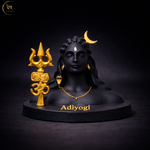
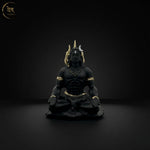
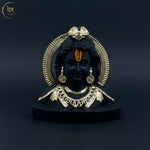
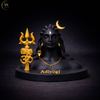
When cosmic forces inspire devotion, bring their earthly forms into your home with these handcrafted murtis


The Cosmic Confrontation That Never Was
The scriptures speak of a moment when these two supreme weapons nearly clashed. During the great war between the devas and asuras, when even Indra's vajra proved insufficient, both Shiva and Vishnu prepared to release their ultimate astras. The Pashupatastra began to glow with the fire of dissolution, while the Sudarshan Chakra spun with the light of a thousand suns.
But then something extraordinary happened. As the weapons approached each other, they began to merge rather than collide. The ancient rishis who witnessed this cosmic event understood a profound truth: these weapons represent complementary aspects of the same divine reality.
The Vishnu Purana records this moment differently than the Shiva Purana, and both differ from the folk traditions of Tamil Nadu. Yet all agree on one point — when ultimate power meets ultimate power, the result is not destruction but transformation.
The Philosophy Behind the Power
To understand which weapon is more powerful, we must first understand what power means in the cosmic sense. The Pashupatastra embodies samhara shakti — the power of dissolution that clears the way for new creation. It is the power of the void, of that pregnant emptiness from which all possibilities emerge.
The Sudarshan Chakra represents dharma shakti — the power that maintains cosmic order and protects righteousness. It is the power of discernment, of cutting through ignorance to reveal truth.
In the Bhagavad Gita, Krishna reveals: I am Time, the destroyer and creator of worlds. This suggests that the Sudarshan Chakra, as his weapon, partakes in both creation and destruction. Similarly, the Rudra Samhita tells us that Shiva's dance of destruction is simultaneously the dance of creation.
Regional Wisdom and Textual Variations
In the temples of Kerala, the priests will tell you that the Pashupatastra and Sudarshan Chakra are like the two eyes of Brahman — one sees what must be dissolved, the other sees what must be preserved. Neither can function without the other.
The Tamil Shaivite tradition holds that the Pashupatastra is supreme because it can dissolve even dharma itself when the cosmic cycle demands it. Meanwhile, the Vaishnavite tradition of Vrindavan maintains that the Sudarshan Chakra is ultimate because it protects the very foundation upon which existence rests.
In the folk songs of Rajasthan, there's a beautiful verse that translates roughly as: "When Shiva's arrow meets Vishnu's wheel, the universe holds its breath — for in that moment, destruction and preservation dance as one."
The Answer That Is No Answer
After decades of studying these texts, of sitting in meditation before the murtis of both Shiva and Vishnu, of listening to the wisdom of village grandmothers and learned pandits alike, I have come to understand something profound about this question.
The question itself reveals our limited understanding of divine power. We think in terms of competition, of one force overcoming another. But the cosmic reality operates on a different principle entirely.
The Pashupatastra and Sudarshan Chakra are not opponents — they are dance partners in the cosmic ballet. One leads when dissolution is needed, the other when preservation is required. Their power is not in their ability to defeat each other, but in their perfect coordination in maintaining the rhythm of existence.
Perhaps the real question is not which weapon is more powerful, but how we can align ourselves with the cosmic intelligence that wields both with perfect wisdom.
The Living Truth in Today's World
Even now, in temples across India, priests perform the evening aarti holding both the trishul of Shiva and the chakra symbol of Vishnu. In Haridwar, during the Ganga aarti, you can see devotees with tilaka marks of both traditions, understanding intuitively what the scriptures teach through story.
The power of these divine weapons lives not in ancient tales alone, but in the choices we make each day. When we face a situation that requires us to let go of what no longer serves — we invoke the Pashupatastra. When we must protect what is righteous and true — we call upon the Sudarshan Chakra.
In the end, the most powerful weapon is the wisdom to know when to use which power. And that wisdom, the scriptures tell us, comes only through devotion, through surrender to the divine intelligence that orchestrates this cosmic dance of creation, preservation, and dissolution.
The debate continues in the celestial realms, and perhaps it is meant to continue. For in that eternal question lies an eternal teaching: true power is not about dominance, but about perfect harmony with the cosmic will.