 All Deities
 Gift & Worship
 Best seller
 About Us
 Contact Us
 Blogs
BlogsWhich Divine Weapons Still Guard Us Today?
The Arsenal of the Divine
In the pre-dawn darkness of a village temple in Tamil Nadu, the priest raises a small brass trishul toward the oil lamp's flame. The three prongs catch the light — creation, preservation, destruction — and for a moment, the cosmic dance of Shiva lives in that tiny metal form. This is not worship of a weapon. This is recognition of a truth so vast that only symbol can contain it.
The weapons of our gods are not instruments of war. They are technologies of transformation, each one a concentrated form of divine energy that has shaped the spiritual landscape of Bharat for millennia. When we speak of Vishnu's chakra or Indra's vajra, we speak of forces that still move through the world, still protect the righteous, still cut through the illusions that bind us.
Vishnu's Sudarshan Chakra — The Wheel of Perfect Vision
The Sudarshan Chakra spins at the tip of Vishnu's finger, a disc of pure light that never misses its mark. Su-darshan — beautiful vision, perfect sight. This is the weapon that sees through all deception, that cuts through maya itself.
In the great battle at Kurukshetra, when the sun refused to set and Jayadratha hid behind its light, Krishna raised his chakra. The sun vanished behind its brilliance, and in that moment of cosmic twilight, Arjuna's arrow found its mark. The chakra had not destroyed the sun — it had revealed the truth that was always there.
The Vishnu Purana tells us that this chakra was forged from the dust of Surya's own radiance, ground down by Vishvakarma's wheel until it became a weapon of pure consciousness. When it spins, it creates the wheel of time itself — past, present, and future collapsing into a single point of divine will.
But watch a potter's wheel in any village today. See how the clay rises under the potter's hands, how formlessness becomes form through the power of the spinning wheel. The Sudarshan Chakra lives there too — in every act of creation that brings order from chaos, beauty from the raw earth.
Shiva's Trishul — The Three-Pronged Truth
The trishul in Shiva's hand carries the weight of existence itself. Three prongs — three gunas, three worlds, three states of consciousness. This is not a weapon that destroys enemies. This is the instrument that destroys ignorance.
When Shiva dances his Tandava, the trishul moves with him, each prong tracing the rhythm of cosmic law. Creation rises on one prong, preservation balances on another, and dissolution completes the cycle on the third. The demon Andhakasura learned this when Shiva's trishul pierced him — not to kill, but to burn away the darkness of his name until he became Bhringi, the devoted one.
In the Shiva Purana, we read how this trishul emerged from the fire of Shiva's third eye, forged in the furnace of pure consciousness. When Daksha's sacrifice burned with the fire of ego, it was the trishul that restored cosmic balance, not through violence, but through the fierce compassion that cuts away what no longer serves.
Sacred Forms for Sacred Spaces
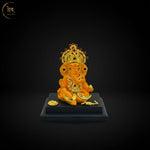
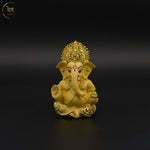
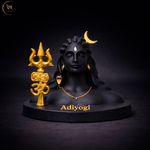
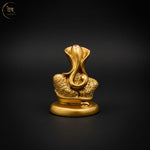
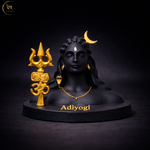
These handcrafted murtis carry the same divine energy that flows through the ancient stories


Indra's Vajra — The Thunderbolt of Awakening
Before it became a weapon, the vajra was a sacrifice. The sage Dadhichi gave his bones so that Indra might have a weapon strong enough to defeat Vritra, the drought-demon who had swallowed all the waters of the world. This is the deepest truth of the vajra — it is forged from surrender, from the willingness to give everything for the sake of dharma.
The Rig Veda sings of this moment: When Indra hurled the vajra, the mountains trembled and the waters burst forth like cattle released from their pen. But this is not just the story of a weather god defeating a demon. This is the eternal battle between consciousness and unconsciousness, between the flow of life and the forces that would dam it up.
In Tibet, they call it the dorje — the indestructible diamond that cuts through all illusion. But in the villages of Rajasthan, you can still see the vajra's power in the lightning that breaks the summer's heat, in the first drops of monsoon rain that awaken the sleeping earth. The weapon of Indra lives wherever consciousness breaks through the hard shell of ignorance.
Durga's Arsenal — The Weapons of Collective Divinity
When the gods could not defeat Mahishasura, they gave their weapons to Devi. Vishnu's chakra, Shiva's trishul, Indra's vajra — all placed in her eighteen hands. But she was not merely carrying their weapons. She had become the source from which all weapons draw their power.
The Devi Mahatmya tells us that each weapon blazed with new fire in her hands, as if recognizing its true origin. The lion she rode was not tamed — it was awakened to its own divine nature. When she fought Mahishasura, she was not using violence against violence. She was using the focused power of the universe to restore balance.
Watch the Durga Puja in Bengal, and you will see this truth enacted every year. The weapons in her hands are not symbols of war — they are symbols of the divine feminine's power to protect, to nurture, to transform. Each weapon represents a different aspect of shakti, the creative force that moves through all existence.
Hanuman's Gada — The Mace of Devotion
The gada in Hanuman's hand was not forged by any divine smith. It grew from his devotion itself, heavy with the weight of his love for Rama. When he leaped across the ocean to Lanka, the gada flew with him, not as a burden but as an extension of his own strength.
In the Ramayana, when Hanuman strikes down the demons in Ashoka Vatika, each blow of his gada rings with the sound of Rama's name. The weapon has become a form of prayer, each swing an offering of service. This is why the gada represents not just physical strength, but the strength that comes from complete surrender to the divine will.
The Hanuman Chalisa reminds us: Ram rasayan tumhare pasa, sada raho Raghupati ke dasa — You possess the elixir of Ram's name, always remain the servant of Raghupati. The gada is that elixir made manifest, devotion given form and weight.
Ganesha's Ankusha — The Goad of Gentle Guidance
The small curved blade in Ganesha's hand looks almost delicate compared to the mighty weapons of other gods. But the ankusha — the elephant goad — carries its own profound wisdom. It is the tool that guides without forcing, that directs without violence.
An elephant mahout knows that the ankusha is not used to hurt the elephant, but to communicate with it, to remind it of the path when it wanders into dangerous territory. In Ganesha's hand, the ankusha becomes the divine guidance that steers us away from the obstacles we create for ourselves.
The Ganesha Purana tells us that this ankusha can hook and pull away the ego-mind when it becomes too attached to temporary pleasures. But it does so with the gentleness of a mother guiding a child, not the harshness of a conqueror subduing an enemy.
The Living Weapons in Our Temples
Walk into any temple in India today, and you will see these weapons still alive, still active. The brass trishul behind the Shiva lingam, the small chakra spinning in the morning aarti, the miniature gada placed before Hanuman's murti. These are not decorations. They are focal points for the same divine energies that once moved through the great cosmic battles.
In the temple at Tirupati, the chakra of Venkateshwara is said to spin on its own during the pre-dawn abhishekam. In Varanasi, the trishul of Kashi Vishwanath glows with its own inner light during the evening aarti. These are not miracles in the sense of violations of natural law. They are the natural result of concentrated devotion meeting the eternal presence of the divine.
The weapons of the gods are not museum pieces from a mythological past. They are living technologies of transformation, as active today as they were in the age of the Puranas. Every time we choose dharma over adharma, every time we cut through our own illusions, every time we protect what is sacred — we are wielding these weapons ourselves.
In a small temple in Kerala, an old priest still performs the ancient ritual of Shastra Puja — the worship of weapons. He places flowers on a simple iron trishul, lights incense before a brass chakra, offers rice to a wooden gada. He knows what the modern world has forgotten: that these forms are not symbols of violence, but of the divine power that protects all life.
The weapons of the gods are still here, still guarding us, still cutting through the darkness. We need only the eyes to see them, the heart to recognize them, the wisdom to wield them with the same love and devotion that first brought them into being.