 All Deities
 Gift & Worship
 Best seller
 About Us
 Contact Us
 Blogs
BlogsWhich Sword Could Cut Through Time Itself?
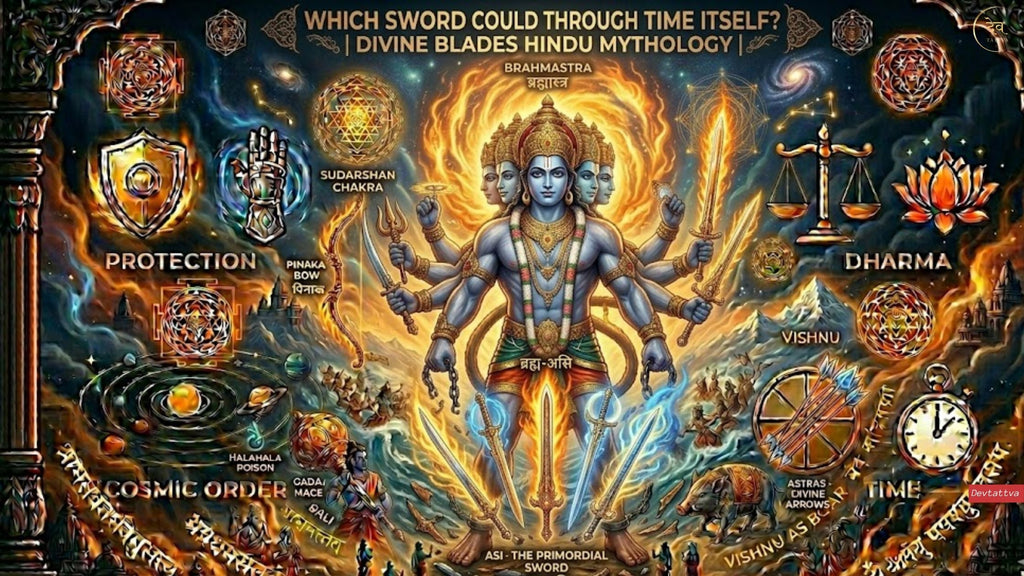
The Blade That Commands All Blades
In the armory of the gods, where weapons are forged from starlight and tempered in cosmic fire, one sword stands above all others. Its name whispers through the Puranas like a prayer that even demons fear to hear.
But which blade holds this supreme power? The answer lies not in the sharpness of its edge, but in the hand that wields it and the purpose it serves.
Nandaka - The Sword of Vishnu

In the eternal realm of Vaikuntha, where time moves like honey and every breath is a blessing, Vishnu holds Nandaka - the sword of joy. This is no ordinary weapon. When the Vishnu Purana speaks of Nandaka, it describes a blade that cuts through the very fabric of illusion.
Nandaka sarva-shastra-shreshtham - Nandaka is the supreme among all weapons, declares the ancient text. But what makes it supreme is not its ability to destroy bodies, but its power to sever the bonds of ignorance that bind souls to suffering.
The sword appears in Vishnu's hand whenever dharma itself is threatened. During the great churning of the ocean, when demons and gods fought for the nectar of immortality, Nandaka gleamed in the Lord's grasp - not to spill blood, but to ensure that cosmic order would prevail.
A fisherman's daughter in Dwarka once asked her grandmother: "Why does Krishna carry a sword when he has the Sudarshan Chakra?" The old woman smiled, her hands still weaving nets in the pre-dawn darkness. "Child," she said, "the chakra destroys what must be destroyed. But the sword - the sword cuts away what should never have been."
Chandrahas - Shiva's Blade of Cosmic Laughter
High in the peaks of Kailash, where the air is so thin that only gods can breathe it freely, Shiva carries Chandrahas - the sword that laughs like the moon. Its name means "laughter of the moon," and those who have glimpsed it in battle say it seems to smile as it moves through the air.
The Shiva Purana tells us that Chandrahas was gifted to Ravana by Shiva himself, pleased with the demon king's devotion. But here lies the terrible irony - the sword that was meant to protect Ravana ultimately became a symbol of his downfall. For Chandrahas could only be wielded by one whose heart was pure. The moment Ravana's pride corrupted his devotion, the sword began to turn against him.
In the final battle of Lanka, when Rama's arrows filled the sky like falling stars, Ravana reached for Chandrahas. But the blade, sensing the darkness in his heart, grew heavy as a mountain in his hands. The sword that had once danced like moonlight now refused to move.
This is the deepest truth about divine weapons - they serve not the one who holds them, but the righteousness that flows through them.
Divine Guardians for Your Sacred Space
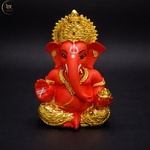
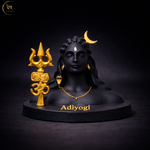
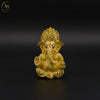
Just as these legendary swords protected dharma, let these blessed murtis guard your home with their divine presence


Asi - The Primordial Sword of Brahma
Before Nandaka, before Chandrahas, before any weapon had ever tasted battle, there was Asi - the first sword, born from the sacrifice of Brahma himself. The Mahabharata speaks of this blade in hushed tones, calling it sarva-shastra-janaka - the father of all weapons.
The story of Asi's birth reads like a cosmic poem written in fire and sacrifice. When the forces of chaos threatened to overwhelm creation itself, Brahma performed a great yajna. From the sacred flames emerged a being of pure energy, holding a sword that blazed like a captured sun. This was Asi, and the being who held it was the first Kshatriya - the protector of dharma.
But Asi was too powerful for any mortal to wield. Its very presence could burn through the fabric of reality. So Brahma divided its essence among all future weapons, ensuring that no single blade would ever again hold such absolute power. Every sword forged thereafter carries a fragment of Asi's original fire.
In the great battle of Kurukshetra, when Arjuna drew his bow and Krishna spoke the Bhagavad Gita, some say they could see the ghost of Asi flickering in the air above the battlefield - not as a weapon, but as a reminder that all conflict must ultimately serve the cause of righteousness.
The Sword of Karttikeya - Vel That Cuts Through Ignorance

In the Tamil lands, where devotion flows like the monsoon rains and every temple stone has been worn smooth by millions of prostrations, they speak of Vel - the divine spear-sword of Karttikeya. Though called a spear, Vel possesses the cutting power of the finest blade, and its spiritual significance runs deeper than any ocean.
The Skanda Purana tells us that Vel was forged from the combined tejas - the spiritual fire - of all the gods. When demons threatened the very existence of knowledge and wisdom, Parvati herself gave this weapon to her son Karttikeya. Vel Muruga, the devotees cry even today - "Spear of Muruga" - and in that cry lives the memory of every battle fought against ignorance.
But here is what makes Vel unique among divine weapons: it was designed not just to destroy enemies, but to cut through the illusions that create enmity in the first place. When Karttikeya wielded Vel against the demon Tarakasura, he was not merely killing a demon - he was severing the very root of pride and ignorance that had created the demon's power.
A young priest in Palani once asked his guru: "Why do we offer prayers to Vel separately from Muruga?" The old man pointed to the weapon gleaming in the deity's hand. "Because, my child, sometimes we need the god's compassion. But sometimes we need the weapon's precision. Both are forms of grace."
The Paradox of Divine Power
As I have walked through temples from Kanyakumari to Kashmir, from the ghats of Varanasi to the peaks of Kedarnath, one truth has emerged again and again: the most powerful sword in Hindu mythology is not the one that cuts deepest into flesh, but the one that cuts most precisely through illusion.
The Bhagavad Gita speaks of this when Krishna tells Arjuna: Nainam chindanti shastrani - weapons cannot cut the soul. The greatest divine swords understand this truth. They are designed not to destroy life, but to protect it by destroying what threatens life's highest purpose.
Each of these legendary blades - Nandaka, Chandrahas, Asi, Vel - represents a different aspect of divine intervention in human affairs. Nandaka cuts through cosmic illusion. Chandrahas destroys pride and ego. Asi establishes the very principle of righteous warfare. Vel pierces through ignorance to reveal truth.
But perhaps the most powerful sword of all is the one mentioned in the Katha Upanishad: Shreyo hi jnanam abhyasat - knowledge is indeed superior to practice. The sword of wisdom, wielded through understanding and devotion, cuts through karma itself.
Living Legends in Modern Times
Even today, in temples across India, you can see the continuation of these ancient traditions. In Tirupati, devotees offer miniature swords to Venkateshwara, remembering his aspect as the protector. In Palani, the Vel of Muruga is carried in procession, its power undiminished by centuries.
During Navaratri, when the Divine Mother is worshipped in her warrior aspect, swords are blessed in temples from Gujarat to Bengal. The priests who perform these rituals understand what their ancestors knew: these weapons are not mere metal, but crystallized intention - the will of the divine made manifest in form.
In the end, the most powerful sword in Hindu mythology is not any single blade, but the principle they all represent: that divine power, when wielded with pure intention, becomes an instrument of liberation rather than destruction. Whether held by Vishnu, Shiva, Karttikeya, or the Divine Mother, these swords remind us that true strength lies not in the ability to harm, but in the wisdom to protect what is sacred.
The next time you see a sword in a deity's hand, remember - you are looking not at a weapon of war, but at a tool of grace, designed to cut away everything that stands between the soul and its highest destiny.