 All Deities
 Gift & Worship
 Best seller
 About Us
 Contact Us
 Blogs
BlogsWhich Divine Bows Shaped the Fate of Three Worlds?
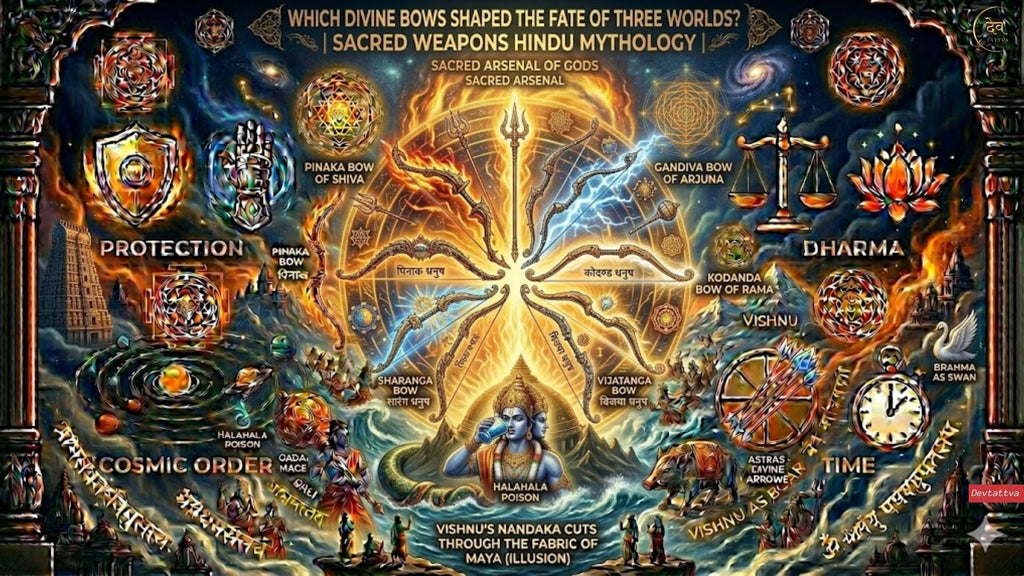
The Weapons That Held the Universe in Their String
In the great armory of the cosmos, where gods forge weapons from starlight and demons craft blades from darkness, ten bows stand apart. These are not mere instruments of war — they are the very threads upon which the fabric of dharma is woven. When drawn, they do not simply release arrows. They release destiny itself.
The ancient texts whisper their names with reverence. The Mahabharata tells us: Yatra dharmastatra jayah — where there is dharma, there is victory. But sometimes, dharma needs a bow to make its voice heard across the three worlds.
Pinaka — The Bow That Could Unmake Creation

In Shiva's hands rests Pinaka, the bow that trembles at the very thought of being drawn. Crafted by Vishvakarma from the essence of Mount Meru itself, this bow carries within its curve the power to dissolve the universe back into the cosmic void from which it emerged.
When Sati's father Daksha insulted Shiva at the great yajna, it was Pinaka that Shiva reached for first. The bow's string, when touched, sent tremors through all fourteen realms. Even the gods fell to their knees, knowing that if Shiva drew it fully, creation itself would end in that moment.
The bow's wood comes from the cosmic tree that grows at the center of existence. Its string is woven from the serpent Vasuki's shed skin, blessed by time itself. When an arrow is nocked upon Pinaka, it does not seek a target — it seeks the very concept that needs to be erased from reality.
Gandiva — The Bow That Never Knew Defeat

From the cosmic fires emerged Gandiva, destined for the hands of the greatest archer the world would ever know. When Agni, the fire god, gifted it to Arjuna, he spoke these words: This bow shall make you invincible in battle, for it carries within it the concentrated tapas of a thousand sages.
Gandiva's string produces a sound like thunder rolling across the heavens. This divine roar alone was enough to scatter enemy armies before a single arrow flew. The bow could fire a hundred arrows in the time it takes to blink, each one guided by the archer's pure intention rather than mere skill.
During the great war at Kurukshetra, when Arjuna hesitated to fight his own kinsmen, it was Gandiva that reminded him of his dharma. The bow grew heavy in his hands — not from its weight, but from the weight of cosmic justice that demanded to be served.
Warriors of Dharma — Bring Divine Strength Home
These sacred murtis carry the same unwavering devotion that guided the greatest archers of our epics


Kodanda — Rama's Bow of Righteous Fury
When dharma walks the earth in human form, it needs a weapon worthy of its purpose. Kodanda was that weapon — the bow that Rama carried through fourteen years of exile and into the great war against Ravana's forces in Lanka.
This bow came to Rama through his guru Vishvamitra, who had received it from the gods themselves. Unlike other divine weapons that demanded worship and elaborate rituals, Kodanda responded only to pure intention. In the hands of one whose heart harbored even a trace of selfish desire, it would not draw. But in Rama's hands, it became an extension of cosmic justice itself.
The most telling moment of Kodanda's power came not in battle, but in a moment of testing. When Sita emerged from her trial by fire, proving her purity to a doubting world, Kodanda's string sang without being touched — the bow itself bearing witness to truth that human eyes could not see.
Vijaya — The Bow That Knew Only Victory
In the hands of Karna, the son of Surya, rested Vijaya — the bow that had never tasted defeat. Crafted by Vishvakarma for Indra himself, this weapon carried within its frame the concentrated power of a thousand thunderbolts.
Vijaya's arrows did not follow the laws of earthly physics. They could curve around mountains, pierce through multiple targets, and return to the quiver if their mission was not yet complete. The bow's string was made from the hair of celestial horses, and its grip was wrapped in the hide of the cosmic serpent Shesha.
When Karna drew Vijaya for the final time at Kurukshetra, facing Arjuna in single combat, the very earth trembled. Two divine bows — Vijaya and Gandiva — faced each other across the battlefield, and for a moment, time itself held its breath to see which would prove supreme.
Sharanga — Vishnu's Bow of Cosmic Order
In the hands of Vishnu rests Sharanga, the bow that maintains the balance of the universe. Unlike weapons of destruction, Sharanga exists to preserve — to protect dharma when it falters and to restore cosmic order when chaos threatens to overwhelm creation.
Sharanga's arrows carry within them the power of time itself. They can age a demon to dust in moments or restore youth to a dying sage. The bow's wood comes from the cosmic tree Kalpataru, and its string is woven from the rays of a thousand suns.
When Vishnu incarnates upon the earth, Sharanga takes forms appropriate to each avatar. In Krishna's hands, it became the bow that could fire arrows of pure love, piercing the hearts of the gopis and drawing them into divine ecstasy. In Rama's time, it manifested as the great bow that only he could string, proving his divine nature to Sita's father.
Rudra — The Bow of Divine Wrath
Before Pinaka, there was Rudra — the first bow ever created, forged in the cosmic fires that burned before the first creation. This weapon belongs to Shiva in his aspect as the destroyer of evil, the one who dances upon the corpse of ignorance.
Rudra's arrows are not physical projectiles but concentrated aspects of divine wrath. They seek out adharma wherever it hides — in the hearts of kings, in the councils of gods, in the deepest caves where demons plot against creation. Once released, these arrows cannot be recalled until their purpose is fulfilled.
The bow's most fearsome quality is its ability to multiply. In moments of great cosmic crisis, Rudra can become a thousand bows in Shiva's thousand hands, each one capable of ending a different aspect of the threat facing dharma.
Vayu — The Bow That Rides the Wind
Hanuman carries Vayu, the bow that moves faster than thought itself. Crafted by the wind god for his son, this weapon can fire arrows that travel between dimensions, striking targets in past, present, and future simultaneously.
Vayu's string produces no sound when drawn — its arrows arrive before the enemy even knows they have been fired. The bow can shoot arrows of pure prana, the life force itself, either draining enemies of their strength or restoring allies to full vigor in the midst of battle.
During the great war in Lanka, when Hanuman needed to cross the ocean in a single leap, it was Vayu that he drew. The arrow he fired created a bridge of compressed air that carried him across the waters faster than any bird could fly.
Brahmastra Dhanush — The Bow of Ultimate Knowledge
In the hands of Brahma rests the bow that fires arrows of pure knowledge. This weapon does not destroy through force but through revelation — its arrows carry the power to show beings their true nature, stripping away all illusion and maya.
The bow's arrows can pierce through any deception, any disguise, any false identity. When fired at a demon, they reveal the divine spark hidden beneath layers of ignorance. When fired at a sage, they can grant instant enlightenment or reveal the next step on their spiritual journey.
Brahmastra Dhanush appears rarely in the great epics, for its power is too profound for most conflicts. It emerges only when the very nature of reality is at stake, when the cosmic order needs to be reminded of its own true foundation.
Mahakala — The Bow That Commands Time
Time itself bows before Mahakala, the weapon that can slow moments into eternities or compress years into heartbeats. This bow belongs to Shiva in his aspect as the lord of time, the one who dances the universe through its cycles of creation and destruction.
Mahakala's arrows can age enemies to dust or restore the dead to life by reversing the flow of time around them. The bow can fire into the past, preventing events from occurring, or into the future, ensuring that certain destinies come to pass.
When the great sage Markandeya was destined to die at sixteen, it was Mahakala that Shiva used to grant him immortality — not by preventing death, but by creating a bubble of eternal present around the young devotee, where time could never advance enough to claim him.
Indrastra — The Bow of Divine Authority
Indra's bow carries within it the authority of kingship itself. Indrastra does not merely defeat enemies — it establishes the divine right to rule, the cosmic mandate that separates legitimate authority from mere power.
The bow's arrows carry the weight of cosmic law. When they strike, they do not simply wound — they establish justice. A king struck by Indrastra's arrow will either become a perfect ruler or lose his throne entirely, for the weapon cannot tolerate the abuse of power.
During the great churning of the ocean, when gods and demons fought over the nectar of immortality, it was Indrastra that maintained order. Its arrows ensured that each side received exactly what their karma had earned, no more and no less.
The Eternal Dance of Divine Weapons
These ten bows exist not merely as weapons but as principles — cosmic forces given form so that dharma might have hands to work with in the world. Each one represents a different aspect of divine will: preservation, destruction, justice, knowledge, time, authority.
The Bhagavad Gita reminds us: Paritranaya sadhunam vinashaya cha dushkritam — for the protection of the good and the destruction of evil. These bows are the instruments through which that cosmic promise is fulfilled.
In temples across India, devotees still offer prayers to these divine weapons. In Kerala, the Kodanda Rama temples maintain ancient bows blessed by generations of priests. In the Himalayas, certain caves still echo with the sound of Pinaka's string, though no mortal hand has drawn it for millennia.
The power of these bows lives on not in museums or legends, but in the hearts of those who understand that true strength comes not from the weapon but from the purity of purpose that guides it. When dharma needs defending, when truth needs speaking, when justice needs serving — the cosmic bowstring still trembles, waiting for hands worthy enough to draw it.
And in that trembling, in that eternal readiness, lies the promise that no darkness, however deep, can ever fully extinguish the light of righteousness from this world.