 All Deities
 Gift & Worship
 Best seller
 About Us
 Contact Us
 Blogs
BlogsHow Powerful is Shiva? The Night Creation Trembled
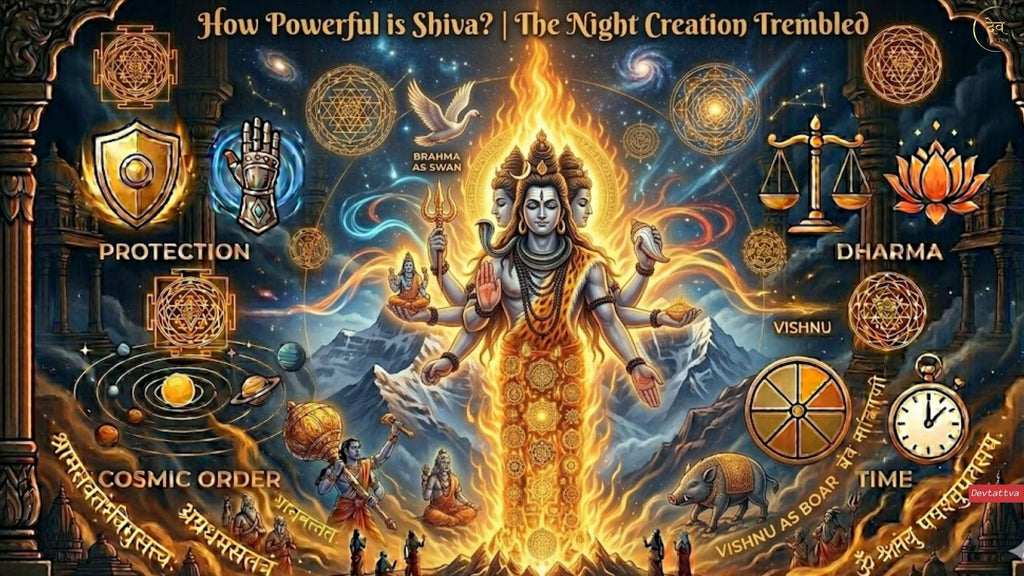
The Question That Shook the Heavens
When Brahma and Vishnu argued over who was supreme, the cosmos itself held its breath. Mountains stopped growing. Rivers paused mid-flow. Even time seemed to wait for an answer that would never come through words alone.
Then appeared a pillar of fire — endless, blazing, without beginning or end. And in that moment, both creator and preserver understood they were witnessing power beyond their comprehension. This was not Shiva announcing his strength. This was existence itself revealing its deepest truth.
The Fire That Has No Limits
Brahma took the form of a swan and flew upward for a thousand years, searching for the top of the luminous column. Vishnu became a boar and dug downward for another thousand years, seeking its base. Neither found what they sought. The pillar stretched infinitely in both directions — a geometric impossibility that was also the most fundamental reality.
When they returned, humbled and exhausted, the pillar split open. From within stepped Shiva, calm as a mountain lake, terrible as the fire that ends worlds. Shivoham — I am Shiva — he spoke, and the words contained not arrogance but simple truth. The power they had witnessed was not separate from him. It was him.
The Shiva Purana tells us: He is the beginning, the middle, and the end of all that exists. Beyond him, there is nothing. Before him, there was nothing. He is the eternal, the infinite, the absolute.
The Third Eye That Unmakes Worlds

Shiva's power does not rest in his weapons, though the Trishul can pierce through any armor ever forged. It does not rest in his strength, though he can lift mountains like pebbles. His true power lies in his third eye — the eye of knowledge that sees beyond the veil of maya.
When Kamadeva, the god of desire, dared to disturb Shiva's meditation by shooting arrows of attraction, the third eye opened for just an instant. Kamadeva was reduced to ash before he could blink. Not from anger — Shiva felt no anger. The eye simply saw desire for what it truly was: an illusion that dissolves when touched by pure awareness.
But this same eye that can destroy can also create. When Shiva's consort Parvati playfully covered his eyes, darkness fell across the universe. To restore light, Shiva opened his third eye, and its gentle radiance brought warmth back to all living beings. The eye that unmakes can also remake. The power that destroys is the same power that preserves.
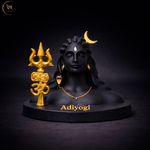
Invoke the Power of Mahadev
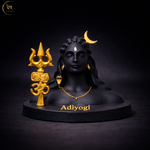
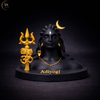
These sacred murtis carry the same divine energy that flows through every Shiva temple across Bharat

The Dance That Sustains All Existence
In the cosmic dance hall of Chidambaram, Shiva performs the Tandava — the dance of creation, preservation, and destruction. Each movement of his feet creates new worlds. Each gesture of his hands maintains the rhythm of time itself. Each breath he takes is the cycle of birth and death for countless beings.
But the most powerful moment in this eternal dance is not when he creates or destroys. It is when he lifts his left foot in perfect balance, suspended between earth and sky. In that moment of absolute stillness within movement, devotees glimpse the truth: all power, all energy, all existence flows from this single point of divine equilibrium.
The sages who first witnessed this dance understood something that modern minds struggle to grasp. Shiva's power is not the power to control. It is the power to let go. Not the strength to hold the universe together, but the wisdom to allow it to unfold according to its own deepest nature.
The Poison That Saved Creation

When the gods and demons churned the cosmic ocean for the nectar of immortality, fourteen precious things emerged. Thirteen were gifts — the goddess Lakshmi, the divine horse Ucchaishravas, the wish-fulfilling tree Kalpavriksha. But the fourteenth was halahala — poison so potent it could dissolve all of creation.
The gods ran to Vishnu. Vishnu directed them to Shiva. And Shiva, without hesitation, drank the poison that no other being could even touch. But he held it in his throat, neither swallowing nor spitting it out. The poison turned his throat blue, earning him the name Neelkanth — the blue-throated one.
This is perhaps the deepest teaching about Shiva's power. He does not use his strength to avoid suffering or to push away what is difficult. He transforms poison into beauty, darkness into light, destruction into the space where new creation can emerge. His power is not separate from his compassion. They are the same force, flowing from the same infinite source.
The Silence That Contains All Sound
The Vigyan Bhairav Tantra records a conversation between Shiva and Parvati where she asks him to reveal the deepest secrets of existence. His answer fills 112 verses, each one a doorway into direct experience of the divine. But the most profound teaching comes not in words but in the spaces between words — the silence from which all sound emerges and into which all sound returns.
In the beginning was the Word, and the Word was with Shiva, and the Word was Shiva — but before the Word was the Silence, and that Silence is his truest power. It is the power of pure potential, the space of infinite possibility from which all manifestation springs.
The Beggar Who Owns Everything
Shiva wanders as a naked ascetic, carrying only a begging bowl made from a human skull. He owns nothing, possesses nothing, claims nothing. Yet kings and gods bow before him. Why? Because in owning nothing, he lacks nothing. In possessing nothing, he contains everything. In claiming nothing, he is everything.
This is the paradox that reveals the true nature of his power. It does not come from accumulation but from renunciation. Not from grasping but from letting go. Not from becoming more but from recognizing what was always already complete.
A merchant once asked a wandering sadhu: "If Shiva is so powerful, why does he live like a beggar?" The sadhu smiled and replied: "When you own the entire universe, what is left to possess?"
The Power That Transcends Power
In the end, asking "How powerful is Shiva?" is like asking "How wet is water?" or "How bright is light?" Power is not something Shiva has. Power is what Shiva is. He is the source from which all energy flows, the ground in which all strength is rooted, the space in which all force moves.
The Rudram, one of the most ancient hymns to Shiva, addresses him as the power in the thunderbolt, the strength in the mountain, the force in the wind, the energy in fire. But it also calls him the gentleness in a mother's touch, the patience in a sage's meditation, the love in a devotee's heart. His power encompasses all opposites because it transcends all categories.
Even today, in temples across India, devotees pour water on the Shivalinga at 4 AM, knowing that this simple act connects them to the same infinite power that once manifested as a pillar of fire. The water they pour is the same water that flows in the Ganga, which flows from Shiva's hair. The hands that pour are moved by the same consciousness that dances the cosmic dance. The devotion they feel is the same love that holds all creation in perfect balance.
This is Shiva's ultimate power — not to remain distant and untouchable, but to be so intimately present that every breath we take, every heartbeat we feel, every moment of awareness we experience is his power flowing through us, as us, for the sheer joy of existence itself.