 All Deities
 Gift & Worship
 Best seller
 About Us
 Contact Us
 Blogs
BlogsWhich Divine Weapons Still Shape Our World Today?
The Night Indra's Vajra Split the Sky and Changed Everything
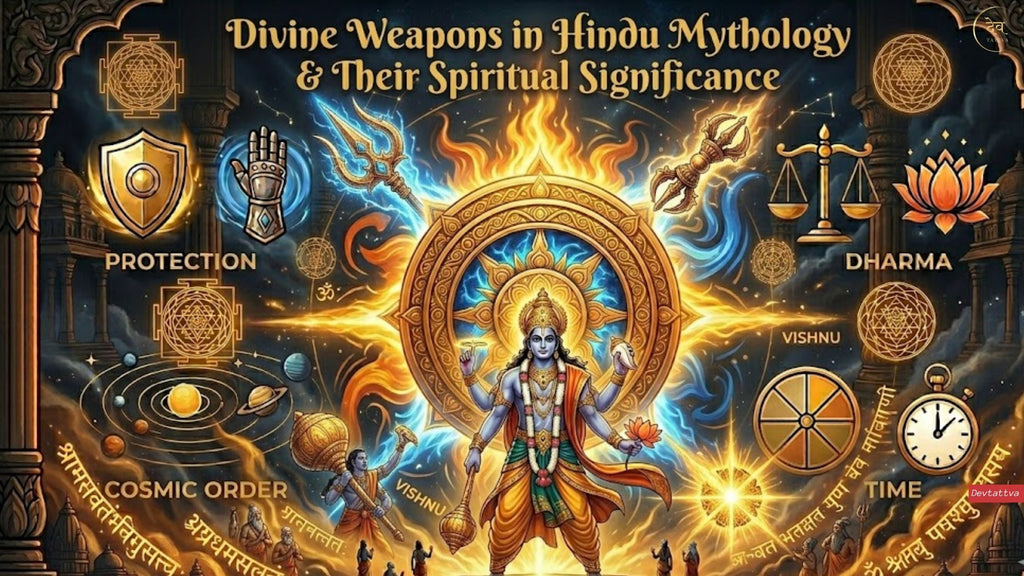
In the cosmic armory of the gods, no weapon was ever forged merely to destroy. Each divine astra carried within it a fragment of universal truth, a piece of the cosmic order that maintains balance between creation and dissolution. Tonight, as temple bells ring across India and devotees light their evening diyas, these same weapons continue their eternal work — not on ancient battlefields, but in the hearts of those who understand their deeper meaning.
The astras — divine weapons of Hindu mythology — were never mere instruments of war. They were manifestations of cosmic principles, each one a concentrated expression of the divine will that governs existence itself.
The Sudarshan Chakra: The Wheel That Never Stops Turning

In Vishnu's right hand spins the Sudarshan Chakra, its thousand spokes catching starlight as it turns. Su-darshan — beautiful vision, perfect sight. This is not a weapon that cuts flesh. This is the wheel of time itself, the cosmic principle that ensures dharma prevails over adharma, truth over falsehood.
The Bhagavad Gita speaks of this eternal principle: Yada yada hi dharmasya glanir bhavati bharata, abhyutthanam adharmasya tadatmanam srjamy aham — whenever dharma declines and adharma rises, the divine manifests to restore balance.
Watch a potter's wheel spin clay into form, and you witness the Sudarshan Chakra at work. See a mother's love shape her child's character through countless small corrections, and you see the same divine principle. The chakra never stops turning because the work of maintaining cosmic order never ends.
In the great battle of Kurukshetra, when Krishna released the Sudarshan Chakra, it did not merely defeat enemies. It restored the balance that had been disturbed by Duryodhana's greed and Shakuni's deception. The weapon served dharma, not destruction.
Shiva's Trishul: The Three-Pointed Truth

From the snowy peaks of Kailash comes the sound of Shiva's trishul striking stone. Three points, three fundamental forces: creation, preservation, destruction. But look closer — the trishul is not three separate weapons. It is one weapon with three expressions, just as Brahman manifests as Brahma, Vishnu, and Mahesh.
The middle prong represents consciousness itself — pure awareness that witnesses all change but remains unchanged. The left prong is ida, the cooling lunar energy. The right prong is pingala, the heating solar energy. Together, they represent the dance of opposites that creates all existence.
Every breath you take follows the trishul's pattern. Inhalation, retention, exhalation. Birth, life, death. Past, present, future. The weapon teaches what the Upanishads declare: Sarvam khalvidam brahma — all this is indeed Brahman, appearing in three aspects but remaining one.
Sacred Forms for Sacred Spaces
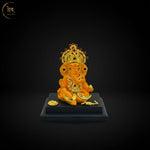
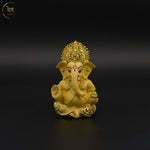
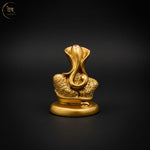
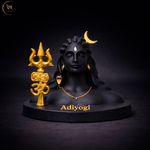
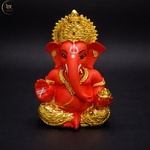
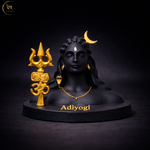
These handcrafted murtis carry the same divine energy that flows through the cosmic weapons — perfect for your home temple or meditation space


The Brahmastra: The Weapon That Unmakes Worlds
There exists a weapon so terrible that even its name makes sages pause before speaking. The Brahmastra — the weapon of Brahma, the creator himself. But here lies the deepest mystery: how can the force of creation also be the force of ultimate destruction?
The answer lies in understanding what creation truly means. To create something new, something old must be dissolved. To birth the dawn, the night must die. The Brahmastra does not destroy — it returns everything to its primordial state, to the unmanifest potential from which new creation can emerge.
In the Mahabharata, when Ashwatthama releases the Brahmastra in his rage, Krishna intervenes not because the weapon is evil, but because the time for such cosmic dissolution has not yet come. The weapon serves the cosmic cycle, not human anger.
Arjuna possessed the Brahmastra but used it only once, against divine beings who could withstand its power. This teaches us that the greatest weapons require the greatest wisdom. Power without understanding is not strength — it is catastrophe.
Indra's Vajra: The Thunderbolt of Awakening
High in the heavens, Indra raises his vajra — the thunderbolt that splits clouds and brings the life-giving rain. But the vajra is more than a weapon of the storm god. It is the sudden flash of realization that cuts through the clouds of ignorance.
The word vajra means both thunderbolt and diamond — the hardest substance that can cut through anything, yet remains itself uncut. This is the nature of truth. It can penetrate any delusion, any false belief, any constructed reality, but truth itself remains unchanged by what it destroys.
In Buddhist tradition, the vajra becomes the symbol of enlightenment itself — the indestructible awareness that shatters the illusion of separation. Hindu and Buddhist wisdom converge here: the weapon that destroys ignorance is the same force that reveals our true nature.
When Indra strikes the demon Vritra with his vajra, he is not merely defeating an enemy. Vritra represents drought, stagnation, the hoarding of life's waters. The vajra releases what has been held back, allowing the rivers of consciousness to flow freely once again.
Hanuman's Gada: The Mace of Devotion
In Hanuman's mighty grip rests a weapon that appears simple — a gada, a mace. No cosmic wheels, no three-pointed mysteries, no world-ending power. Just a heavy club that a devoted servant carries in service of his beloved Ram.
But simplicity can be the most profound complexity. The gada represents bhakti — pure devotion that needs no elaborate philosophy, no complex understanding. It simply serves. It simply loves. It simply acts when action is needed.
The Hanuman Chalisa declares: Ram duware tum rakhvare, hoat na aagya binu paisare — You are the guardian at Ram's door; none can enter without your permission. The gada is not just a weapon — it is the strength that protects what is sacred.
Every mother lifting her child, every farmer working his field, every teacher shaping young minds — they all carry Hanuman's gada. Devotion in action becomes the most powerful weapon against the forces that would diminish love.
The Pashupatastra: Shiva's Ultimate Mystery
Beyond all other weapons lies one so secret that its very existence is whispered rather than proclaimed — the Pashupatastra, the weapon of Shiva as Pashupati, the lord of all creatures. This astra cannot be countered, cannot be defended against, cannot be recalled once released.
But the Pashupatastra carries within it the deepest teaching of all divine weapons: it can only be used by one who has transcended the desire to use it. Only someone who has moved beyond ego, beyond personal will, beyond the illusion of being the doer, can wield this ultimate power.
Arjuna receives this weapon from Shiva himself, but the conditions of its use ensure that it serves only the cosmic order, never personal ambition. The weapon teaches what the Bhagavad Gita proclaims: Nishkama karma — action without attachment to results.
The Living Weapons of Today
Walk into any temple at dawn, and you will see these weapons still at work. The priest's bell is Indra's vajra, awakening consciousness with its clear sound. The circular movements of aarti are Vishnu's chakra, maintaining the rhythm of devotion. The three flames of the diya mirror Shiva's trishul, representing the three aspects of existence.
In the Kumbh Mela, millions gather not to witness ancient history, but to participate in the ongoing cosmic battle between dharma and adharma. Each pilgrim carries within themselves all the divine weapons — the discriminating wisdom of the chakra, the transforming power of the trishul, the awakening force of the vajra.
The weapons of the gods were never separate from the gods themselves. They are expressions of divine consciousness, and that same consciousness dwells within every sincere seeker. The Upanishads remind us: Tat tvam asi — That thou art. The divine weapons are not distant mythological artifacts. They are the spiritual forces available to anyone who approaches them with proper understanding and pure intention.
Tonight, as you light your evening lamp, remember: you hold in your hands the same fire that powers the cosmic weapons. Use it wisely. Use it with devotion. Use it in service of the light that never dies.