 All Deities
 Gift & Worship
 Best seller
 About Us
 Contact Us
 Blogs
BlogsWhich Divine Weapons Could Destroy All Creation?
When Gods Forged Weapons From Starlight
In the cosmic armory of the divine, where weapons are born not from metal but from mantras, where arrows carry the power of creation itself, there exists an arsenal so magnificent that even the gods hesitate before invoking them. These are not tools of destruction alone — they are instruments of cosmic justice, forged in the fires of righteousness and tempered in the waters of dharma.
The ancient texts speak of a time when the very fabric of reality could be torn and rewoven with a single weapon's release. When Arjuna stood on the battlefield of Kurukshetra, the Brahmastra resting in his consciousness like a sleeping sun, he carried within himself the power to unmake worlds.
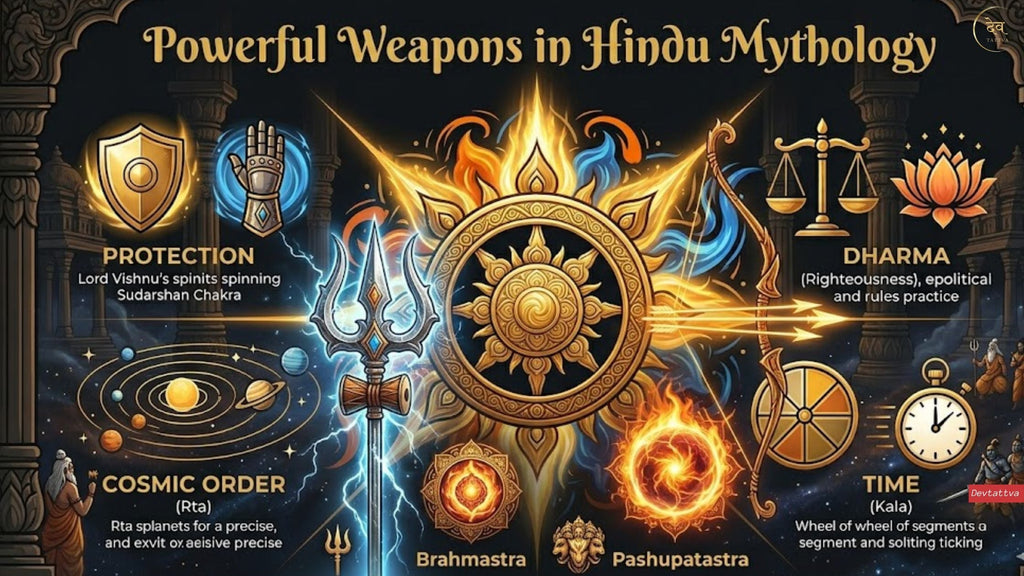
The Brahmastra — Fire of Creation's End

In the beginning, Brahma creates. But within creation lies the seed of its own dissolution. The Brahmastra emerges from this cosmic paradox — a weapon that carries the creator's own fire, capable of reducing entire armies to ash in moments.
The Mahabharata tells us: When the Brahmastra is released, it blazes like a thousand suns rising together in the sky. But this is no mere metaphor. The weapon draws its power from the very force that ignited the first stars, that breathed life into the cosmic egg from which all existence emerged.
Drona teaches this ultimate astra to his most devoted students, but with a warning that echoes through the ages: once invoked, it cannot be recalled. The weapon chooses its own target, guided by the intention in the wielder's heart. When Ashwatthama releases it in grief and rage after his father's death, it seeks out the wombs of the Pandava women, threatening to end their lineage forever.
Only Krishna's intervention saves the unborn Parikshit, but the child is born marked by the weapon's touch — a reminder that some powers are too vast for mortal hands to wield without consequence.
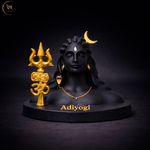
Shiva's Trishul — The Trident of Time Itself
Before weapons, before war, before the very concept of destruction, there was Shiva's Trishul. This is not a weapon forged in any earthly fire — it is the crystallization of time itself, the physical manifestation of the cosmic principle that what is born must die, what is created must be dissolved.
The three prongs represent the three gunas — sattva, rajas, and tamas — the fundamental forces that weave the fabric of existence. When Shiva raises the Trishul, he does not merely threaten to destroy. He reminds creation of its own impermanence.
The Shiva Purana describes how the Trishul can pierce through the seven lokas in a single thrust, how it can cut through the bonds of karma itself. When the demon Andhaka, born from Shiva's own sweat, grows arrogant with power, it is the Trishul that pins him to the cosmic mountain, burning away his ego until only devotion remains.
Divine Protectors for Your Sacred Space
Just as these cosmic weapons protected dharma, let these blessed murtis guard your home with their divine presence


Vishnu's Sudarshan Chakra — The Wheel of Cosmic Order

In Vishnu's hand rests a weapon that is also a promise — the Sudarshan Chakra, the wheel of cosmic order that ensures dharma prevails across all realms of existence. This is not merely a discus of war; it is the very principle of justice made manifest, spinning with the rhythm of cosmic law.
The Chakra possesses its own consciousness, its own devotion to the divine will. When Vishnu releases it, the weapon travels through dimensions, cutting through illusion and ignorance to strike at the heart of adharma. It can divide itself into countless forms, appearing simultaneously in multiple battles across the universe.
The Bhagavata Purana reveals: The Sudarshan Chakra moves faster than thought itself, and no power in creation can obstruct its path when dharma calls. When the demon Shishupala exhausts his hundred lifetimes of forgiveness, it is the Chakra that severs his head, liberating his soul in the very moment of his destruction.
But the weapon's greatest power lies not in destruction but in protection. During the Kurukshetra war, when the sun threatens to set before Arjuna can fulfill his vow to kill Jayadratha, Krishna uses the Chakra to eclipse the sun temporarily, creating the illusion of sunset that draws the enemy into the open.
Indra's Vajra — Lightning Crystallized
From the bones of the sage Dadhichi comes Indra's Vajra — a weapon born from sacrifice, forged from the willing surrender of a great soul. This is the thunderbolt of the gods, the crystallized essence of lightning itself, capable of shattering mountains and splitting the heavens.
The story of its creation reveals the weapon's true nature. When the demon Vritra threatens to withhold the rains forever, the gods despair. No ordinary weapon can pierce the demon's hide. Only something forged from the bones of one who has transcended all attachment to the body can hope to succeed.
Dadhichi, the great sage, offers his life without hesitation. What use is this body if it cannot serve dharma? he asks, and dissolves his mortal form through the power of his tapas. From his bones, Vishvakarma crafts the Vajra — a weapon that carries within it the sage's selfless devotion.
When Indra wields the Vajra against Vritra, he carries not just a weapon but the accumulated merit of a soul that chose cosmic welfare over personal survival. The demon falls not merely to the thunderbolt's power, but to the purity of intention that forged it.
Karna's Shakti — The Spear of Singular Purpose
Among all divine weapons, perhaps none carries more tragedy than Karna's Shakti — the spear gifted by Indra in exchange for the warrior's natural armor and earrings. This weapon embodies the cruel mathematics of fate: infinite power, but only once.
The Shakti never misses its target. It can pierce any armor, overcome any protection, defeat any warrior. But once thrown, it returns to its divine source, leaving its wielder mortal once more. Indra's gift is also Indra's trap — a weapon designed to save Arjuna by ensuring Karna cannot use it against him.
Karna knows this. In his heart, he understands that the weapon represents both his greatest strength and his ultimate limitation. When Ghatotkacha threatens to destroy the Kaurava army with his demonic powers, Karna faces an impossible choice: use the Shakti to save his allies, knowing it means his own doom in tomorrow's battle with Arjuna.
He chooses dharma over survival. The Shakti blazes through the night sky like a falling star, and Ghatotkacha dies with a smile, knowing his death has saved his father's brother. In that moment, the weapon reveals its deepest truth — that true power lies not in the ability to destroy, but in the wisdom to sacrifice.
The Pashupatastra — Shiva's Final Word
Beyond all other weapons lies the Pashupatastra — Shiva's ultimate creation, a weapon so powerful that its very existence threatens the stability of creation. This is not merely an instrument of war; it is the embodiment of Shiva's role as Mahakala, the great destroyer who dances at the end of time.
The Mahabharata tells us that when Arjuna receives this weapon from Shiva himself, he is warned never to use it against lesser foes, for it would consume not just the target but the entire universe. The Pashupatastra represents the ultimate test of a warrior's wisdom — infinite power coupled with infinite responsibility.
Only those who have transcended the ego can wield it safely. The weapon reads the heart of its user, and if it finds even a trace of personal desire or hatred, it turns upon the wielder. This is Shiva's final teaching embedded in his greatest gift — that true strength comes not from the ability to destroy, but from the restraint to preserve.
The Living Truth of Divine Weapons
These weapons live still in the consciousness of devotees who understand their deeper meaning. Every time a mother protects her child with fierce love, she wields the Trishul. Every time a judge delivers fair verdict despite personal cost, the Sudarshan Chakra spins in their heart. Every time someone sacrifices personal gain for collective good, they forge their own Vajra from the bones of selflessness.
In temples across India, priests still chant the mantras that once invoked these astras, not to call down destruction, but to invoke the qualities they represent — righteousness, sacrifice, protection of the innocent, and the courage to stand for dharma when the world seems lost to darkness.
The weapons of the gods were never about war. They were about the eternal battle between light and shadow that rages in every human heart, and the divine power that awakens when we choose to fight on the side of truth.