 All Deities
 Gift & Worship
 Best seller
 About Us
 Contact Us
 Blogs
BlogsWhat Does Lord Ganesha's Modak Symbolise?

Lord Ganesha's modak symbolises the sweet reward of inner joy, wisdom and devotion. The word modak is linked to the Sanskrit moda, meaning delight, and the little dumpling is often read as a picture of the happiness that follows patient effort and spiritual understanding. Hidden inside its soft shell is a filling of coconut and jaggery, a gentle reminder that real sweetness lies within.
In this article we look at the layers of meaning, the stories people tell, the regional variations and the simple way families offer modak to Bappa today.
Why Is the Modak So Closely Linked With Ganesha?
Among all the sweets of the Indian kitchen, the modak holds a special place in Ganesha's iconography. He is called Modakapriya, the one who loves modak, and Modakahasta, the one who holds a modak in his hand. In many murtis you will see a small bowl of modaks or a single modak resting in his palm.
This is not decoration alone. Hindu imagery is full of objects that carry a teaching, and the modak is one of the gentlest of them. It tells us that the path of devotion need not be bitter or fearsome; it can be sweet.
The Word Behind the Sweet
Modak is connected to the Sanskrit word moda, which means joy, pleasure and delight. So when Ganesha holds a modak, he is, in a sense, holding joy itself. Storytellers and teachers often explain the name this way, though explanations differ from one tradition to another.
What Is a Modak, Exactly?
A modak is a sweet dumpling with a pointed top, often shaped like a closed lotus bud or a small pouch. In Maharashtra, Goa and the Konkan coast, the best-loved version is the ukdiche modak: a rice-flour shell steamed around a filling of fresh grated coconut and jaggery, usually scented with cardamom.
Elsewhere you may find fried modaks with a wheat-flour covering, or versions made with khoya and dry fruits. Every region and every family has its own recipe, and each is offered with equal devotion.

The Core Symbolism of the Modak
Sweetness Hidden Within
The most common reading is about the filling. The outer shell of a modak is plain, soft and humble, but the sweetness is inside. In the same way, many spiritual teachers say that the divine rests within us, and we must look past the outer layers of daily life to taste it.
Some devotees see the shell as the body and mind, and the filling as the atman, the inner Self. It is a gentle metaphor, not a rule, and you will hear different people explain it in their own words.
The Fruit of Sadhana
A good modak takes time. The dough is kneaded while warm, the shell is shaped by hand, the pleats are pinched one by one, and then the modak is steamed patiently. Nothing about it can be hurried.
This makes the modak a symbol of the sweet fruit that comes from steady effort, whether that effort is study, work, prayer or self-discipline. Ganesha is the lord of beginnings and the remover of obstacles, so the modak quietly suggests that persistence, held with a calm heart, has its own reward.
Shape of a Bud, Shape of Fulfilment
The modak's pleated crown and rounded base are often compared to a lotus bud about to open. In Hindu symbolism the lotus stands for purity and spiritual unfolding, because it rises from the mud yet stays untouched by it.
Some families also see the many small pleats as the many small efforts that together make something whole. A modak with a closed top is complete in itself, much like a mind at peace.

Coconut, Jaggery and Rice
Even the ingredients carry meaning in popular understanding. Rice is the staple grain that sustains life, coconut is considered pure and auspicious in nearly every puja, and jaggery brings a natural, earthy sweetness. Together they make a humble, wholesome offering rather than an extravagant one.
That simplicity matters. Devotees often say that Ganesha is pleased by sincere devotion rather than grand display, and a modak made at home with love expresses exactly that idea.
A Hint of Moksha
In some devotional traditions the modak is also read as a symbol of moksha, the sweetness of liberation that follows when attachments loosen. The shell is shed in the act of eating, and what remains is pure sweetness. Not every tradition frames it this way, but the thought is a beautiful one to carry into your prayers.
Sweetness That Is Shared
Sweetness is also meant to be shared. A modak offered to Ganesha returns to the family as prasad, and in many homes neighbours and friends are invited to receive it. The lesson is quiet but clear: joy grows when it is passed on.

How the Modak Appears in Ganesha's Form
Look closely at a traditional Ganesha murti and you will notice the placement of the modak. In many forms the trunk curves towards a modak held in a bowl or in one hand. The curve of the trunk, drawn towards the sweet, is often read as the devotee's attention turning towards joy.
Some artists show Ganesha holding an entire bowl, a modak patra, filled to the brim. A full bowl is read as abundance of joy and contentment, though a single modak held delicately in his palm carries the same meaning.
Ganesha is also known as Lambodara, the one with a large belly. Many see the belly as a symbol of a generous capacity to take in life's joys and sorrows with equanimity, and the modak as the sweetness he savours along the way.
His vahana, the humble mouse, is often shown near a modak too. Some traditions read the mouse as the restless mind, which settles when it is given something sweet and worthy to hold.

Stories Behind Ganesha and the Modak
The Modak of Wisdom
One much-loved story tells of Parvati holding a special sweet, a modak, and promising it to whichever of her sons first proved himself wiser or more devoted. In the popular telling, Kartikeya set out to travel around the world, while Ganesha simply walked around his parents, Shiva and Parvati, since they were his whole universe.
Ganesha received the prize. Versions differ, and some storytellers speak of a fruit rather than a modak, but the message stays steady: devotion and understanding are worth more than speed.
A Love of Food, A Lesson in Love
Regional folk tellings often dwell on Ganesha's love of food and sweets. Storytellers use his appetite to teach that a humble offering made with a full heart matters more than a grand one made without feeling.

Modak Across India: Many Names, One Feeling
Although the modak is strongly associated with Maharashtra, similar sweets appear across the country during Ganesh Chaturthi and other festivals. In Karnataka, families often prepare steamed dumplings called kadubu, while in Tamil Nadu and Kerala you will hear of kozhukattai or modakam.
Fillings and shells vary too. Some use rice flour, others wheat, and some families add sesame, poppy seeds or dry fruits. This variety is a lovely reminder that devotion adapts to the kitchen, the season and the family, without losing its heart.
Offering Modak at Home
In Hindu worship, naivedya is the food offered to the deity before it is shared among devotees. It is not meant to satisfy a hunger; it is a way of saying that everything we have comes from the divine, and we return the first taste with gratitude.
Seen this way, offering a modak is an act of thankfulness as much as celebration. The sweet carries our joy to Ganesha, and comes back to us as prasad, shared with love.
On Ganesh Chaturthi, and often on Sankashti Chaturthi or Wednesday pujas, many families offer modak to Ganesha. Some offer 21 modaks, others 11, 5 or even a single one, depending on family custom. The number is explained in different ways from house to house, so follow what your elders practise.
A Simple Way to Offer
- Clean the puja space and place the Ganesha murti on a clean cloth or small platform.
- Light a diya and incense, and offer fresh flowers. Many families also add durva grass, which is traditionally dear to Ganesha.
- Place the modak on a clean plate or a banana leaf in front of the murti.
- Fold your hands, chant a mantra of your choice and offer the sweet with a quiet mind.
- Afterwards, share the modak as prasad with everyone at home.
The best-known mantra is ॐ गं गणपतये नमः (Om Gam Ganapataye Namaha), meaning I bow to Lord Ganesha. Many families also recite this widely loved prayer:
वक्रतुण्ड महाकाय सूर्यकोटि समप्रभ । निर्विघ्नं कुरु मे देव सर्वकार्येषु सर्वदा ॥
Vakratunda Mahakaya Suryakoti Samaprabha, Nirvighnam Kuru Me Deva Sarvakaryeshu Sarvada.
O Lord with the curved trunk and mighty form, whose brilliance equals a million suns, please keep all my undertakings free of obstacles, always.

If You Cannot Make Modak
Not every home can steam modaks, and that is perfectly fine. Many families offer laddoos, pedas, a bowl of fruit or simply a spoonful of jaggery and coconut. What matters most is bhav, the feeling with which you offer.
Carrying the Meaning Into Everyday Life
The modak is a teaching you can carry beyond the puja room. Let it remind you to look past outer appearances, to enjoy the sweetness of small moments, and to keep going patiently with whatever you have begun.
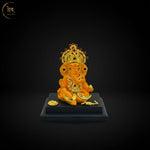
Students often keep a small Ganesha murti on the study table as a symbol of a fresh and focused start, while others place one on an office desk or at a home shrine. A piece such as the Gold Plated Crown Ganesha Idol with Base can become the quiet centre of a small corner of prayer.
Whichever idol you choose, give it a clean, respectful place and offer a flower, a diya and, when you can, a modak. Traditions on placement and direction vary by family and region, so follow the custom you have grown up with. The care you bring to the space matters more than its size.

Frequently Asked Questions
Why is modak considered Ganesha's favourite sweet?
Tradition names him Modakapriya, the lover of modak, and ties the sweet to the word moda, meaning joy. Different traditions add their own layers of meaning, from the fruit of sadhana to the sweetness of the Self within. No single explanation is the only one.
How many modaks should be offered to Ganesha?
Many households offer 21, while others offer 11, 5 or just one. There is no single rule, and the number depends on family custom and your means. A single modak offered sincerely is complete.
Can I offer something else if I cannot make modak?
Yes. Laddoos, pedas, fruit or jaggery with coconut are all commonly offered. The feeling behind the offering is what counts, so offer what you can prepare or obtain with a clean heart.
Why do some Ganesha idols show a laddoo instead of a modak?
Artists and regions depict the sweet differently. Some murtis hold a laddoo, a bowl of sweets or a modak, and each is accepted as an expression of Ganesha's joyful, generous nature. The modak is simply the most widely recognised in many parts of India.
The next time you place a modak before Ganesha, remember that you are offering a small symbol of joy, patience and the sweetness within. If you wish to set up a place of prayer at home, you are welcome to explore our Ganesha collection of handcrafted idols and find one that feels right for your space. May Bappa's presence fill your home with a happy heart.

About the author
Pandit Om Prakash Saxena
Pandit Om Prakash Saxena is 94 years old and still active. For the last 72 years he has been involved in pooja, paath and all forms of karmakand, and he is associated with Shanti Kunj, Haridwar.
-
Posted in
Ganesh Chaturthi, Ganesha, Hindu Symbolism, Modak, Naivedya