 All Deities
 Gift & Worship
 Best seller
 About Us
 Contact Us
 Blogs
BlogsLaxmi Ganesh Position: Left or Right? A Pandit's Answer
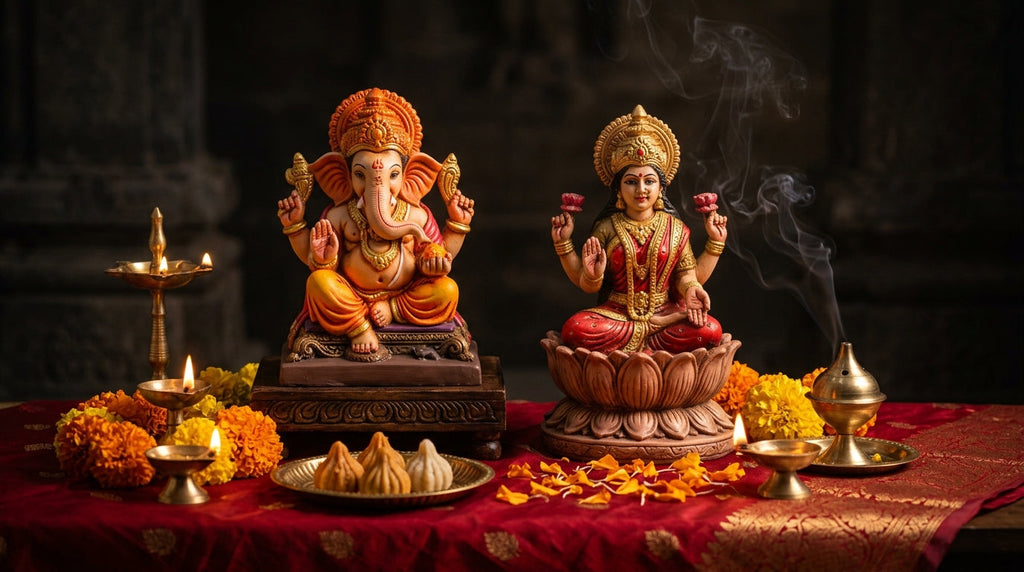
It is said that on the evening of Diwali, when every doorstep glows with diyas, a family sits before two small murtis and a quiet worry creeps in. Which one goes on which side? Nobody wants to begin the puja with a doubt.
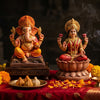
Here is the answer, plainly. The most common household custom puts Lakshmi on Ganesha's own right. So when you stand in front and look at the pair, Lakshmi is on your left and Ganesha is on your right. Some families do the reverse, and no scripture fixes the rule, so either is accepted when the puja is done with a sincere heart.
Sit with me for a while. We will hear why these two are worshipped together, then settle the left and the right, and finally arrange the idols step by step. This guide is written for the families who come to Dev Tattva looking for handcrafted murtis for the home mandir.
The Katha of Lakshmi: When the Ocean of Milk Gave Up Its Treasures
Listen to how the story goes. The devas had lost their strength and the asuras were mighty, and both wished for amrit, the nectar that conquers death. So they took the great mountain Mandara as a churning rod and the serpent Vasuki as the rope, and they began to churn the ocean of milk.
It was a long and heavy labour. The mountain began to sink, and Vishnu, taking the form of a great tortoise, bore it upon his back. The sea groaned and foamed, and slowly it began to give up its treasures, one after another.
And then, the elders say, the waters brightened. Lakshmi rose, seated on a lotus and holding lotus flowers, so radiant that gods and demons forgot their quarrel and only looked. She glanced over the whole assembly. She chose Vishnu, the steady one, and placed a garland around his neck.
Tellings differ in small things, such as the order in which the treasures appeared. But they agree on the heart of it. Lakshmi does not go to the loudest hand or the greediest one. She goes where there is steadiness.

The Katha of Ganesha: Why He Is Worshipped First
Now let us turn to the other half of the pair. In popular tellings, Shiva and Parvati once set a contest for their two sons, Kartikeya and Ganesha. Whoever circled the whole world first would be honoured first.
Kartikeya mounted his peacock and flew across the three worlds, swift as the wind. Ganesha looked at his small mouse, then at his own great body, and understood that he could not win by speed.
So he did something quiet. He walked around his mother and father, for in his eyes they were the whole world. Shiva and Parvati were moved by his understanding. The elders tell us that this is why Ganesha is invoked at the start of every undertaking, from a wedding to a new shop to a Lakshmi Puja.
Versions vary on who said what and what prize was given, and I will not decorate the story beyond what tradition tells. The lesson stands plain: buddhi, wisdom, reaches the goal where speed cannot. This is the Ganesha whom families keep in the home mandir, and the Ganesh collection at Dev Tattva offers him in several handcrafted forms.

Why Lakshmi and Ganesha Sit Together
Why, then, are the two worshipped as a pair on Diwali? Ask the elders and you will hear one idea again and again: wealth needs wisdom to guide it. Lakshmi is prosperity. Ganesha is the one who clears the path and gives clear judgement. Wealth without judgement scatters, and judgement without means stays only a good idea.
The practice itself is certain. In the Diwali Lakshmi Puja, Ganesha is invoked first and Lakshmi is welcomed next. Some retellings offer a story to explain the pairing, but they differ from place to place, so I will not fix one of them for you.
The puja is held in the evening of Diwali, and the date changes every year, so do check a trusted panchang.
What the Pair Teaches: Wealth Guided by Wisdom
Look at the two murtis together and the picture speaks. Elders read Ganesha's large ears as the habit of listening, and his small mouth as the habit of speaking less. He teaches us to hear before we decide.
Lakshmi sits on a lotus, a flower that rises out of the mud and yet stays unstained. Her open hand, pouring out coins in many images, is read as wealth that is meant to flow and to be shared, and not hoarded.
So the deeper puja is a quiet resolution. We light the first diya for Ganesha because a home that thinks before it spends is a home where prosperity can stay in good company. The side on which each idol sits matters far less than this lesson.

Laxmi Ganesh Position: Left or Right, and Whose Right?
Now to the question that brought you here. The whole confusion lives in one word: right. The idol's right, or yours?
Here is a simple way to see it. Stand in front of the idols, as a devotee does. Ganesha faces you. His right hand is on your left, and his left hand is on your right. Keep that picture in your mind.
Then the two customs are easy to name.
- First custom, the most common: Lakshmi on Ganesha's right. You see Lakshmi on your left and Ganesha on your right.
- Second custom: Lakshmi on Ganesha's left. You see Ganesha on your left and Lakshmi on your right.
Many pages say only that Lakshmi goes on the right and leave you to guess whose right they mean. Some even contradict themselves from one paragraph to the next. No wonder families worry.
Why do two customs exist? There are two logics. The first treats the right side as the place of honour, so the revered guest, Lakshmi, is seated on Ganesha's right. The second borrows from the way many images show a divine consort on her husband's left.
But Lakshmi is not Ganesha's wife, so the second logic does not fit cleanly. And even where it does, conventions vary. In the tradition of the Tirumala temple, the festival image of Malayappa Swami is described with Sridevi on his left and Bhudevi on his right. Sides depend on the tradition, not on one law for all.
And what do the old texts say? The classical manuals of temple building and image-making, such as the Mayamatam and the Manasara, deal with architecture and the crafting of images. As far as I know, they do not lay down this household rule. It is custom, and custom is honoured by following it with love.
So my advice is this. Follow your own family's way if you have one. If you have none, take the first custom and keep it the same every year. Steadiness matters more than the side.

When Your Pair Is Placed the Other Way Round
What if the murtis came already arranged the opposite way? Do not worry.
If Ganesha and Lakshmi are two separate murtis, you can simply swap them to suit your custom. If they are made as one piece on a single base, leave it as the craftsperson made it. A murti is not to be forced or broken to fit a rule that no text demands.
The same holds for a pair that came as a gift. A loved one's gift is itself a blessing, and you need not say a word to the giver. Place it the way your family does, bow, and begin.
Remember also that the puja is for bhava, the feeling in the heart. A god who is pleased by a single flower offered with love does not turn away over a hand's width of arrangement.
Saraswati, Kubera and Gajalakshmi: The Other Arrangements
Some homes add a third deity. Saraswati, goddess of learning, joins in families where books, pens and accounts are worshipped on Diwali. Many homes keep Ganesha in the middle with Lakshmi on one side and Saraswati on the other, though this too is custom and not rule.
In other households Kubera, the treasurer of the gods, is worshipped beside Lakshmi. His place is likewise decided by family practice. Keep the group level and let Ganesha receive his invocation first.
And then there is Gajalakshmi, Lakshmi seated on a lotus while elephants raise pots of water to bathe her. It is among the oldest images of the goddess, carved in stone more than two thousand years ago. If left and right trouble you, this single image of the goddess asks no such question.

How to Set the Lakshmi Ganesha Murtis for Puja
Now let us place the pair together, as an elder would guide you. A few simple steps are enough.
- Clean the spot and spread a fresh cloth on a raised, steady base, such as a wooden chowki. Murtis are not kept on the bare floor. Many families face the puja towards the east or north-east, though customs differ.
- Set the two murtis level, with Ganesha seated, and leave a little space so neither leans on the other. Many families prefer Lakshmi seated too, as a sign of steadiness, though standing images are also worshipped. Check that the base does not wobble.
- Light a diya and invite Ganesha first. The popular prayer goes: वक्रतुण्ड महाकाय सूर्यकोटि समप्रभ। निर्विघ्नं कुरु मे देव सर्वकार्येषु सर्वदा॥ (Vakratunda Mahakaya Suryakoti Samaprabha, Nirvighnam Kuru Me Deva Sarvakaryeshu Sarvada). It means: O Ganesha of the curved trunk and mighty body, with the brilliance of a million suns, make all my undertakings free of obstacles, always.
- Then welcome Lakshmi: ॐ महालक्ष्म्यै नमः (Om Mahalakshmyai Namah), I bow to Goddess Mahalakshmi. Offer flowers, rice and sweets such as modak or laddoo, and light incense.
- Close with aarti, and ask forgiveness for any lapse you may have made in the puja.
A cracked or broken murti is traditionally not kept for worship. Families differ in what they do next, but many respectfully immerse it in flowing water or leave it at a temple, and bring a new one home.
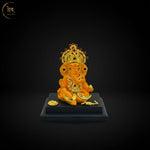
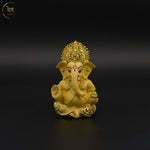
Dev Tattva handcrafts Ganesha murtis that many families bring into the puja, such as the Gold Plated Crown Ganesha Idol with Base. The Diwali Ganesha collection at Dev Tattva gathers murtis suited to the festival. For Lakshmi, use the murti or picture that your own family worships, since the Dev Tattva catalog is built around Ganesha and a few other deities.
For the desk at a shop or an office, a small seated Ganesha is a common way to begin work in his name. Keep the place clean, respectful and free of clutter, and you may look through Dev Tattva's office desk murtis for a size that suits your table.

Choosing and Gifting a Lakshmi Ganesha Pair
If you are gifting a pair, look at it with care before wrapping. Are both murtis of a similar height and finish? Does each stand steadily? Is there any crack or chip?
Include a small note on the two customs, so the receiver can arrange the pair as their family does. A murti given at a housewarming, a wedding or on Diwali should arrive with no doubt attached. You may browse the gifting collection at Dev Tattva if you are thinking of a handcrafted murti as a gift.

Frequently Asked Questions
Is Lakshmi on Ganesha's right or on my right?
In the most common custom, Lakshmi is on Ganesha's right, which is your left as you stand facing the pair. Some families follow the reverse. Since no text fixes it, follow your family tradition and keep it consistent.
Can Lakshmi be on the left of Ganesha?
Yes. Some families place Lakshmi on Ganesha's left, so you see her on your right. It is a custom followed in some homes, not a fault. Choose one arrangement and keep it year after year.
Which direction should the Lakshmi Ganesh idol face?
Customs vary by region and family. Many keep the puja facing east or north-east, and some prefer that the worshipper sits facing east. A clean, quiet spot and a steady raised base matter more than exact compass precision.
Can I keep the Lakshmi Ganesh pair in the bedroom or office?
Many families prefer the home mandir or a clean, quiet corner. A pair or a single Ganesha on an office or shop desk is common, if the place is kept tidy and respectful. If you have no separate space at home, give the murtis a clean raised spot and treat it with care.
May your Diwali puja be unhurried, and may wisdom walk ahead of every blessing that enters your home. If you are looking for a handcrafted Ganesha for your mandir, Dev Tattva's Diwali Ganesha collection awaits you at devtattva.com. Shubh Deepavali to you and your family.

About the author
Pandit Om Prakash Saxena
Pandit Om Prakash Saxena is 94 years old and still active. For the last 72 years he has been involved in pooja, paath and all forms of karmakand, and he is associated with Shanti Kunj, Haridwar.
-
Posted in
diwali puja, ganesha, home mandir, lakshmi puja, laxmi ganesh, murti placement