 All Deities
 Gift & Worship
 Best seller
 About Us
 Contact Us
 Blogs
BlogsKrishna Hand Flute: Meaning, Katha and Placement
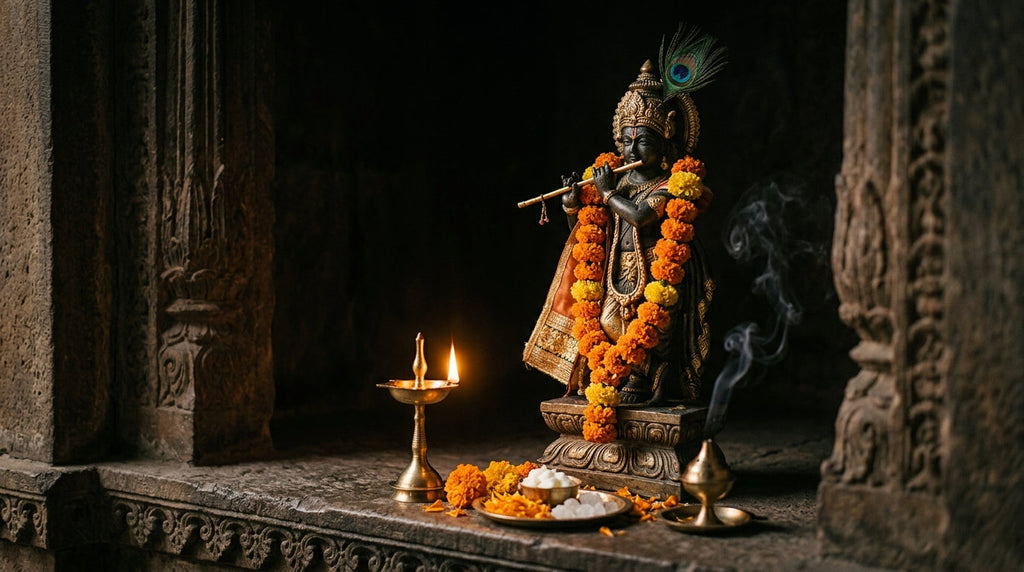
It is said that when the cows came home to Vrindavan at dusk, with the dust of the road glowing gold in the last light, a thin sweet sound would float over the fields. No drum, no conch. Only a bamboo flute, and a boy standing in the shade of a kadamba tree.
So what does a Krishna hand flute mean? Two hands holding the bansuri (bamboo flute) show the call of Krishna's love, and the hollow flute itself shows a heart emptied of ego, so that the divine breath can sound through it. A hands-only idol keeps your eye on that one gesture.
Come, sit a while. I will tell you the katha, explain the symbols, and then speak plainly about choosing and placing such an idol, a question that families visiting Dev Tattva often ask.
The Katha: How the Flute Came to Krishna's Hands
Krishna, the beloved avatar of Vishnu, was born in Mathura and grew up among the cowherds of Gokul and Vrindavan. The Bhagavata Purana tells of those years: the butter, the calves, the Yamuna, the forest. And always, in the telling, there is the flute, whose charm the Puranic tradition lingers over again and again.
Many names are given to it. Murali, vamsi, venu and bansuri are all the same bamboo flute, and that is why Krishna is lovingly called Murlidhar and Vamsidhar, the one who holds the flute.
But how did it come to him? Listen, because the elders tell it in more than one way, and I will keep the versions apart.
In one telling, Krishna himself took a length of bamboo from the forest, shaped it with his own hands, and breathed into it. The silent stalk woke up as music.
In another telling, a reed growing in Vrindavan longed only to be of use to him. It asked for nothing. Krishna cut it, hollowed it, pierced it with seven holes, and filled it with his own breath. These are devotional retellings handed down in different regions, and I would not name one scripture as their single source. What every version agrees on is the heart of it: the flute has no music of its own.
Think about that for a moment. A reed is cut, emptied, and pierced, and only then does it sing. The elders do not say this to frighten anyone. They say it to show that surrender is not loss. It is the beginning of the song.

The Sound That Called the Gopis of Vrindavan
Now to the most loved scene of all. It is told that on a moonlit autumn night, Krishna stood by the Yamuna and raised the flute to his lips. The sound travelled through the forest and across the sleeping village.
The gopis heard it. One was in the middle of her work, another was feeding a child, another was tending the lamp. In popular tellings, each of them left everything where it was and followed the sound into the forest. No one called them by name, yet each felt she was the one being called.
The elders add that the whole of Vrindavan listened. The cows are said to have stopped chewing, the calves stood with milk still at their lips, the birds went quiet on their branches, and even the river seemed to slow its flow. This is the rasa-lila, the circle of divine love, which the Bhagavata Purana and countless bhakti poets after it have sung.
What does the story teach? The gopis did not come for the music alone. They came for the one who played it. The sound was only an invitation, and the invitation was answered with the whole heart.
In many tellings, when pride crept in among the gopis, Krishna quietly withdrew from their sight, to remind them that love grows in humility. Tellings differ in the details, but the lesson is carried the same way.
Why a Hollow Bamboo? What Krishna's Flute Symbolises
The most common reading among devotees is this: the flute is hollow, so the breath passes through it freely. A heart full of "I" and "mine" has no room for the divine note. When ego is emptied, the bamboo is ready.
There is also a gentler reading. A flute is played by another, and so the devotee, too, is an instrument and not the musician. Whatever sweetness comes through a good life is the breath of something greater passing through us.
Some teachers connect the flute to nada, the sacred sound, and to prana, the breath, because a flute lives only on breath. This is a meditative reading that many find beautiful, and it sits comfortably with the katha.
One caution, since a pandit must be careful with scripture. You may read online that the flute music "is" the Bhagavad Gita. That is not a claim the tradition makes. The Gita was spoken on the battlefield of Kurukshetra, in a different mood and a different hour of Krishna's life. The flute belongs to Vrindavan, to love and longing. It is the same Krishna, but we do well not to mix the two.

Flute, Peacock Feather and Tribhanga: One Set of Symbols
Look at any traditional picture or murti of Krishna and you will see three things together. The flute, the peacock feather in his crown, and the gentle triple bend of his body, called tribhanga, with the neck, waist and knee each curving a little.
Devotees read them as a single picture. The flute is the call. The feather, the mor pankh, gathers many colours into one eye of beauty, and many see in it the grace and playfulness of creation. The tribhanga is the ease of a body that is not rushing or striving, because playing the flute is play, a lila, and not work.
This is why artists from the Kangra miniature painters to Raja Ravi Varma have kept the flute in his hands. When the flute is shown, you already understand the mood of the whole scene.
What a Krishna Hand Flute Idol Shows
The idol that people search for as a "Krishna hand flute" usually shows only two hands, held in the playing position with a bansuri between the fingers, and very often a peacock feather rising behind. There is no face and no crown.
Why only the hands? Tradition does not lay this down, so I can only offer a thoughtful guess. The hands-only form keeps all attention on the flute and the gesture of calling. It is also compact, which suits a small shelf, a desk or a dashboard. Some devotees find it a quiet reminder, because the player is not shown but you know who he is.
The same idea of a single hand carrying a whole presence is seen in the handcrafted Shiv hand with trishul idol, where one hand holding one sacred symbol is enough to call a deity to mind. Dev Tattva's idols of Shiva, Ganesha and Hanuman are made with this same care for small, clear detail.

Choosing a Krishna Hand Flute Idol
If you are looking for one, keep a few simple things in mind. They are about craft and respect, not about luck.
- The hands: the fingers should look natural and gently curved around the flute, not stiff or fused.
- The flute: it should be thick enough not to snap, with clear detail, since the flute is the whole point.
- The base: a steady, flat base matters, especially for a car or a desk.
- The material: brass, resin, polyresin and wood are all used. Brass is heavy and lasting, resin and polyresin are lighter and hold fine detail, and wood has a warm, quiet look.
- The finish: gold-toned, matte, glossy or antique. Choose what suits the room and the way you will care for it.
- The size: a few inches suits a dashboard or study table, and something larger suits a mandir shelf.
Look closely at the edges and the finishing. A murti made with care shows it in small places, and you will be looking at it every day.

Where to Place a Krishna Flute Idol
Traditions vary by region and by family, so take what follows as common practice and not as a rule. I will keep it modest.
Home mandir: many families place deities on a clean, raised spot and keep the mandir facing east or north-east where the house allows it. Do not worry if your home cannot manage that. A clean, quiet place, kept with devotion, matters more than a compass direction.
Car dashboard: choose a flat, non-slip spot where the idol sits firmly and does not block your view or any controls. Safety on the road comes first. You can browse the car dashboard idols at Dev Tattva to see how small murtis are shaped for a stable seat.
Office desk or study table: a small idol facing you can be a gentle reminder to work calmly and speak softly. The office desk collection shows the sizes that usually fit such spaces, and the study table is much the same.
Gifting: a murti is a thoughtful gift for a housewarming, wedding, birthday or return gift, because it carries a blessing and not just an object. Many people look at Dev Tattva's gifting collection for ideas.
Whatever the place, keep it clean, dust it gently, and do not set the idol on the floor or beside things that are unclean.

Simple Ways to Honour Krishna's Flute Every Day
You do not need a long ritual. A few quiet minutes are enough.
Light a small diya or a stick of incense, fold your hands and look at the idol. You may say the old mantra:
ॐ नमो भगवते वासुदेवाय
Om Namo Bhagavate Vasudevaya
I bow to Lord Vasudeva, Krishna.
Offer a fresh flower or a tulsi leaf, which is dear to the Vaishnava tradition. Many families also offer a little butter and sugar candy (makhan-mishri), because Krishna is lovingly remembered as the butter-loving child of Gokul. Then sit in silence for a breath or two and ask yourself one simple question: what in me is blocking the music today?
On Janmashtami, the festival of Krishna's birth, families decorate a small swing or cradle, sing bhajans and keep a late-night vigil. The date changes every year with the lunar calendar, so check a trusted panchang. A flute idol, adorned with a fresh flower or a small peacock feather, is a lovely thing to have in the mandir that night.


Frequently Asked Questions
Why does Krishna always hold a flute?
The flute is the sign of his Vrindavan years, when his music drew the gopis, the cows and the whole forest to him. Devotees read it as the call of divine love, and as a picture of a heart emptied of ego so that something greater can sound through it.
What is Krishna's flute called?
It is called murali, vamsi, venu or bansuri, depending on the region and the text. All of these words point to the same bamboo flute, and that is why Krishna is also called Murlidhar.
What does the peacock feather with the flute mean?
Devotees read the feather as beauty, grace and the many colours of creation gathered in one eye. Together with the flute and the tribhanga pose, it makes the single picture of Krishna in his playful, loving form.
Where should I place a Krishna hand flute idol?
A clean, raised, quiet spot is traditional, whether that is the home mandir, a study table or an office desk. In a car, choose a flat, non-slip place that does not block your view. Customs differ by family, so follow your own tradition first.
May the flute of Krishna play softly in your home, and may your heart be as open and simple as the bamboo that held his breath. When you are ready to bring a murti home, you are always welcome to explore Dev Tattva and the handcrafted idols made with devotion there. Radhe Radhe.

About the author
Pandit Om Prakash Saxena
Pandit Om Prakash Saxena is 94 years old and still active. For the last 72 years he has been involved in pooja, paath and all forms of karmakand, and he is associated with Shanti Kunj, Haridwar.
-
Posted in
bansuri, home mandir, Janmashtami, Krishna flute, Krishna idol, Vrindavan