 All Deities
 Gift & Worship
 Best seller
 About Us
 Contact Us
 Blogs
BlogsWhich Hindu God Carries Which Divine Weapon and Why?
The Night the Gods Forged Their Sacred Arsenal
In the cosmic workshop of Vishvakarma, divine architect of the universe, sparks fly not from ordinary metal, but from concentrated starlight and crystallized prayers. Here, in the space between worlds, the weapons of the gods take shape — each one a universe of power compressed into form, each one carrying the weight of cosmic law itself.
These are not mere instruments of war. They are extensions of divine consciousness, manifestations of the very principles that keep existence in balance. When Vishnu raises his Sudarshan Chakra or Shiva lifts his Trishul, they do not simply wield weapons — they become the living embodiment of cosmic order itself.
Vishnu's Sudarshan Chakra — The Wheel That Cuts Through Maya
The story begins in the churning of the cosmic ocean, when gods and demons worked together to extract the nectar of immortality. As the great serpent Vasuki coiled around Mount Mandara, and the ocean frothed with a thousand lifetimes of karma, something unexpected emerged from the depths.
It rose like a sun made of pure consciousness — a spinning disc of light that could cut through anything in creation. But this was no ordinary blade. The Sudarshan Chakra, whose name means beautiful vision, possessed the power to slice through the greatest enemy of all: illusion itself.
Wherever dharma declines and adharma rises, there I manifest myself, speaks the Bhagavad Gita. And in Vishnu's hand, the chakra becomes the instrument of that divine promise. It spins with the speed of cosmic time, its thousand spokes representing the thousand names of the divine, its edge sharper than the moment between one breath and the next.
In the great war of the Mahabharata, when the sun refused to set and Jayadratha hid behind the cosmic twilight, Krishna raised his Sudarshan Chakra to part the very sky. For a moment, the sun appeared to set, Jayadratha emerged from hiding, and Arjuna's arrow found its mark. The chakra had not destroyed an enemy — it had revealed truth hidden behind the veil of time itself.
Shiva's Trishul — The Three-Pronged Key to Existence
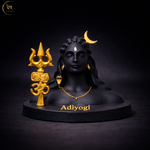
From the forge of cosmic fire comes Shiva's Trishul, the trident that holds the secret of all creation. Its three prongs pierce through the three fundamental qualities of existence — sattva, rajas, and tamas — the very building blocks from which all reality is woven.
But watch how Shiva holds it. Not as a weapon of destruction, but as a tuning fork that keeps the universe in perfect harmony. When the three prongs vibrate, they create the primordial sound — the Om that births galaxies and dissolves them back into silence.
The Shiva Purana tells us of the moment when the Trishul first blazed into existence. As Shiva danced the Tandava, the cosmic dance of creation and destruction, his movement generated such intense energy that it crystallized into form. The central prong represents the sushumna nadi, the spiritual channel through which consciousness ascends. The two outer prongs are ida and pingala, the lunar and solar energies that spiral around the spine of existence itself.
When demons threaten the cosmic order, Shiva does not attack them with his Trishul — he transforms them. The weapon becomes a lightning rod that draws the darkness out of their hearts and transmutes it into light. This is why even Ravana, after being crushed beneath Mount Kailash, emerged not as an enemy but as a devotee, singing the Shiva Tandava Stotram with tears of recognition streaming down his face.
Sacred Forms for Sacred Spaces
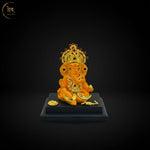
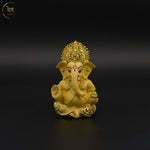
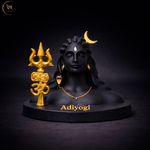
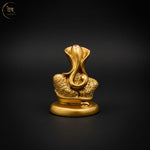
These handcrafted murtis carry the same divine energy that flows through the ancient stories


Ganesha's Ankush — The Goad That Guides the Mind
In Ganesha's gentle hand rests the ankush, the elephant goad that appears so small, so simple, that many devotees overlook its profound significance. But this curved hook holds the secret to mastering the greatest elephant of all — the human mind.
The elephant, for all its strength and wisdom, can be guided by the gentlest touch of the mahout's ankush. Not through force, but through understanding. The goad does not hurt the elephant — it simply reminds it of the direction it already knows it should go.
So too with consciousness. The mind, like a great elephant, possesses tremendous power. It can uproot the trees of old habits, it can carry the heavy loads of karma across the rivers of time. But without guidance, it wanders in circles, trumpeting its confusion to the sky.
Ganesha's ankush represents the gentle discipline of awareness. When the mind begins to charge toward the thorny bushes of desire, the ankush touches it lightly — not to punish, but to redirect. This way, it whispers. This is the path that leads home.
Hanuman's Gada — The Mace of Devotion
From the sacred mountain of Dronagiri comes the wood for Hanuman's gada, the mighty mace that he swings not in anger, but in the ecstasy of devotion. Watch him in battle — every blow he strikes rings out with the name of Ram, every swing of his weapon becomes a prayer offered to the sky.
The gada represents the concentrated power of bhakti, devotion so pure and focused that it becomes an unstoppable force. When Hanuman leaps across the ocean to Lanka, his mace does not weigh him down — it propels him forward, each revolution adding momentum to his flight.
But the true power of the gada reveals itself in a quieter moment. When Hanuman sits in meditation, the mace rests beside him, and its weight keeps him grounded to the earth even as his consciousness soars to touch the feet of Ram. The weapon becomes an anchor, holding the devotee steady in the storms of spiritual experience.
Hanuman ki jai — victory to Hanuman — but what is this victory? Not conquest over enemies, but the triumph of love over fear, of service over selfishness, of devotion over doubt.
Durga's Arsenal — The Weapons of Shakti
When the gods faced the buffalo demon Mahishasura, they discovered that their individual weapons were powerless against him. So they did something unprecedented — they offered their weapons to the Divine Mother, and she accepted them all.
From Vishnu came the chakra, from Shiva the trident, from Indra the thunderbolt, from Brahma the kamandalu. But in Durga's hands, these weapons transformed. They became not instruments of war, but expressions of the divine feminine power that creates, sustains, and transforms the universe.
Watch her in battle — she does not fight with anger, but with the fierce compassion of a mother protecting her children. Each weapon in her multiple hands moves with perfect coordination, like a cosmic dance choreographed by love itself.
The Devi Mahatmya tells us: When the going gets tough, the Divine Mother manifests. But she manifests not to destroy, but to restore balance. Her weapons cut through the illusion that separates us from our own divine nature.
Krishna's Flute — The Weapon That Conquers Without Fighting
Among all divine weapons, perhaps the most powerful is also the gentlest — Krishna's flute. This simple bamboo reed, hollow and unassuming, possesses the ability to stop time itself, to make the rivers flow backward, to cause the very stones to weep with longing.
The flute represents the power of divine love to transform consciousness without force. When Krishna plays, he does not command — he invites. The gopis do not come to him because they must, but because the music awakens in them a memory of their own divine nature.
The bamboo had to be cut, hollowed out, pierced with holes before it could become an instrument of divine music. So too, the devotee must be emptied of ego, pierced by longing, before the breath of the divine can flow through them and create the music of liberation.
The Living Weapons of Today
These divine weapons are not museum pieces from an ancient past. They live today in every act of conscious choice, every moment of spiritual discipline, every gesture of selfless service.
The businessman who uses his wealth like Kubera's mace — not for hoarding, but for the welfare of society. The teacher who wields knowledge like Saraswati's veena — not to dominate, but to awaken. The mother who guides her children like Ganesha's ankush — not through force, but through loving wisdom.
In temples across India, these weapons are still worshipped, still honored, still recognized as living symbols of the divine power that flows through every conscious being. The devotee who truly understands bows not to the metal or wood, but to the principle it represents — the cosmic force that maintains harmony in a universe that could so easily dissolve into chaos.
For in the end, every divine weapon points to the same truth: the greatest power in existence is not the ability to destroy, but the wisdom to know when to act and when to be still, when to fight and when to surrender, when to hold on and when to let go.
And that wisdom — that perfect balance — lives not in some distant heaven, but in the depths of every human heart that has learned to beat in rhythm with the cosmic dance.