 All Deities
 Gift & Worship
 Best seller
 About Us
 Contact Us
 Blogs
BlogsWho Is the Father of Lord Shiva? The Mystery Revealed
The Question That Puzzles Even the Gods
In the cosmic halls where time itself was born, even Brahma once wondered: who gave birth to the one who dances at the edge of creation and destruction? The question of Shiva's father is not merely about divine genealogy — it is about understanding the very nature of existence itself.
When Brahma Sought to Create the Perfect Devotee
The Shiva Purana tells us that in the beginning, when Brahma sat in deep meditation to create the universe, his mind turned toward the need for a being of perfect devotion. From the intensity of his contemplation, from the fire of his spiritual longing, emerged a radiant child with ash-smeared skin and eyes that held the depth of eternity.
This child was Rudra — the fierce one, the howler, the first form of what we know as Shiva. In this telling, Brahma becomes the father, not through physical birth, but through the power of divine meditation. The child who emerged was no ordinary being — he was born crying, and when Brahma asked why, the child replied that he had no name, no place, no purpose.
Brahma then gave him eight names: Rudra, Bhava, Sarva, Ishana, Pasupati, Bhima, Ugra, and Mahadeva. He gave him dominion over the eight elements: earth, water, fire, air, space, the sun, the moon, and the soul itself. Thus, through Brahma's meditation and naming, Shiva received his place in the cosmic order.
The Deeper Truth: Swayambhu — The Self-Born
But the Linga Purana whispers a different truth, one that makes the heart pause in wonder. It speaks of Shiva as Swayambhu — the self-manifested, the one who exists without cause, without beginning, without father or mother.
In this understanding, Shiva is not born but simply is. He is the eternal principle that exists before creation, during creation, and after dissolution. He is the consciousness in which all universes rise and fall like waves in an infinite ocean.
The story goes that once, Brahma and Vishnu were arguing about who was supreme. Suddenly, a massive pillar of fire appeared before them, stretching infinitely upward and downward. Brahma took the form of a swan and flew upward to find its top. Vishnu became a boar and dug downward to find its base. Neither could find an end.
Then, from within that pillar of light, Shiva emerged. He was not created by the pillar — he was the pillar. He was not born from the fire — he was the fire itself. In that moment, both Brahma and Vishnu understood: Shiva is the source from which even they emerge.
Bring the Eternal Presence Home
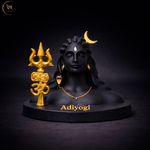
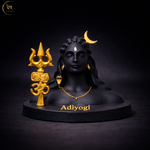
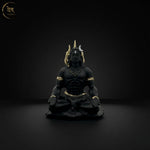
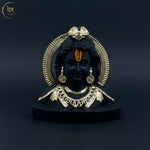
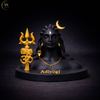
These sacred Shiva murtis carry the same timeless energy that emerged from the pillar of light

The Paradox That Holds All Truth
Here lies the beautiful contradiction that makes Hindu philosophy so rich: Shiva is both born and unborn, both son and father, both created and creator. In one breath, the scriptures call Brahma his father. In the next, they declare him as the source of Brahma himself.
The Mahabharata resolves this paradox with profound wisdom: He is the father of all fathers, and yet he is his own father. He is the son of none, and yet he is the son of all.
This is not confusion — this is the nature of the infinite trying to express itself through finite words. Shiva represents that aspect of divinity that cannot be contained within the usual relationships of parent and child, cause and effect, beginning and end.
What the Village Grandmother Knows
In the villages of Tamil Nadu, old women will tell you that Shiva has no father because he is everyone's father. In the temples of Kashmir, priests will whisper that Shiva is his own father because consciousness creates itself in an eternal dance.
In Bengal, during the monsoon nights when lightning splits the sky, mothers tell their children that Shiva was born from the first sound that ever was — the Om that still echoes in every heartbeat, every breath, every moment of silence between thoughts.
Each telling carries truth. Each tradition holds a piece of the infinite puzzle.
The Living Answer in Your Own Heart
Perhaps the question of Shiva's father is not meant to be answered with names and genealogies. Perhaps it is meant to point us toward a deeper recognition: that the divine consciousness which Shiva represents has no beginning because it is the beginning itself.
When you sit in meditation and watch thoughts arise and dissolve, when you witness the breath coming and going without your effort, when you experience that awareness which observes all but is touched by none — that is the Shiva principle. That has no father because it is the source of all fatherhood.
The scriptures say Tat tvam asi — thou art that. The consciousness that wonders about Shiva's father is itself the answer to the question. The seeker and the sought are one.
In temples across India, even today, devotees offer water to the Shiva linga not because they believe in a story, but because they recognize something eternal in themselves that needs no birth, no father, no beginning — something that simply is, and always has been, and always will be.
The question of who is Shiva's father dissolves into the recognition of what Shiva truly represents: the deathless, birthless, eternal consciousness that you are.