 All Deities
 Gift & Worship
 Best seller
 About Us
 Contact Us
 Blogs
BlogsWhich Divine Weapon Rules All Others in Hindu Mythology?
The Arsenal of the Gods
In the cosmic armory where gods forge weapons from starlight and demons tremble at their names, one question echoes through every battlefield: which weapon holds dominion over all others?
The answer lies not in the sharpest blade or the most destructive force, but in understanding what these divine armaments truly represent. Each weapon carries within it the essence of its wielder — their dharma, their cosmic responsibility, their very nature made manifest in form.
The Sudarshan Chakra — Vishnu's Wheel of Time
When Vishnu raises his hand and the golden disc appears, spinning with the fury of a thousand suns, even time itself holds its breath. The Sudarshan Chakra is not merely a weapon — it is the wheel of dharma made visible, the cosmic order given cutting edge.
In the great battle of Kurukshetra, when Krishna's divine form blazed forth before Arjuna's trembling eyes, the Chakra spun behind his shoulder like a second sun. Yada yada hi dharmasya glanir bhavati bharata — whenever dharma declines, the Chakra reminds us, divine intervention follows.
The disc never misses its target because it does not seek flesh and bone — it seeks the violation of cosmic law itself. It can split into multiple forms, each one guided by the supreme intelligence that governs the movement of planets and the beating of every heart.
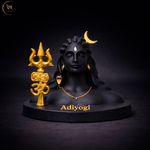
Shiva's Trishul — The Three-Pronged Truth
From the snow-covered peaks of Kailash comes a weapon that predates creation itself. Shiva's Trishul carries the power of the three gunas — sattva, rajas, and tamas — the fundamental forces that weave the fabric of existence.
When the demon Andhaka dared to covet Parvati, Shiva's Trishul pierced not just his body but his very capacity for desire. The three prongs represent creation, preservation, and destruction — the eternal cycle that no force in the universe can escape.
The Trishul's power lies in its completeness. While other weapons destroy, it transforms. It does not merely end — it prepares for new beginning.
Divine Presence for Your Sacred Space
These handcrafted murtis carry the same power and devotion that flows through every divine weapon's story


The Brahmastra — The Ultimate Weapon
In the silence before dawn, when the greatest warriors of the Mahabharata prepared for battle, there was one weapon none dared to name lightly. The Brahmastra — the weapon of Brahma himself, containing within its core the power of creation turned inside out.
Arjuna possessed it. Ashwatthama wielded it in his rage. But possessing the Brahmastra and understanding its true nature are different things entirely. This weapon does not destroy bodies — it unmakes the very possibility of existence in the space it touches.
The sage Bharadwaja, who first received this knowledge from Brahma, understood what modern minds struggle to grasp: the most powerful weapon is not the one that kills the most enemies, but the one that carries the greatest responsibility. Brahmastra tu mahaghora sarva-shastra-vinashakam — the Brahmastra is terrible beyond measure, destroyer of all other weapons.
Hanuman's Gada — Strength Made Sacred
When Hanuman lifts his golden mace, mountains tremble not from fear but from recognition. Here is strength that has surrendered itself completely to devotion, power that knows no ego, force that serves only love.
The Gada of Hanuman carries within it every prayer ever whispered in desperation, every moment when the weak found strength they did not know they possessed. It is not forged from metal but from bhakti itself — devotion so pure it becomes indestructible.
In the great battle of Lanka, when demons fell before Hanuman's mace like wheat before the wind, they were not defeated by strength alone. They were overcome by the impossible power of a heart that holds nothing for itself.
The Vel of Murugan — Wisdom's Sharp Edge
From the Tamil lands comes a weapon that cuts through ignorance itself. Murugan's Vel, the divine spear gifted by Shakti, represents knowledge so sharp it can pierce the veil of maya that blinds all beings.
When the demon Surapadman faced this weapon, he discovered that some battles cannot be won through strength or cunning. The Vel seeks not the body but the delusion that separates the soul from truth. It is the weapon of the guru, the blade of enlightenment.
Indra's Vajra — The Thunderbolt of Dharma
Forged from the bones of the sage Dadhichi, who gave his life so that the gods might have a weapon capable of defeating the demon Vritra, the Vajra carries within it the ultimate sacrifice. It is power born from surrender, strength that emerges from the willingness to give everything.
The Vajra's true power lies not in its ability to shatter mountains — though it can — but in its reminder that the greatest strength comes from those who hold nothing back in service of dharma.
The Supreme Weapon — Beyond Form
But which weapon stands supreme above all others? The answer reveals itself not in the cosmic battles of the Puranas but in a quiet moment in the Bhagavad Gita, when Krishna speaks the words that have echoed through millennia: Sarva-dharman parityajya mam ekam sharanam vraja — abandon all dharmas and surrender unto me alone.
The most powerful weapon in all of Hindu mythology is not a weapon at all. It is surrender. Complete, unconditional surrender to the divine will. This is the force that makes all other weapons possible, the power that guides the Sudarshan Chakra, that steadies Arjuna's bow, that gives strength to Hanuman's devotion.
Every divine weapon, no matter how terrible or beautiful, is ultimately an expression of this one truth: when the individual will aligns perfectly with cosmic will, when the ego dissolves completely into divine purpose, what emerges is not just power but the source of all power.
The Living Tradition
Today, in temples across India, devotees still offer prayers to these divine weapons. In Kerala, the Vel of Murugan is worshipped during Skanda Shasti. In Rajasthan, warriors still invoke the Trishul before battle. In every Vishnu temple, the Sudarshan Chakra spins eternally behind the deity's shoulder.
These are not museum pieces or mythological curiosities. They are living symbols of the forces that shape existence itself — creation, preservation, destruction, and the surrender that makes all three possible.
The most powerful weapon in Hinduism is the one that requires no hand to wield it, no strength to lift it, no skill to aim it. It is the weapon of the heart that has learned to want nothing for itself, and in that wanting nothing, becomes capable of everything.
In the end, every divine weapon points to the same truth: the greatest power is not the ability to destroy one's enemies, but the wisdom to recognize that there were never any enemies at all — only aspects of the one divine consciousness, playing out the eternal drama of awakening to itself.