 All Deities
 Gift & Worship
 Best seller
 About Us
 Contact Us
 Blogs
BlogsWhich Divine Weapons Hold the Power to Reshape Destiny?
When the Gods Forged Light Into Weapons
In the cosmic forge of creation, when darkness threatened to swallow all light, the gods did not retreat into meditation. They picked up weapons. But these were not weapons as mortals understand them — forged from metal and sharpened on stone. These were fragments of cosmic law itself, given form and weight, blessed with the power to cut through illusion and restore balance to a universe spinning toward chaos.
Each divine weapon carries within it not just the strength to destroy, but the wisdom to know what must be destroyed and what must be preserved. They are instruments of dharma — cosmic justice made manifest in forms that even human eyes can comprehend.
The Sudarshan Chakra — Vishnu's Wheel of Time
Watch Vishnu raise his hand, and see how the Sudarshan Chakra spins into existence — a disc of pure light that cuts through the fabric of space itself. This is not merely a weapon. This is time made visible, karma given form.
The chakra moves faster than thought, guided not by Vishnu's will but by the cosmic law that governs all existence. It seeks out adharma wherever it hides — in the heart of a demon king, in the shadow of a corrupt ruler, in the whispered lie that destroys a family. And when it finds its target, it does not simply destroy. It restores balance.
Yada yada hi dharmasya glanir bhavati bharata — whenever dharma declines, the Bhagavad Gita reminds us, the divine manifests to restore order. The Sudarshan Chakra is that manifestation made tangible, spinning through the ages, cutting away what no longer serves the cosmic good.
In the great battle against the demon Shishupala, the chakra moved with such precision that it severed his head at the exact moment his accumulated sins reached their cosmic limit. One hundred transgressions Vishnu had promised to forgive. At the hundred and first, the chakra moved of its own accord.
Shiva's Trishul — The Three-Pronged Truth
The trishul in Shiva's hand carries three points, and each point pierces a different realm of existence. The first destroys ignorance. The second destroys ego. The third destroys the illusion of separateness that makes us believe we are anything other than consciousness itself.
When Shiva dances his cosmic dance, the trishul moves in rhythm with his steps. It is not a weapon he wields — it is an extension of his very being, the physical form of his power to dissolve what has outlived its purpose. Mountains crumble before it. Demons flee at its sight. But its greatest power is not in destruction — it is in the space that destruction creates for new life to emerge.
The sage Dadhichi understood this when he offered his bones to create the vajra that would defeat the demon Vritra. Destruction in service of creation is not violence — it is the highest form of sacrifice.
Sacred Guardians for Your Sacred Space
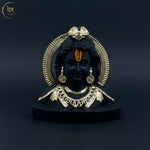
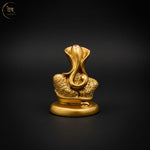
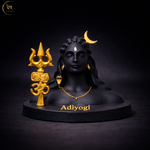
These handcrafted murtis carry the same protective power that flows through the divine weapons themselves


Indra's Vajra — The Thunderbolt of Awakening
From the bones of the sage Dadhichi, the gods forged the vajra — a weapon that strikes not just the body but the very core of ignorance itself. In Indra's hands, it becomes the thunderbolt that splits the clouds of delusion and brings the rain of wisdom to a parched earth.
The vajra appears in different forms across the sacred texts. Sometimes it is a club, sometimes a thunderbolt, sometimes a diamond that cuts through the hardest stone. But always, it carries the same essential power — the ability to shatter what seems unbreakable, to find the crack in every fortress of ego and pride.
When the demon Vritra swallowed all the waters of the world, holding them prisoner in his vast belly, it was the vajra that split him open and released the rivers back to their courses. But the deeper truth lies in what Vritra represents — the drought of the spirit, the hoarding of wisdom, the refusal to let life flow freely.
Durga's Arsenal — The Weapons of Righteous Fury
When the gods found themselves powerless against the buffalo demon Mahishasura, they did something unprecedented. They pooled their individual powers and created a goddess who would carry not one divine weapon, but all of them. Durga emerges from their combined light holding Vishnu's chakra, Shiva's trishul, Indra's vajra, and weapons from every corner of the divine realm.
But watch her hands as she fights. Each weapon moves with perfect precision, never interfering with the others, each striking at exactly the right moment. This is not chaos — this is cosmic choreography. Durga teaches us that true power lies not in wielding one great strength, but in harmonizing all our capabilities toward a single righteous purpose.
The Devi Mahatmya tells us that when she finally defeats Mahishasura, the demon's last words are not of anger but of wonder. Even in his final moment, he recognizes the divine justice that has found him. This is the mark of a truly divine weapon — it destroys without hatred, restores without vengeance.
Hanuman's Gada — The Mace of Devotion
In Hanuman's hands, the gada becomes something more than a weapon — it becomes an instrument of devotion made manifest. Every swing carries the power of his love for Rama, every strike echoes with the sound of the holy name.
The gada teaches us that the greatest strength comes not from anger or fear, but from love so pure it becomes unstoppable. When Hanuman leaps across the ocean to Lanka, the gada does not weigh him down — it gives him the momentum to fly. When he faces the demons in Ashoka Vatika, the gada moves with the rhythm of his prayers.
Hanuman ki jai — the victory cry that still echoes in temples across India carries within it the memory of that gada, swinging through the air of Lanka, clearing the path for dharma to triumph.
The Bow of Arjuna — Gandiva's Song
Gandiva sings when Arjuna draws the string. Not metaphorically — the bow actually produces a sound so pure and terrifying that enemies flee before the first arrow is even nocked. This is the sound of dharma preparing to act, of cosmic justice tuning itself for perfect pitch.
But the real power of Gandiva lies not in its ability to never miss its target, but in its ability to help Arjuna see clearly what the target truly is. In the moments before the great battle of Kurukshetra, when Arjuna's hands shake and his vision blurs with tears, it is the familiar weight of Gandiva that grounds him, that reminds him who he is and what he must do.
The Bhagavad Gita begins with Arjuna setting down his bow. It ends with him picking it up again. In between lies the entire journey from confusion to clarity, from doubt to devotion. Gandiva waits through it all, patient as a teacher, ready as a friend.
The Living Power of Divine Weapons Today
These weapons did not disappear when the great battles ended. They continue to exist wherever dharma needs defending, wherever truth needs a voice, wherever love needs the strength to protect what it cherishes.
In the hands of a mother protecting her child, the power of Durga's arsenal awakens. In the voice of a teacher speaking truth to ignorance, Saraswati's sword of wisdom cuts through darkness. In the heart of anyone who chooses courage over comfort, the vajra of Indra strikes down the demons of fear and doubt.
The weapons of the gods are not museum pieces. They are living forces, waiting for the moment when a human heart becomes pure enough, brave enough, devoted enough to wield them. Not in violence, but in service. Not in anger, but in love.
Every morning, in temples across India, priests still invoke these divine weapons in their prayers, calling upon their protection for all who seek shelter in dharma. The mantras have not changed. The power has not diminished. The weapons of the gods remain as sharp, as true, as ready as they were in the first moment of creation.
And in that readiness lies our hope — that no matter how dark the age becomes, no matter how powerful the forces of adharma appear, the weapons of light remain within reach of any hand pure enough to grasp them.